

4.2 Bioorthogonal Chemistry
113
modification of the NIs and methods of shielding them from nucleophilic attack.
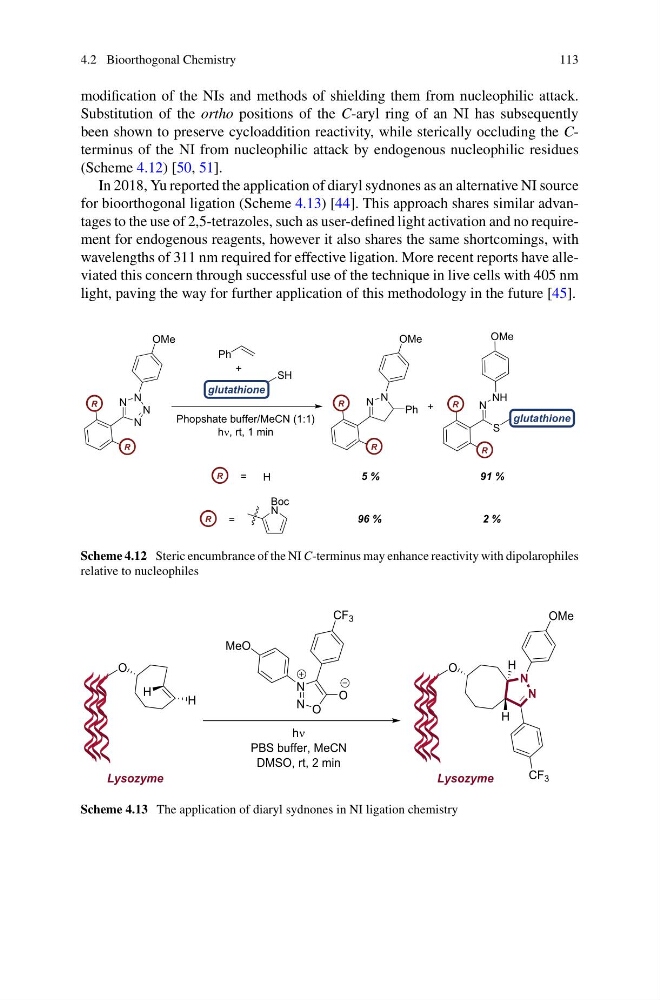
Substitution of the ortho positions of the C-aryl ring of an NI has subsequently
been shown to preserve cycloaddition reactivity, while sterically occluding the Cterminus of the NI from nucleophilic attack by endogenous nucleophilic residues
(Scheme 4.12) [50, 51].
In 2018, Yu reported the application of diaryl sydnones as an alternative NI source
for bioorthogonal ligation (Scheme 4.13) [44]. This approach shares similar advantages to the use of 2,5-tetrazoles, such as user-defined light activation and no requirement for endogenous reagents, however it also shares the same shortcomings, with
wavelengths of 311 nm required for effective ligation. More recent reports have alleviated this concern through successful use of the technique in live cells with 405 nm
light, paving the way for further application of this methodology in the future [45].
SH
N
N
N
N
R
R
OMe
Ph
glutathione
+
Phopshate buffer/MeCN (1:1)
h, rt, 1 min
N N
R
R
OMe
Ph
N
S
NH
R
R
OMe
glutathione
+
R
=
H
Boc
N
R
=
5 %
91 %
96 %
2 %
Scheme 4.12 Steric encumbrance of the NI C-terminus may enhance reactivity with dipolarophiles
relative to nucleophiles
O
h
PBS buffer, MeCN
DMSO, rt, 2 min
Lysozyme
H
H
O
Lysozyme
N
N O
MeO
CF 3
O
N
N
CF 3
OMe
H
H
Scheme 4.13 The application of diaryl sydnones in NI ligation chemistry
113
modification of the NIs and methods of shielding them from nucleophilic attack.
Substitution of the ortho positions of the C-aryl ring of an NI has subsequently
been shown to preserve cycloaddition reactivity, while sterically occluding the Cterminus of the NI from nucleophilic attack by endogenous nucleophilic residues
(Scheme 4.12) [50, 51].
In 2018, Yu reported the application of diaryl sydnones as an alternative NI source
for bioorthogonal ligation (Scheme 4.13) [44]. This approach shares similar advantages to the use of 2,5-tetrazoles, such as user-defined light activation and no requirement for endogenous reagents, however it also shares the same shortcomings, with
wavelengths of 311 nm required for effective ligation. More recent reports have alleviated this concern through successful use of the technique in live cells with 405 nm
light, paving the way for further application of this methodology in the future [45].
SH
N
N
N
N
R
R
OMe
Ph
glutathione
+
Phopshate buffer/MeCN (1:1)
h, rt, 1 min
N N
R
R
OMe
Ph
N
S
NH
R
R
OMe
glutathione
+
R
=
H
Boc
N
R
=
5 %
91 %
96 %
2 %
Scheme 4.12 Steric encumbrance of the NI C-terminus may enhance reactivity with dipolarophiles
relative to nucleophiles
O
h
PBS buffer, MeCN
DMSO, rt, 2 min
Lysozyme
H
H
O
Lysozyme
N
N O
MeO
CF 3
O
N
N
CF 3
OMe
H
H
Scheme 4.13 The application of diaryl sydnones in NI ligation chemistry