

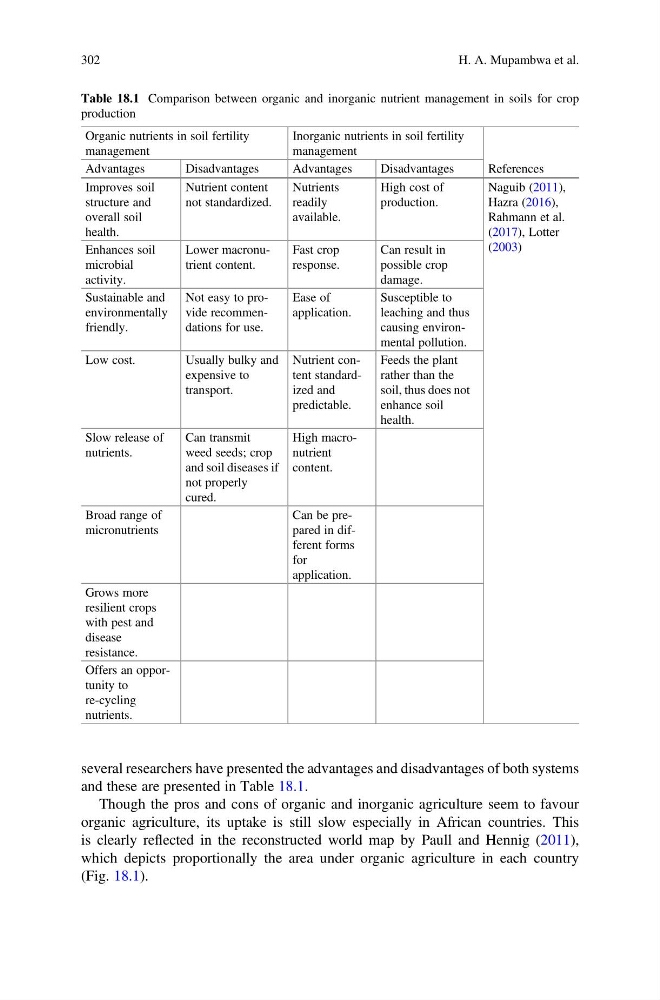
several researchers have presented the advantages and disadvantages of both systems
and these are presented in Table 18.1.
Though the pros and cons of organic and inorganic agriculture seem to favour
organic agriculture, its uptake is still slow especially in African countries. This
is clearly reflected in the reconstructed world map by Paull and Hennig (2011),
which depicts proportionally the area under organic agriculture in each country
(Fig. 18.1).
Table 18.1 Comparison between organic and inorganic nutrient management in soils for crop
production
Organic nutrients in soil fertility
management
Inorganic nutrients in soil fertility
management
References
Advantages
Disadvantages
Advantages
Disadvantages
Improves soil
structure and
overall soil
health.
Nutrient content
not standardized.
Nutrients
readily
available.
High cost of
production.
Naguib (2011),
Hazra (2016),
Rahmann et al.
(2017), Lotter
(2003)
Enhances soil
microbial
activity.
Lower macronutrient content.
Fast crop
response.
Can result in
possible crop
damage.
Sustainable and
environmentally
friendly.
Not easy to provide recommendations for use.
Ease of
application.
Susceptible to
leaching and thus
causing environmental pollution.
Low cost.
Usually bulky and
expensive to
transport.
Nutrient content standardized and
predictable.
Feeds the plant
rather than the
soil, thus does not
enhance soil
health.
Slow release of
nutrients.
Can transmit
weed seeds; crop
and soil diseases if
not properly
cured.
High macronutrient
content.
Broad range of
micronutrients
Can be prepared in different forms
for
application.
Grows more
resilient crops
with pest and
disease
resistance.
Offers an opportunity to
re-cycling
nutrients.
302
H. A. Mupambwa et al.
and these are presented in Table 18.1.
Though the pros and cons of organic and inorganic agriculture seem to favour
organic agriculture, its uptake is still slow especially in African countries. This
is clearly reflected in the reconstructed world map by Paull and Hennig (2011),
which depicts proportionally the area under organic agriculture in each country
(Fig. 18.1).
Table 18.1 Comparison between organic and inorganic nutrient management in soils for crop
production
Organic nutrients in soil fertility
management
Inorganic nutrients in soil fertility
management
References
Advantages
Disadvantages
Advantages
Disadvantages
Improves soil
structure and
overall soil
health.
Nutrient content
not standardized.
Nutrients
readily
available.
High cost of
production.
Naguib (2011),
Hazra (2016),
Rahmann et al.
(2017), Lotter
(2003)
Enhances soil
microbial
activity.
Lower macronutrient content.
Fast crop
response.
Can result in
possible crop
damage.
Sustainable and
environmentally
friendly.
Not easy to provide recommendations for use.
Ease of
application.
Susceptible to
leaching and thus
causing environmental pollution.
Low cost.
Usually bulky and
expensive to
transport.
Nutrient content standardized and
predictable.
Feeds the plant
rather than the
soil, thus does not
enhance soil
health.
Slow release of
nutrients.
Can transmit
weed seeds; crop
and soil diseases if
not properly
cured.
High macronutrient
content.
Broad range of
micronutrients
Can be prepared in different forms
for
application.
Grows more
resilient crops
with pest and
disease
resistance.
Offers an opportunity to
re-cycling
nutrients.
302
H. A. Mupambwa et al.