

13.3 Vermicompost and Vermicomposting
Vermicomposting is a biological process to convert organic wastes into humic
acid-enriched soil amendments. Vermicomposting is the controlled oxidative
decomposition of organic substrates by mutual interaction between earthworm and
microorganisms. Cow manure is generally mixed with initial organic wastes to
provide easily available energy source and favourable environment to the earthworms (Reinecke et al. 1992). Unlike conventional composting, vermicompost does
not contain any pathogens. Pramanik et al. (2010) observed that vermicompost
prepared from the organic portion of medical wastes is also free from pathogens.
During vermicomposting, organic matter is stabilized by the enhanced decomposition (humification) in the presence of earthworms (Atiyeh et al. 2001) but by a
non-thermophilic process (Elvira et al. 1998). Earthworms harbour microorganisms
in their intestine, which secretes several exo-cellular enzymes for degrading injected
organic substrates and for releasing nutrients in an ionic form from the bound
complex structures. Hence, vermicompost has higher concentration of nutrients in
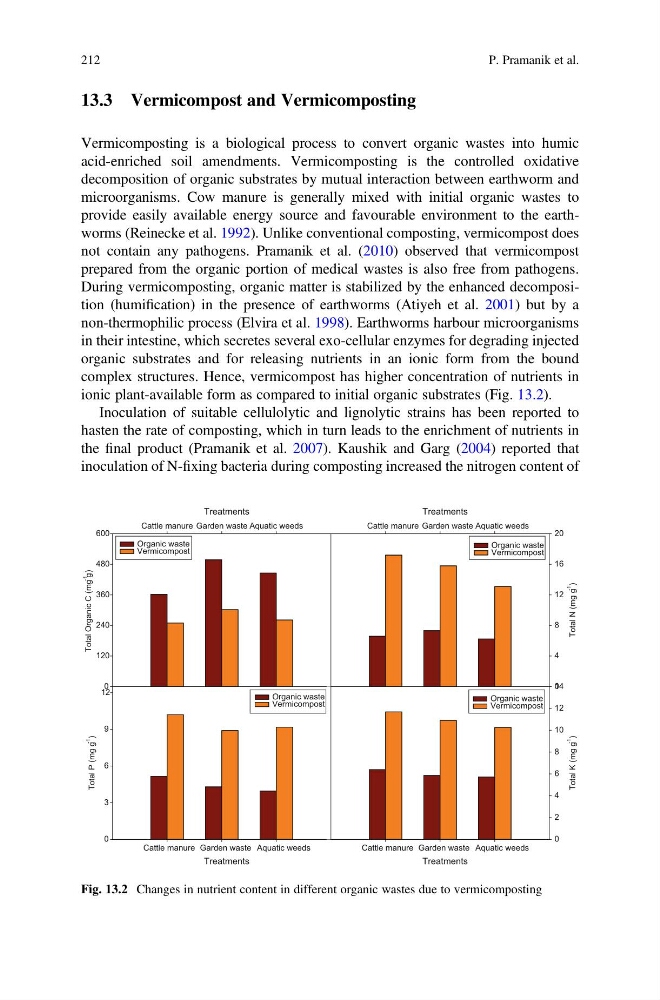
ionic plant-available form as compared to initial organic substrates (Fig. 13.2).
Inoculation of suitable cellulolytic and lignolytic strains has been reported to
hasten the rate of composting, which in turn leads to the enrichment of nutrients in
the final product (Pramanik et al. 2007). Kaushik and Garg (2004) reported that
inoculation of N-fixing bacteria during composting increased the nitrogen content of
Treatments
Cattle manure Garden waste Aquatic weeds
Total Organic C (mg g
-1
)
0
120
240
360
480
600
Organic waste
Vermicompost
Treatments
Cattle manure Garden waste Aquatic weeds
Total N (mg g
-1
)
0
4
8
12
16
20
Organic waste
Vermicompost
Treatments
Cattle manure Garden waste Aquatic weeds
Total P (mg g
-1
)
0
3
6
9
12
Organic waste
Vermicompost
Treatments
Cattle manure Garden waste Aquatic weeds
Total K (mg g
-1
)
0
2
4
6
8
10
12
14
Organic waste
Vermicompost
Fig. 13.2 Changes in nutrient content in different organic wastes due to vermicomposting
212
P. Pramanik et al.
Vermicomposting is a biological process to convert organic wastes into humic
acid-enriched soil amendments. Vermicomposting is the controlled oxidative
decomposition of organic substrates by mutual interaction between earthworm and
microorganisms. Cow manure is generally mixed with initial organic wastes to
provide easily available energy source and favourable environment to the earthworms (Reinecke et al. 1992). Unlike conventional composting, vermicompost does
not contain any pathogens. Pramanik et al. (2010) observed that vermicompost
prepared from the organic portion of medical wastes is also free from pathogens.
During vermicomposting, organic matter is stabilized by the enhanced decomposition (humification) in the presence of earthworms (Atiyeh et al. 2001) but by a
non-thermophilic process (Elvira et al. 1998). Earthworms harbour microorganisms
in their intestine, which secretes several exo-cellular enzymes for degrading injected
organic substrates and for releasing nutrients in an ionic form from the bound
complex structures. Hence, vermicompost has higher concentration of nutrients in
ionic plant-available form as compared to initial organic substrates (Fig. 13.2).
Inoculation of suitable cellulolytic and lignolytic strains has been reported to
hasten the rate of composting, which in turn leads to the enrichment of nutrients in
the final product (Pramanik et al. 2007). Kaushik and Garg (2004) reported that
inoculation of N-fixing bacteria during composting increased the nitrogen content of
Treatments
Cattle manure Garden waste Aquatic weeds
Total Organic C (mg g
-1
)
0
120
240
360
480
600
Organic waste
Vermicompost
Treatments
Cattle manure Garden waste Aquatic weeds
Total N (mg g
-1
)
0
4
8
12
16
20
Organic waste
Vermicompost
Treatments
Cattle manure Garden waste Aquatic weeds
Total P (mg g
-1
)
0
3
6
9
12
Organic waste
Vermicompost
Treatments
Cattle manure Garden waste Aquatic weeds
Total K (mg g
-1
)
0
2
4
6
8
10
12
14
Organic waste
Vermicompost
Fig. 13.2 Changes in nutrient content in different organic wastes due to vermicomposting
212
P. Pramanik et al.