

the stabilized product. It was found that microorganisms, present in the earthworm’s
intestine, contribute enzymes to the organic substrates during their passage through
the gut of earthworms during vermicomposting. Pramanik et al. (2009) revealed that
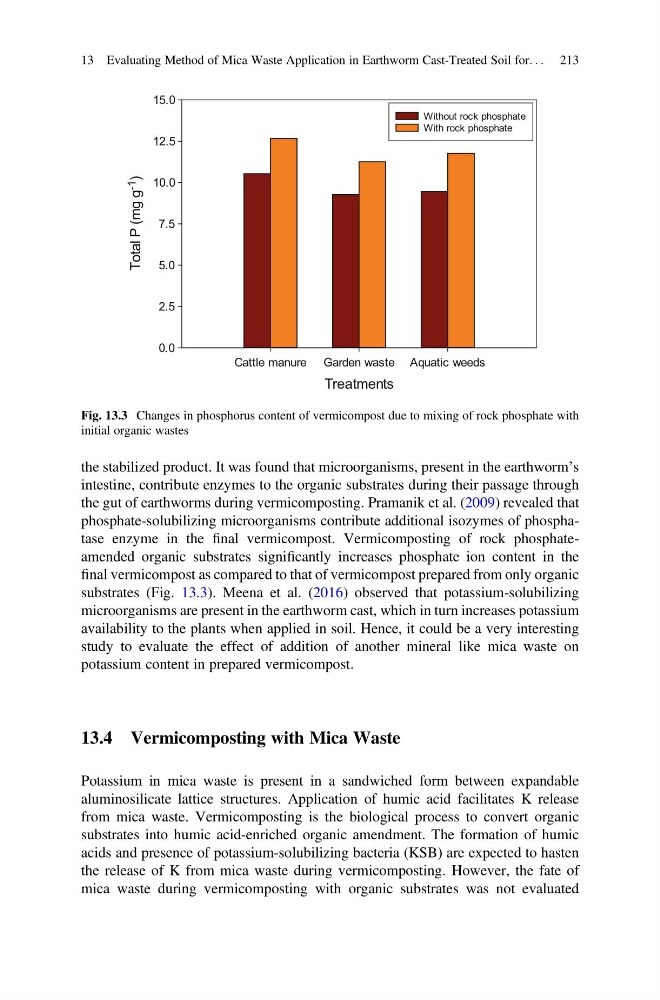
phosphate-solubilizing microorganisms contribute additional isozymes of phosphatase enzyme in the final vermicompost. Vermicomposting of rock phosphateamended organic substrates significantly increases phosphate ion content in the
final vermicompost as compared to that of vermicompost prepared from only organic
substrates (Fig. 13.3). Meena et al. (2016) observed that potassium-solubilizing
microorganisms are present in the earthworm cast, which in turn increases potassium
availability to the plants when applied in soil. Hence, it could be a very interesting
study to evaluate the effect of addition of another mineral like mica waste on
potassium content in prepared vermicompost.
13.4 Vermicomposting with Mica Waste
Potassium in mica waste is present in a sandwiched form between expandable
aluminosilicate lattice structures. Application of humic acid facilitates K release
from mica waste. Vermicomposting is the biological process to convert organic
substrates into humic acid-enriched organic amendment. The formation of humic
acids and presence of potassium-solubilizing bacteria (KSB) are expected to hasten
the release of K from mica waste during vermicomposting. However, the fate of
mica waste during vermicomposting with organic substrates was not evaluated
Treatments
Cattle manure Garden waste Aquatic weeds
Total P (mg g -1
)
0.0
2.5
5.0
7.5
10.0
12.5
15.0
Without rock phosphate
With rock phosphate
Fig. 13.3 Changes in phosphorus content of vermicompost due to mixing of rock phosphate with
initial organic wastes
13 Evaluating Method of Mica Waste Application in Earthworm Cast-Treated Soil for. . . 213
intestine, contribute enzymes to the organic substrates during their passage through
the gut of earthworms during vermicomposting. Pramanik et al. (2009) revealed that
phosphate-solubilizing microorganisms contribute additional isozymes of phosphatase enzyme in the final vermicompost. Vermicomposting of rock phosphateamended organic substrates significantly increases phosphate ion content in the
final vermicompost as compared to that of vermicompost prepared from only organic
substrates (Fig. 13.3). Meena et al. (2016) observed that potassium-solubilizing
microorganisms are present in the earthworm cast, which in turn increases potassium
availability to the plants when applied in soil. Hence, it could be a very interesting
study to evaluate the effect of addition of another mineral like mica waste on
potassium content in prepared vermicompost.
13.4 Vermicomposting with Mica Waste
Potassium in mica waste is present in a sandwiched form between expandable
aluminosilicate lattice structures. Application of humic acid facilitates K release
from mica waste. Vermicomposting is the biological process to convert organic
substrates into humic acid-enriched organic amendment. The formation of humic
acids and presence of potassium-solubilizing bacteria (KSB) are expected to hasten
the release of K from mica waste during vermicomposting. However, the fate of
mica waste during vermicomposting with organic substrates was not evaluated
Treatments
Cattle manure Garden waste Aquatic weeds
Total P (mg g -1
)
0.0
2.5
5.0
7.5
10.0
12.5
15.0
Without rock phosphate
With rock phosphate
Fig. 13.3 Changes in phosphorus content of vermicompost due to mixing of rock phosphate with
initial organic wastes
13 Evaluating Method of Mica Waste Application in Earthworm Cast-Treated Soil for. . . 213