

However, Pramanik et al. (2019) observed that application of mica waste at the
recommended dose increased exchangeable K content in soil as compared to control
(received no K input); however, the value was lower than that of MoP treatment. The
mica waste-treated plants had better growth and higher K uptake than plants with the
MoP treatment. Application of mica waste at half of the recommended dose
increased K content in the soil above no K-treated soil and recorded comparable
growth and K accumulation by plants as MoP (Pramanik and Kalita 2019). Hence,
mica waste could be used as K amendment in acidic soil, especially during tea
cultivation.
Türkmen et al. (2004) suggested that applied humic acids had a synergistic effect
on K availability in soil. Humic acids may have some interaction with bound K
compounds for releasing K in ionic form. Humic acids have the ability to release K
from inter-lattice space of mica waste (Pramanik et al. 2019). Their SEM analysis
and X-ray diffractogram analysis suggested that crystal structure and lattice formation of mica waste was definitely affected due to humic acid treatment. In this study,
humic acid-treated mica waste released 43.9 mg K mL
À1 in solution after 10 days of
incubation, while additional 40.6 mg K 2 O kg
À1 were released in soil microcosm
after 75 days of incubation under laboratory condition. Therefore, it could be
inferred that humic acid treatment was effective to release significantly (P < 0.05)
higher amount of K in soil as compared to the sole application of mica waste.
Therefore, it could be hypothesized that incorporation of mica waste with humic
acid-enriched substrates like vermicompost will hasten K release from the minerals.
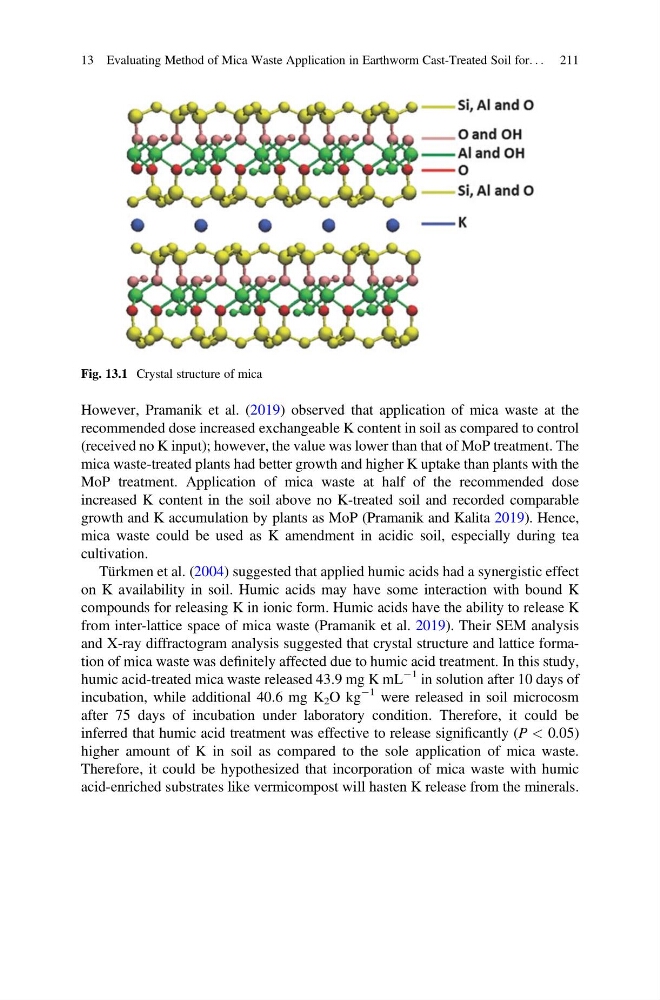
Fig. 13.1 Crystal structure of mica
13 Evaluating Method of Mica Waste Application in Earthworm Cast-Treated Soil for. . . 211
recommended dose increased exchangeable K content in soil as compared to control
(received no K input); however, the value was lower than that of MoP treatment. The
mica waste-treated plants had better growth and higher K uptake than plants with the
MoP treatment. Application of mica waste at half of the recommended dose
increased K content in the soil above no K-treated soil and recorded comparable
growth and K accumulation by plants as MoP (Pramanik and Kalita 2019). Hence,
mica waste could be used as K amendment in acidic soil, especially during tea
cultivation.
Türkmen et al. (2004) suggested that applied humic acids had a synergistic effect
on K availability in soil. Humic acids may have some interaction with bound K
compounds for releasing K in ionic form. Humic acids have the ability to release K
from inter-lattice space of mica waste (Pramanik et al. 2019). Their SEM analysis
and X-ray diffractogram analysis suggested that crystal structure and lattice formation of mica waste was definitely affected due to humic acid treatment. In this study,
humic acid-treated mica waste released 43.9 mg K mL
À1 in solution after 10 days of
incubation, while additional 40.6 mg K 2 O kg
À1 were released in soil microcosm
after 75 days of incubation under laboratory condition. Therefore, it could be
inferred that humic acid treatment was effective to release significantly (P < 0.05)
higher amount of K in soil as compared to the sole application of mica waste.
Therefore, it could be hypothesized that incorporation of mica waste with humic
acid-enriched substrates like vermicompost will hasten K release from the minerals.
Fig. 13.1 Crystal structure of mica
13 Evaluating Method of Mica Waste Application in Earthworm Cast-Treated Soil for. . . 211