

68
Boufadel (Zhao et al. 2016), Schlüter (Pesch et al. 2018), and Paris (Paris et al.
2012; Lindo-Atichati et al. 2016; Perlin et al. 2020).
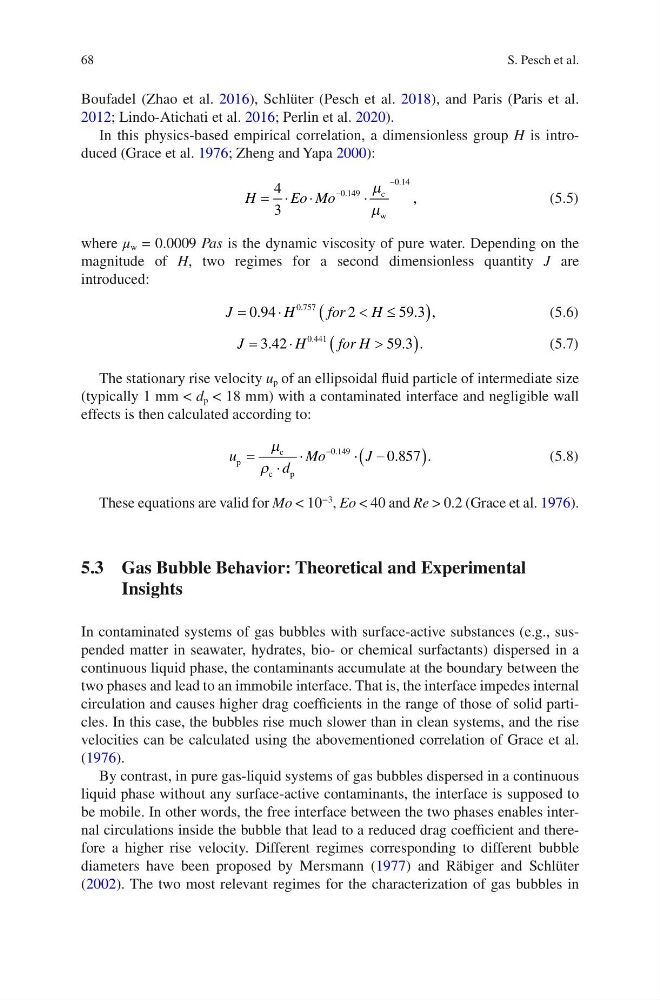
In this physics-based empirical correlation, a dimensionless group H is introduced (Grace et al. 1976; Zheng and Yapa 2000):
H
Eo Mo
= ⋅ ⋅
⋅
−
−
4
3
0 149
0 14
.
.
µ
µ
c
w
,
(5.5)
where μ w = 0.0009 Pas is the dynamic viscosity of pure water. Depending on the
magnitude of H, two regimes for a second dimensionless quantity J are
introduced:
J
H
for
H
=
⋅
< ≤
(
)
0 94
2
59 3
0 757
.
.
.
,
(5.6)
J
H
for H
=
⋅
>
(
)
3 42
5 9 3
0 441
.
.
.
.
(5.7)
The stationary rise velocity u p of an ellipsoidal fluid particle of intermediate size
(typically 1 mm < d p < 18 mm) with a contaminated interface and negligible wall
effects is then calculated according to:
u
d
Mo
J
p
c
c
p
.
= ⋅
⋅
⋅ −
(
)
−
µ
ρ
0 149
0 857
.
.
(5.8)
These equations are valid for Mo < 10
−3
, Eo < 40 and Re > 0.2 (Grace et al. 1976).
5.3 Gas Bubble Behavior: Theoretical and Experimental
Insights
In contaminated systems of gas bubbles with surface-active substances (e.g., suspended matter in seawater, hydrates, bio- or chemical surfactants) dispersed in a
continuous liquid phase, the contaminants accumulate at the boundary between the
two phases and lead to an immobile interface. That is, the interface impedes internal
circulation and causes higher drag coefficients in the range of those of solid particles. In this case, the bubbles rise much slower than in clean systems, and the rise
velocities can be calculated using the abovementioned correlation of Grace et al.
(1976).
By contrast, in pure gas-liquid systems of gas bubbles dispersed in a continuous
liquid phase without any surface-active contaminants, the interface is supposed to
be mobile. In other words, the free interface between the two phases enables internal circulations inside the bubble that lead to a reduced drag coefficient and therefore a higher rise velocity. Different regimes corresponding to different bubble
diameters have been proposed by Mersmann (1977) and Räbiger and Schlüter
(2002). The two most relevant regimes for the characterization of gas bubbles in
S. Pesch et al.
Boufadel (Zhao et al. 2016), Schlüter (Pesch et al. 2018), and Paris (Paris et al.
2012; Lindo-Atichati et al. 2016; Perlin et al. 2020).
In this physics-based empirical correlation, a dimensionless group H is introduced (Grace et al. 1976; Zheng and Yapa 2000):
H
Eo Mo
= ⋅ ⋅
⋅
−
−
4
3
0 149
0 14
.
.
µ
µ
c
w
,
(5.5)
where μ w = 0.0009 Pas is the dynamic viscosity of pure water. Depending on the
magnitude of H, two regimes for a second dimensionless quantity J are
introduced:
J
H
for
H
=
⋅
< ≤
(
)
0 94
2
59 3
0 757
.
.
.
,
(5.6)
J
H
for H
=
⋅
>
(
)
3 42
5 9 3
0 441
.
.
.
.
(5.7)
The stationary rise velocity u p of an ellipsoidal fluid particle of intermediate size
(typically 1 mm < d p < 18 mm) with a contaminated interface and negligible wall
effects is then calculated according to:
u
d
Mo
J
p
c
c
p
.
= ⋅
⋅
⋅ −
(
)
−
µ
ρ
0 149
0 857
.
.
(5.8)
These equations are valid for Mo < 10
−3
, Eo < 40 and Re > 0.2 (Grace et al. 1976).
5.3 Gas Bubble Behavior: Theoretical and Experimental
Insights
In contaminated systems of gas bubbles with surface-active substances (e.g., suspended matter in seawater, hydrates, bio- or chemical surfactants) dispersed in a
continuous liquid phase, the contaminants accumulate at the boundary between the
two phases and lead to an immobile interface. That is, the interface impedes internal
circulation and causes higher drag coefficients in the range of those of solid particles. In this case, the bubbles rise much slower than in clean systems, and the rise
velocities can be calculated using the abovementioned correlation of Grace et al.
(1976).
By contrast, in pure gas-liquid systems of gas bubbles dispersed in a continuous
liquid phase without any surface-active contaminants, the interface is supposed to
be mobile. In other words, the free interface between the two phases enables internal circulations inside the bubble that lead to a reduced drag coefficient and therefore a higher rise velocity. Different regimes corresponding to different bubble
diameters have been proposed by Mersmann (1977) and Räbiger and Schlüter
(2002). The two most relevant regimes for the characterization of gas bubbles in
S. Pesch et al.