

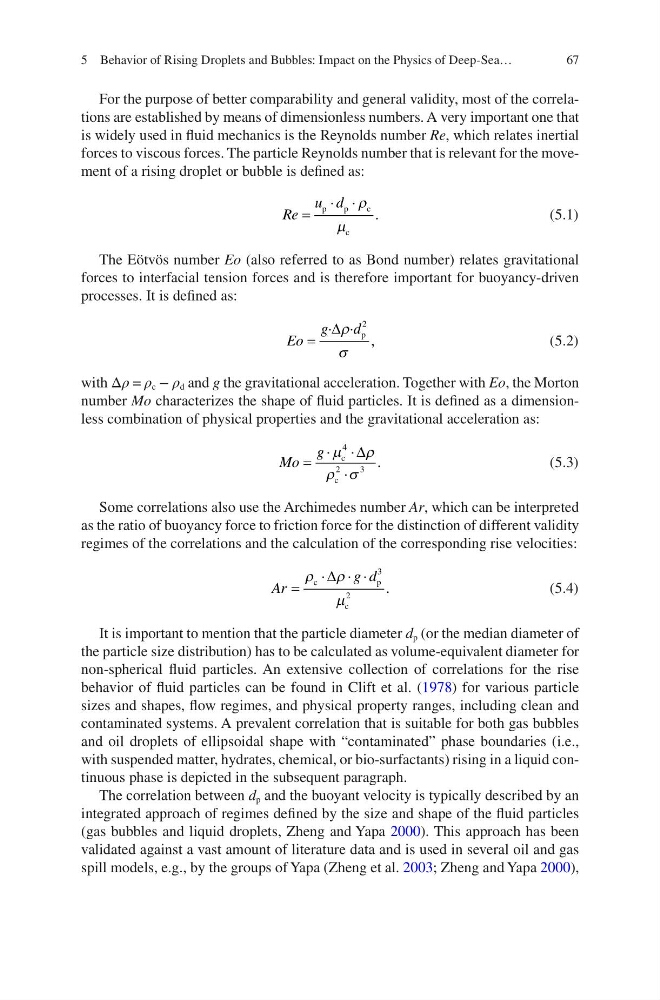
67
For the purpose of better comparability and general validity, most of the correlations are established by means of dimensionless numbers. A very important one that
is widely used in fluid mechanics is the Reynolds number Re, which relates inertial
forces to viscous forces. The particle Reynolds number that is relevant for the movement of a rising droplet or bubble is defined as:
Re
u d
=
⋅ ⋅
p
p
c
c
.
ρ
µ
(5.1)
The Eötvös number Eo (also referred to as Bond number) relates gravitational
forces to interfacial tension forces and is therefore important for buoyancy-driven
processes. It is defined as:
Eo
g
d
=
· ·
∆ρ
σ
p ,
2
(5.2)
with Δρ = ρ c − ρ d and g the gravitational acceleration. Together with Eo, the Morton
number Mo characterizes the shape of fluid particles. It is defined as a dimensionless combination of physical properties and the gravitational acceleration as:
Mo
g
=
⋅ ⋅
⋅
µ
ρ
ρ σ
c
c
.
4
2
3
∆
(5.3)
Some correlations also use the Archimedes number Ar, which can be interpreted
as the ratio of buoyancy force to friction force for the distinction of different validity
regimes of the correlations and the calculation of the corresponding rise velocities:
Ar
g d
=
⋅ ⋅ ⋅
ρ
ρ
µ
c
p
c
.
∆
3
2
(5.4)
It is important to mention that the particle diameter d p (or the median diameter of
the particle size distribution) has to be calculated as volume-equivalent diameter for
non-spherical fluid particles. An extensive collection of correlations for the rise
behavior of fluid particles can be found in Clift et al. (1978) for various particle
sizes and shapes, flow regimes, and physical property ranges, including clean and
contaminated systems. A prevalent correlation that is suitable for both gas bubbles
and oil droplets of ellipsoidal shape with “contaminated” phase boundaries (i.e.,
with suspended matter, hydrates, chemical, or bio-surfactants) rising in a liquid continuous phase is depicted in the subsequent paragraph.
The correlation between d p and the buoyant velocity is typically described by an
integrated approach of regimes defined by the size and shape of the fluid particles
(gas bubbles and liquid droplets, Zheng and Yapa 2000). This approach has been
validated against a vast amount of literature data and is used in several oil and gas
spill models, e.g., by the groups of Yapa (Zheng et al. 2003; Zheng and Yapa 2000),
5 Behavior of Rising Droplets and Bubbles: Impact on the Physics of Deep-Sea…
For the purpose of better comparability and general validity, most of the correlations are established by means of dimensionless numbers. A very important one that
is widely used in fluid mechanics is the Reynolds number Re, which relates inertial
forces to viscous forces. The particle Reynolds number that is relevant for the movement of a rising droplet or bubble is defined as:
Re
u d
=
⋅ ⋅
p
p
c
c
.
ρ
µ
(5.1)
The Eötvös number Eo (also referred to as Bond number) relates gravitational
forces to interfacial tension forces and is therefore important for buoyancy-driven
processes. It is defined as:
Eo
g
d
=
· ·
∆ρ
σ
p ,
2
(5.2)
with Δρ = ρ c − ρ d and g the gravitational acceleration. Together with Eo, the Morton
number Mo characterizes the shape of fluid particles. It is defined as a dimensionless combination of physical properties and the gravitational acceleration as:
Mo
g
=
⋅ ⋅
⋅
µ
ρ
ρ σ
c
c
.
4
2
3
∆
(5.3)
Some correlations also use the Archimedes number Ar, which can be interpreted
as the ratio of buoyancy force to friction force for the distinction of different validity
regimes of the correlations and the calculation of the corresponding rise velocities:
Ar
g d
=
⋅ ⋅ ⋅
ρ
ρ
µ
c
p
c
.
∆
3
2
(5.4)
It is important to mention that the particle diameter d p (or the median diameter of
the particle size distribution) has to be calculated as volume-equivalent diameter for
non-spherical fluid particles. An extensive collection of correlations for the rise
behavior of fluid particles can be found in Clift et al. (1978) for various particle
sizes and shapes, flow regimes, and physical property ranges, including clean and
contaminated systems. A prevalent correlation that is suitable for both gas bubbles
and oil droplets of ellipsoidal shape with “contaminated” phase boundaries (i.e.,
with suspended matter, hydrates, chemical, or bio-surfactants) rising in a liquid continuous phase is depicted in the subsequent paragraph.
The correlation between d p and the buoyant velocity is typically described by an
integrated approach of regimes defined by the size and shape of the fluid particles
(gas bubbles and liquid droplets, Zheng and Yapa 2000). This approach has been
validated against a vast amount of literature data and is used in several oil and gas
spill models, e.g., by the groups of Yapa (Zheng et al. 2003; Zheng and Yapa 2000),
5 Behavior of Rising Droplets and Bubbles: Impact on the Physics of Deep-Sea…