

543
31.3 Results
31.3.1 Population Impacts
In Fig. 31.2, guild biomass is presented relative to a control scenario, a no oil spill
simulation. This figure shows the range of results observed for fishes and invertebrates from sensitivity analysis varying K and [oil] thresh as well as the average of
those simulations. The results for snappers, groupers, Sciaenidae, and large demersal fishes agree with the trends from the oil spill simulations observed in Ainsworth
et al. (2018), though the relative declines vary slightly. Relative changes qualitatively match remotely operated vehicle observations (W. Patterson, Pers. Comm.) in
Ainsworth et al. (2018), which indicated as much as a 75% decrease in small reef
fish and a 70% decrease in some large reef fish post spill. Small pelagics, small
demersal and reef fish, and Sciaenidae exhibit declines during the spill period followed closely by recovery. However, the responses begin to differ with Ainsworth
et al. (2018) around years 5–10. Small demersal and reef fishes and Sciaenidae average above the no-spill scenario from about year 2016 on, while the small pelagic
guild declines again and maintains biomass at roughly half the no-spill scenario.
This trend in small pelagics is driven by the “small pelagic” functional group within
the guild. The small pelagic functional group goes virtually extinct after roughly
20 years due to fishing and increased predation pressure. In the small pelagic guild,
species-specific functional groups menhaden and pinfish recover in 20 and 5 years,
respectively.
When including oil effects on both fishes and benthic invertebrates, increased
benthic invertebrate abundance is no longer evident at the invertebrate guild and
polygon level in October 2010 (6 months after first spill), across all sensitivity
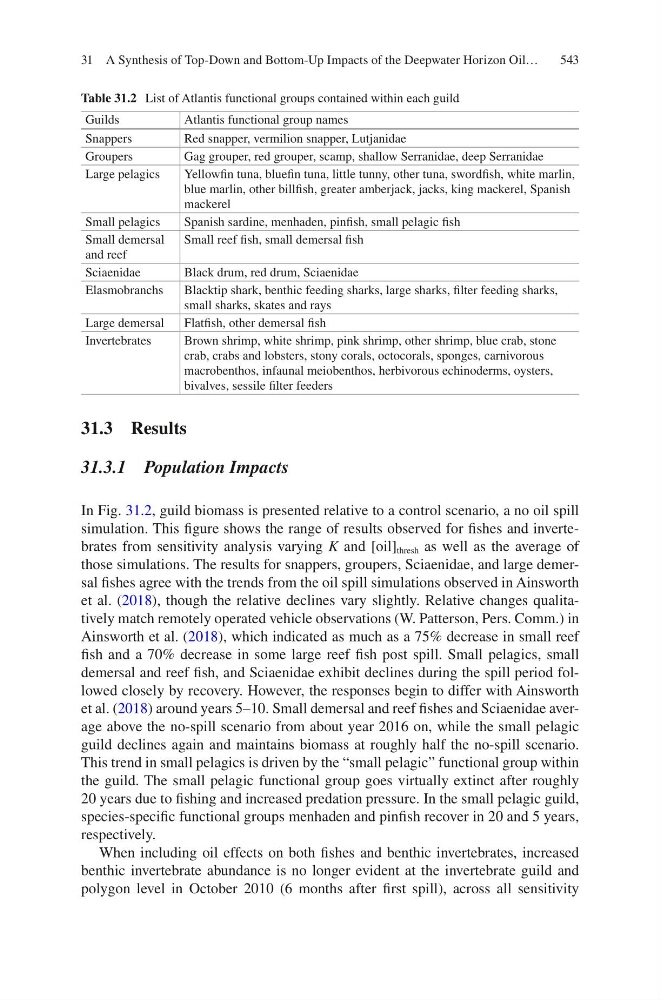
Table 31.2 List of Atlantis functional groups contained within each guild
Guilds
Atlantis functional group names
Snappers
Red snapper, vermilion snapper, Lutjanidae
Groupers
Gag grouper, red grouper, scamp, shallow Serranidae, deep Serranidae
Large pelagics
Yellowfin tuna, bluefin tuna, little tunny, other tuna, swordfish, white marlin,
blue marlin, other billfish, greater amberjack, jacks, king mackerel, Spanish
mackerel
Small pelagics
Spanish sardine, menhaden, pinfish, small pelagic fish
Small demersal
and reef
Small reef fish, small demersal fish
Sciaenidae
Black drum, red drum, Sciaenidae
Elasmobranchs
Blacktip shark, benthic feeding sharks, large sharks, filter feeding sharks,
small sharks, skates and rays
Large demersal
Flatfish, other demersal fish
Invertebrates
Brown shrimp, white shrimp, pink shrimp, other shrimp, blue crab, stone
crab, crabs and lobsters, stony corals, octocorals, sponges, carnivorous
macrobenthos, infaunal meiobenthos, herbivorous echinoderms, oysters,
bivalves, sessile filter feeders
31 A Synthesis of Top-Down and Bottom-Up Impacts of the Deepwater Horizon Oil…