

542
functional group and fleet was originally fit to historical catch as described in
Ainsworth et al. (2015). All scenario parameters are listed in Table 31.1.
31.2.4 Analysis
For consistency and cross comparison, analytical grouping by polygon and guild
matched that of Ainsworth et al. (2018). All results presented here are averaged
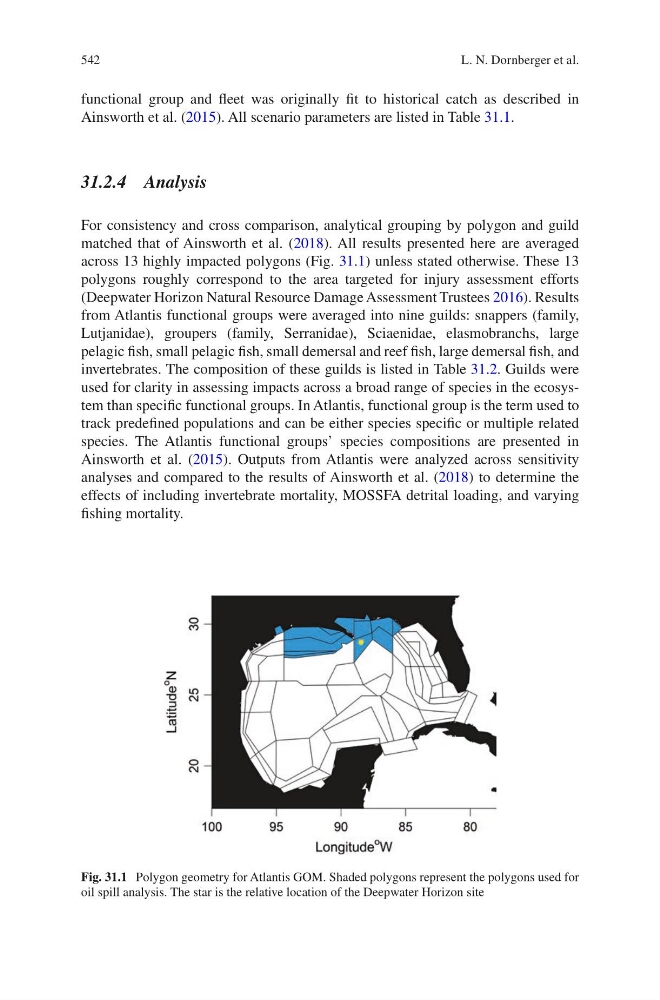
across 13 highly impacted polygons (Fig. 31.1) unless stated otherwise. These 13
polygons roughly correspond to the area targeted for injury assessment efforts
(Deepwater Horizon Natural Resource Damage Assessment Trustees 2016). Results
from Atlantis functional groups were averaged into nine guilds: snappers (family,
Lutjanidae), groupers (family, Serranidae), Sciaenidae, elasmobranchs, large
pelagic fish, small pelagic fish, small demersal and reef fish, large demersal fish, and
invertebrates. The composition of these guilds is listed in Table 31.2. Guilds were
used for clarity in assessing impacts across a broad range of species in the ecosystem than specific functional groups. In Atlantis, functional group is the term used to
track predefined populations and can be either species specific or multiple related
species. The Atlantis functional groups’ species compositions are presented in
Ainsworth et al. (2015). Outputs from Atlantis were analyzed across sensitivity
analyses and compared to the results of Ainsworth et al. (2018) to determine the
effects of including invertebrate mortality, MOSSFA detrital loading, and varying
fishing mortality.
Fig. 31.1 Polygon geometry for Atlantis GOM. Shaded polygons represent the polygons used for
oil spill analysis. The star is the relative location of the Deepwater Horizon site
L. N. Dornberger et al.