

487
particularly important when comparing the results between oil only solutions and
chemically dispersed solutions. Oil components can partition between the fully dissolved phase and the particulate phases (oil droplets). If PAHs are not measured in
the appropriate phase of the test solution for the questions asked, there will either be
an over or underrepresentation of the toxicity observed depending on how a particular organism is exposed to the oil constituents. Some organisms will only be exposed
to the dissolved fraction and others based on their feeding (i.e., indiscriminate feeding on oil droplets due to their size being similar to their prey items), or other physiologies are exposed to both the dissolved and oil droplets fractions. Therefore,
determining oil partitioning between the particulate (oil droplets) and dissolved
fractions, as well as the quantity and size distribution of oil droplets, is critically
important to understand the environmental relevance of toxicity studies. Figure 28.1
demonstrates how the interpretation of toxicity can be misrepresented by the choice
of analytical chemistry conducted on the test solutions.
28.3 Synthesis of DWH Aquatic Toxicity Data
For the specific purpose of this synthesis, study selection was based on a minimum
set of criteria, which were as follows: (1) standard toxicity tests conducted using
MC252 (all types) or surrogate (i.e., South Louisiana crude) oils; (2) toxicity data
reported as measured hydrocarbons and based on the sum of total polycyclic aromatic hydrocarbons (TPAH or ∑50PAH; MC 252 QAPP, 2011); studies reporting
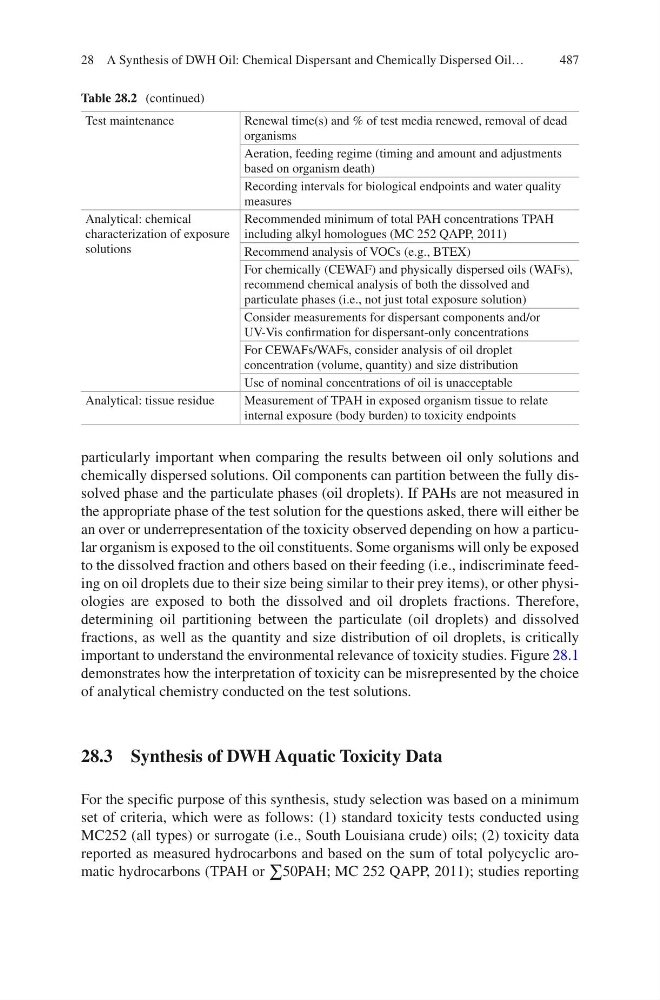
Table 28.2 (continued)
Test maintenance
Renewal time(s) and % of test media renewed, removal of dead
organisms
Aeration, feeding regime (timing and amount and adjustments
based on organism death)
Recording intervals for biological endpoints and water quality
measures
Analytical: chemical
characterization of exposure
solutions
Recommended minimum of total PAH concentrations TPAH
including alkyl homologues (MC 252 QAPP, 2011)
Recommend analysis of VOCs (e.g., BTEX)
For chemically (CEWAF) and physically dispersed oils (WAFs),
recommend chemical analysis of both the dissolved and
particulate phases (i.e., not just total exposure solution)
Consider measurements for dispersant components and/or
UV-Vis confirmation for dispersant-only concentrations
For CEWAFs/WAFs, consider analysis of oil droplet
concentration (volume, quantity) and size distribution
Use of nominal concentrations of oil is unacceptable
Analytical: tissue residue
Measurement of TPAH in exposed organism tissue to relate
internal exposure (body burden) to toxicity endpoints
28 A Synthesis of DWH Oil: Chemical Dispersant and Chemically Dispersed Oil…
particularly important when comparing the results between oil only solutions and
chemically dispersed solutions. Oil components can partition between the fully dissolved phase and the particulate phases (oil droplets). If PAHs are not measured in
the appropriate phase of the test solution for the questions asked, there will either be
an over or underrepresentation of the toxicity observed depending on how a particular organism is exposed to the oil constituents. Some organisms will only be exposed
to the dissolved fraction and others based on their feeding (i.e., indiscriminate feeding on oil droplets due to their size being similar to their prey items), or other physiologies are exposed to both the dissolved and oil droplets fractions. Therefore,
determining oil partitioning between the particulate (oil droplets) and dissolved
fractions, as well as the quantity and size distribution of oil droplets, is critically
important to understand the environmental relevance of toxicity studies. Figure 28.1
demonstrates how the interpretation of toxicity can be misrepresented by the choice
of analytical chemistry conducted on the test solutions.
28.3 Synthesis of DWH Aquatic Toxicity Data
For the specific purpose of this synthesis, study selection was based on a minimum
set of criteria, which were as follows: (1) standard toxicity tests conducted using
MC252 (all types) or surrogate (i.e., South Louisiana crude) oils; (2) toxicity data
reported as measured hydrocarbons and based on the sum of total polycyclic aromatic hydrocarbons (TPAH or ∑50PAH; MC 252 QAPP, 2011); studies reporting
Table 28.2 (continued)
Test maintenance
Renewal time(s) and % of test media renewed, removal of dead
organisms
Aeration, feeding regime (timing and amount and adjustments
based on organism death)
Recording intervals for biological endpoints and water quality
measures
Analytical: chemical
characterization of exposure
solutions
Recommended minimum of total PAH concentrations TPAH
including alkyl homologues (MC 252 QAPP, 2011)
Recommend analysis of VOCs (e.g., BTEX)
For chemically (CEWAF) and physically dispersed oils (WAFs),
recommend chemical analysis of both the dissolved and
particulate phases (i.e., not just total exposure solution)
Consider measurements for dispersant components and/or
UV-Vis confirmation for dispersant-only concentrations
For CEWAFs/WAFs, consider analysis of oil droplet
concentration (volume, quantity) and size distribution
Use of nominal concentrations of oil is unacceptable
Analytical: tissue residue
Measurement of TPAH in exposed organism tissue to relate
internal exposure (body burden) to toxicity endpoints
28 A Synthesis of DWH Oil: Chemical Dispersant and Chemically Dispersed Oil…