

486
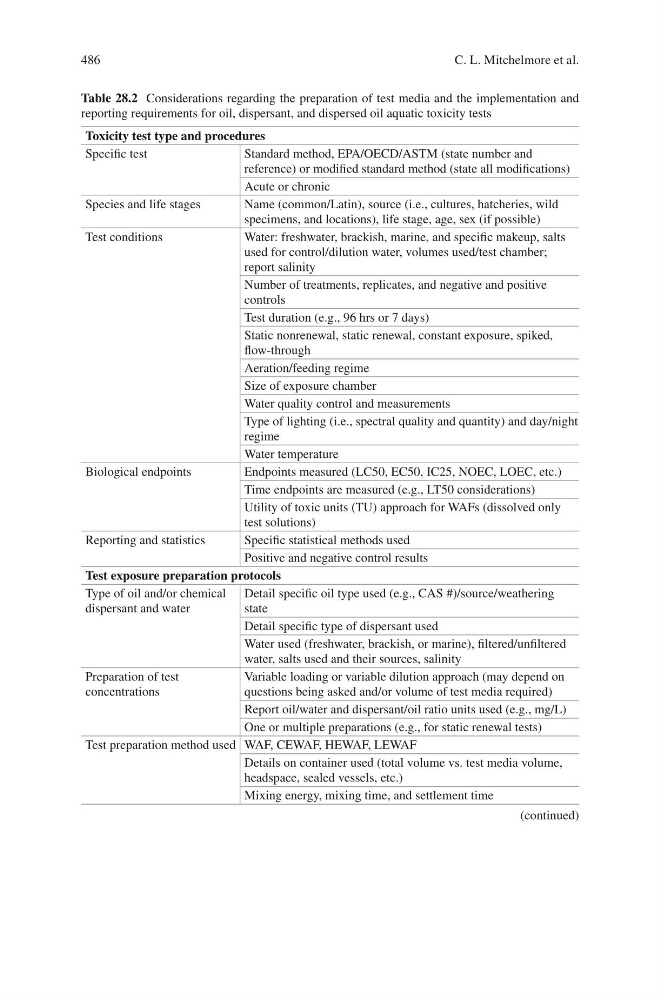
Table 28.2 Considerations regarding the preparation of test media and the implementation and
reporting requirements for oil, dispersant, and dispersed oil aquatic toxicity tests
Toxicity test type and procedures
Specific test
Standard method, EPA/OECD/ASTM (state number and
reference) or modified standard method (state all modifications)
Acute or chronic
Species and life stages
Name (common/Latin), source (i.e., cultures, hatcheries, wild
specimens, and locations), life stage, age, sex (if possible)
Test conditions
Water: freshwater, brackish, marine, and specific makeup, salts
used for control/dilution water, volumes used/test chamber;
report salinity
Number of treatments, replicates, and negative and positive
controls
Test duration (e.g., 96 hrs or 7 days)
Static nonrenewal, static renewal, constant exposure, spiked,
flow-through
Aeration/feeding regime
Size of exposure chamber
Water quality control and measurements
Type of lighting (i.e., spectral quality and quantity) and day/night
regime
Water temperature
Biological endpoints
Endpoints measured (LC50, EC50, IC25, NOEC, LOEC, etc.)
Time endpoints are measured (e.g., LT50 considerations)
Utility of toxic units (TU) approach for WAFs (dissolved only
test solutions)
Reporting and statistics
Specific statistical methods used
Positive and negative control results
Test exposure preparation protocols
Type of oil and/or chemical
dispersant and water
Detail specific oil type used (e.g., CAS #)/source/weathering
state
Detail specific type of dispersant used
Water used (freshwater, brackish, or marine), filtered/unfiltered
water, salts used and their sources, salinity
Preparation of test
concentrations
Variable loading or variable dilution approach (may depend on
questions being asked and/or volume of test media required)
Report oil/water and dispersant/oil ratio units used (e.g., mg/L)
One or multiple preparations (e.g., for static renewal tests)
Test preparation method used WAF, CEWAF, HEWAF, LEWAF
Details on container used (total volume vs. test media volume,
headspace, sealed vessels, etc.)
Mixing energy, mixing time, and settlement time
(continued)
C. L. Mitchelmore et al.
Table 28.2 Considerations regarding the preparation of test media and the implementation and
reporting requirements for oil, dispersant, and dispersed oil aquatic toxicity tests
Toxicity test type and procedures
Specific test
Standard method, EPA/OECD/ASTM (state number and
reference) or modified standard method (state all modifications)
Acute or chronic
Species and life stages
Name (common/Latin), source (i.e., cultures, hatcheries, wild
specimens, and locations), life stage, age, sex (if possible)
Test conditions
Water: freshwater, brackish, marine, and specific makeup, salts
used for control/dilution water, volumes used/test chamber;
report salinity
Number of treatments, replicates, and negative and positive
controls
Test duration (e.g., 96 hrs or 7 days)
Static nonrenewal, static renewal, constant exposure, spiked,
flow-through
Aeration/feeding regime
Size of exposure chamber
Water quality control and measurements
Type of lighting (i.e., spectral quality and quantity) and day/night
regime
Water temperature
Biological endpoints
Endpoints measured (LC50, EC50, IC25, NOEC, LOEC, etc.)
Time endpoints are measured (e.g., LT50 considerations)
Utility of toxic units (TU) approach for WAFs (dissolved only
test solutions)
Reporting and statistics
Specific statistical methods used
Positive and negative control results
Test exposure preparation protocols
Type of oil and/or chemical
dispersant and water
Detail specific oil type used (e.g., CAS #)/source/weathering
state
Detail specific type of dispersant used
Water used (freshwater, brackish, or marine), filtered/unfiltered
water, salts used and their sources, salinity
Preparation of test
concentrations
Variable loading or variable dilution approach (may depend on
questions being asked and/or volume of test media required)
Report oil/water and dispersant/oil ratio units used (e.g., mg/L)
One or multiple preparations (e.g., for static renewal tests)
Test preparation method used WAF, CEWAF, HEWAF, LEWAF
Details on container used (total volume vs. test media volume,
headspace, sealed vessels, etc.)
Mixing energy, mixing time, and settlement time
(continued)
C. L. Mitchelmore et al.