

450
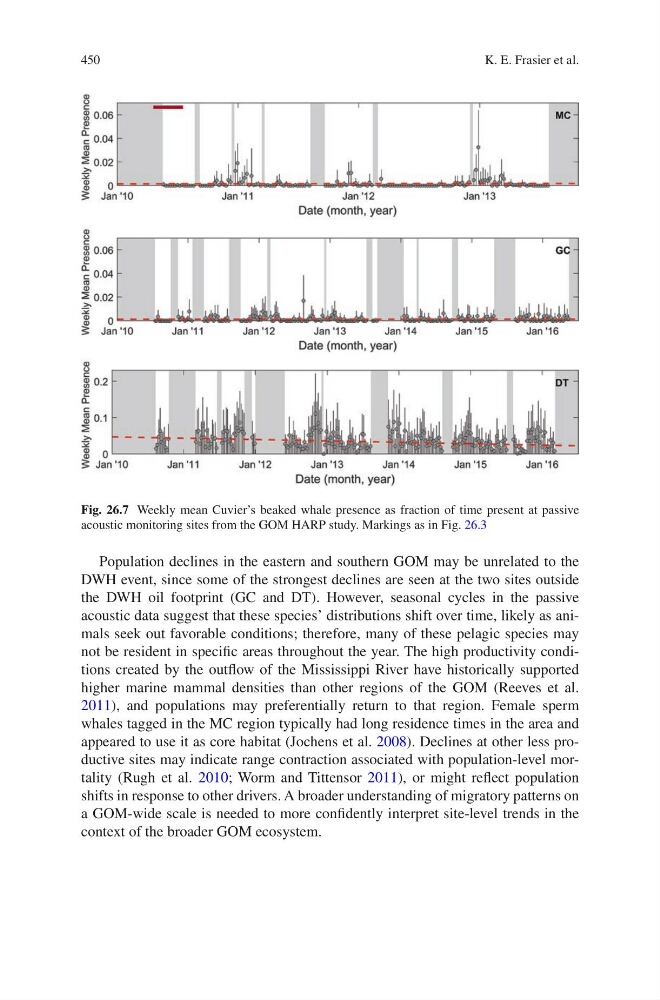
Population declines in the eastern and southern GOM may be unrelated to the
DWH event, since some of the strongest declines are seen at the two sites outside
the DWH oil footprint (GC and DT). However, seasonal cycles in the passive
acoustic data suggest that these species’ distributions shift over time, likely as animals seek out favorable conditions; therefore, many of these pelagic species may
not be resident in specific areas throughout the year. The high productivity conditions created by the outflow of the Mississippi River have historically supported
higher marine mammal densities than other regions of the GOM (Reeves et al.
2011), and populations may preferentially return to that region. Female sperm
whales tagged in the MC region typically had long residence times in the area and
appeared to use it as core habitat (Jochens et al. 2008). Declines at other less productive sites may indicate range contraction associated with population-level mortality (Rugh et al. 2010; Worm and Tittensor 2011), or might reflect population
shifts in response to other drivers. A broader understanding of migratory patterns on
a GOM-wide scale is needed to more confidently interpret site-level trends in the
context of the broader GOM ecosystem.
Fig. 26.7 Weekly mean Cuvier’s beaked whale presence as fraction of time present at passive
acoustic monitoring sites from the GOM HARP study. Markings as in Fig. 26.3
K. E. Frasier et al.
Population declines in the eastern and southern GOM may be unrelated to the
DWH event, since some of the strongest declines are seen at the two sites outside
the DWH oil footprint (GC and DT). However, seasonal cycles in the passive
acoustic data suggest that these species’ distributions shift over time, likely as animals seek out favorable conditions; therefore, many of these pelagic species may
not be resident in specific areas throughout the year. The high productivity conditions created by the outflow of the Mississippi River have historically supported
higher marine mammal densities than other regions of the GOM (Reeves et al.
2011), and populations may preferentially return to that region. Female sperm
whales tagged in the MC region typically had long residence times in the area and
appeared to use it as core habitat (Jochens et al. 2008). Declines at other less productive sites may indicate range contraction associated with population-level mortality (Rugh et al. 2010; Worm and Tittensor 2011), or might reflect population
shifts in response to other drivers. A broader understanding of migratory patterns on
a GOM-wide scale is needed to more confidently interpret site-level trends in the
context of the broader GOM ecosystem.
Fig. 26.7 Weekly mean Cuvier’s beaked whale presence as fraction of time present at passive
acoustic monitoring sites from the GOM HARP study. Markings as in Fig. 26.3
K. E. Frasier et al.