

449
species are most likely to have interacted with the DWH surface and subsurface
footprints for extended periods of time in the spring and summer of 2010. Stenella
and Kogia presence strongly declined at sites GC and DT, Kogia presence declined
at site MC, and Stenella delphinids appear to have declined from 2012 to 2016 following a peak in 2012. Sperm whale presence declined steadily at GC and MC, and
while possibly increasing at site DT, this site may not be part of core sperm whale
habitat (Jochens et al. 2008) given overall low encounter rates there. Blackfish presence is highly variable at site MC; however, this group appears to have been present
during the DWH event based on the acoustic record. Presence of blackfish delphinids has declined at sites MC and GC while remaining approximately constant at
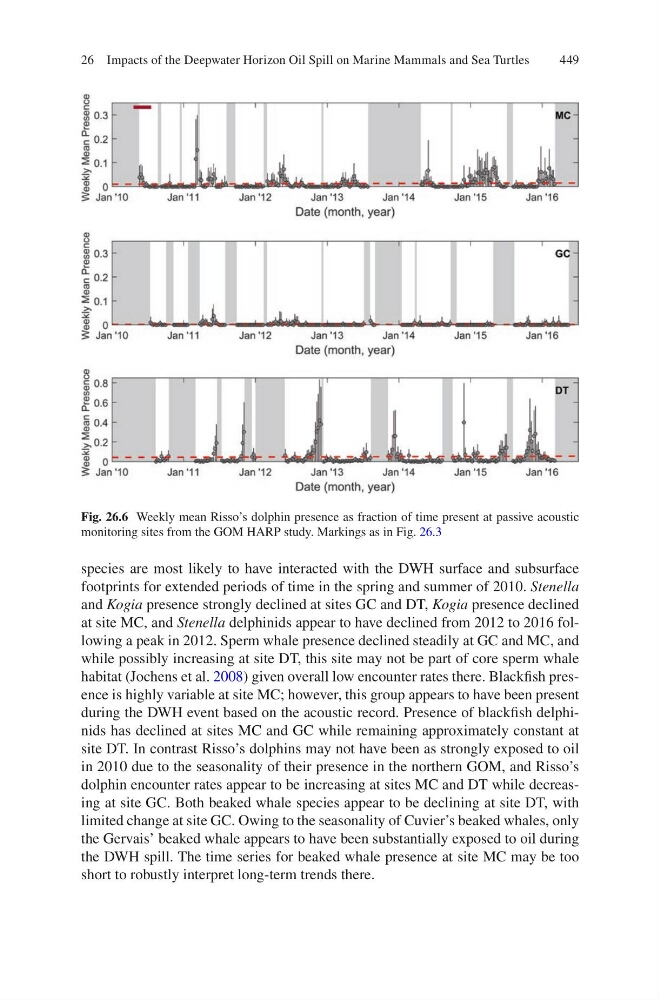
site DT. In contrast Risso’s dolphins may not have been as strongly exposed to oil
in 2010 due to the seasonality of their presence in the northern GOM, and Risso’s
dolphin encounter rates appear to be increasing at sites MC and DT while decreasing at site GC. Both beaked whale species appear to be declining at site DT, with
limited change at site GC. Owing to the seasonality of Cuvier’s beaked whales, only
the Gervais’ beaked whale appears to have been substantially exposed to oil during
the DWH spill. The time series for beaked whale presence at site MC may be too
short to robustly interpret long-term trends there.
Fig. 26.6 Weekly mean Risso’s dolphin presence as fraction of time present at passive acoustic
monitoring sites from the GOM HARP study. Markings as in Fig. 26.3
26 Impacts of the Deepwater Horizon Oil Spill on Marine Mammals and Sea Turtles
species are most likely to have interacted with the DWH surface and subsurface
footprints for extended periods of time in the spring and summer of 2010. Stenella
and Kogia presence strongly declined at sites GC and DT, Kogia presence declined
at site MC, and Stenella delphinids appear to have declined from 2012 to 2016 following a peak in 2012. Sperm whale presence declined steadily at GC and MC, and
while possibly increasing at site DT, this site may not be part of core sperm whale
habitat (Jochens et al. 2008) given overall low encounter rates there. Blackfish presence is highly variable at site MC; however, this group appears to have been present
during the DWH event based on the acoustic record. Presence of blackfish delphinids has declined at sites MC and GC while remaining approximately constant at
site DT. In contrast Risso’s dolphins may not have been as strongly exposed to oil
in 2010 due to the seasonality of their presence in the northern GOM, and Risso’s
dolphin encounter rates appear to be increasing at sites MC and DT while decreasing at site GC. Both beaked whale species appear to be declining at site DT, with
limited change at site GC. Owing to the seasonality of Cuvier’s beaked whales, only
the Gervais’ beaked whale appears to have been substantially exposed to oil during
the DWH spill. The time series for beaked whale presence at site MC may be too
short to robustly interpret long-term trends there.
Fig. 26.6 Weekly mean Risso’s dolphin presence as fraction of time present at passive acoustic
monitoring sites from the GOM HARP study. Markings as in Fig. 26.3
26 Impacts of the Deepwater Horizon Oil Spill on Marine Mammals and Sea Turtles