

448
at site GC (1 ± 4% annual change for Cuvier’s; 4 ± 3% annual increase for Gervais’).
An increase in beaked whale presence at site MC is observed; however, analysis for
beaked whale presence at this site occurred over a limited date range (2010–2013);
therefore, trends are less robust.
Kogia spp. presence was relatively high (0.3–0.5% occurrence within a short
detection range of <1 km) at site MC and GC (Fig. 26.9). Presence of Kogia spp.
increased at site MC (19 ± 7% annual increase), but presence at site GC decreased
strongly after 2013 resulting in a strongly negative long-term trend in mean presence at this site (15 ± 1% annual decrease). Presence also decreased at site DT
(9 ± 3% annual decline), although overall encounter rates at that site were low
(0.1%) throughout the monitoring period.
Population movements and declines may be convolved in the trends seen in
GOM acoustic monitoring because of the limited number of monitoring locations in the HARP dataset. It is unclear to what degree changes in presence
reflect population displacement around the GOM and beyond or rather indicate
offshore mortality. Aspects of both processes may be influencing the long-term
observed trends.
Population trends may be related to exposure: Based on seasonal trends and
encounter rates during the oil spill at site MC, sperm whales, Stenella, and Kogia
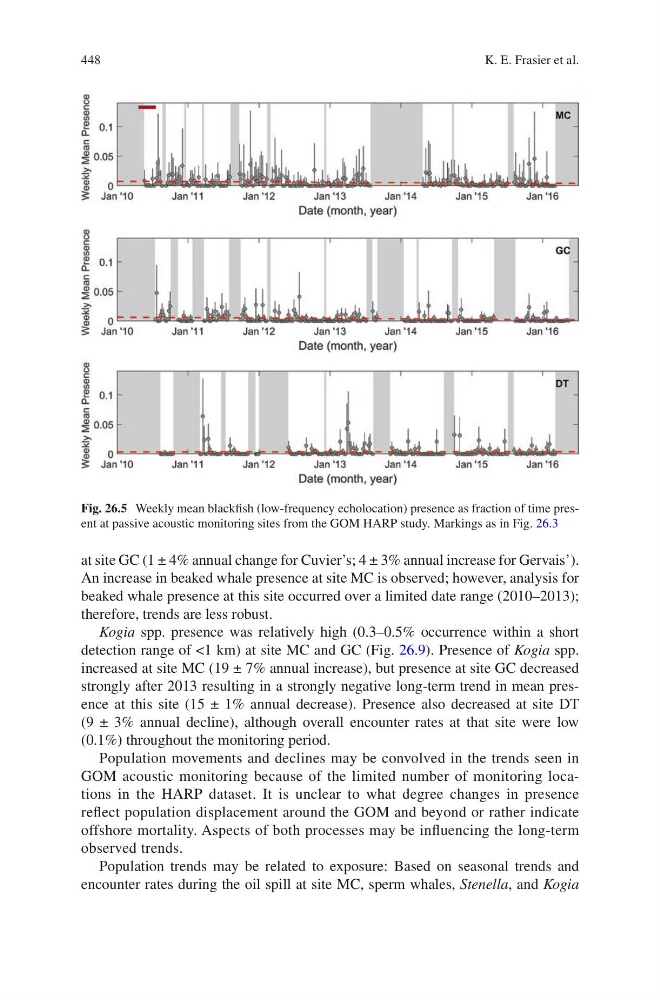
Fig. 26.5 Weekly mean blackfish (low-frequency echolocation) presence as fraction of time present at passive acoustic monitoring sites from the GOM HARP study. Markings as in Fig. 26.3
K. E. Frasier et al.
at site GC (1 ± 4% annual change for Cuvier’s; 4 ± 3% annual increase for Gervais’).
An increase in beaked whale presence at site MC is observed; however, analysis for
beaked whale presence at this site occurred over a limited date range (2010–2013);
therefore, trends are less robust.
Kogia spp. presence was relatively high (0.3–0.5% occurrence within a short
detection range of <1 km) at site MC and GC (Fig. 26.9). Presence of Kogia spp.
increased at site MC (19 ± 7% annual increase), but presence at site GC decreased
strongly after 2013 resulting in a strongly negative long-term trend in mean presence at this site (15 ± 1% annual decrease). Presence also decreased at site DT
(9 ± 3% annual decline), although overall encounter rates at that site were low
(0.1%) throughout the monitoring period.
Population movements and declines may be convolved in the trends seen in
GOM acoustic monitoring because of the limited number of monitoring locations in the HARP dataset. It is unclear to what degree changes in presence
reflect population displacement around the GOM and beyond or rather indicate
offshore mortality. Aspects of both processes may be influencing the long-term
observed trends.
Population trends may be related to exposure: Based on seasonal trends and
encounter rates during the oil spill at site MC, sperm whales, Stenella, and Kogia
Fig. 26.5 Weekly mean blackfish (low-frequency echolocation) presence as fraction of time present at passive acoustic monitoring sites from the GOM HARP study. Markings as in Fig. 26.3
K. E. Frasier et al.