

447
Stenella species and blackfish (presumably short-finned pilot whales) species
were associated with mid- and low-frequency echolocation, respectively. Stenella
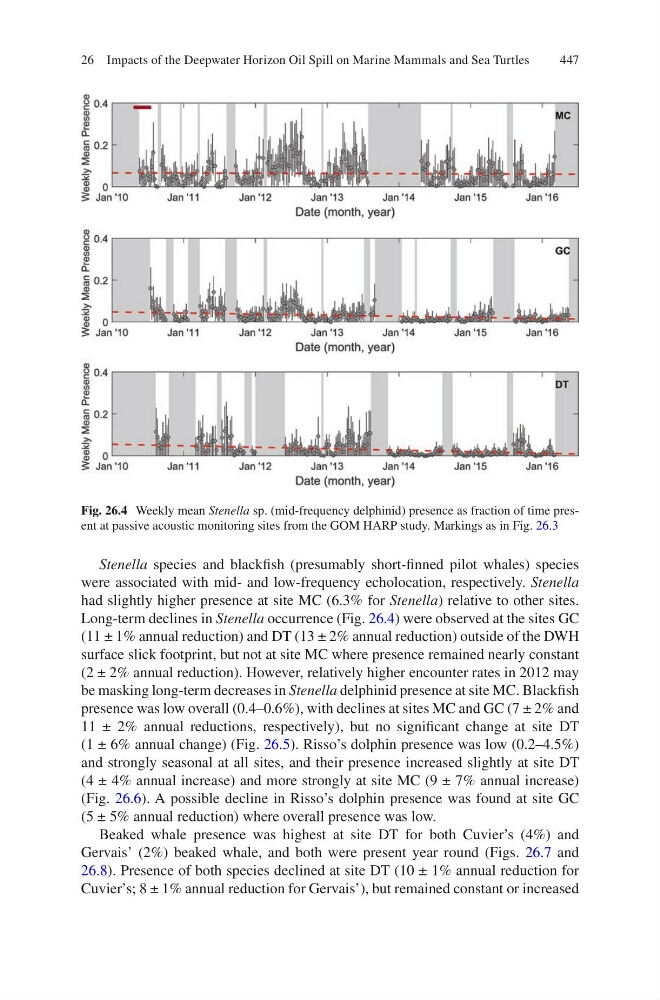
had slightly higher presence at site MC (6.3% for Stenella) relative to other sites.
Long-term declines in Stenella occurrence (Fig. 26.4) were observed at the sites GC
(11 ± 1% annual reduction) and DT (13 ± 2% annual reduction) outside of the DWH
surface slick footprint, but not at site MC where presence remained nearly constant
(2 ± 2% annual reduction). However, relatively higher encounter rates in 2012 may
be masking long-term decreases in Stenella delphinid presence at site MC. Blackfish
presence was low overall (0.4–0.6%), with declines at sites MC and GC (7 ± 2% and
11 ± 2% annual reductions, respectively), but no significant change at site DT
(1 ± 6% annual change) (Fig. 26.5). Risso’s dolphin presence was low (0.2–4.5%)
and strongly seasonal at all sites, and their presence increased slightly at site DT
(4 ± 4% annual increase) and more strongly at site MC (9 ± 7% annual increase)
(Fig. 26.6). A possible decline in Risso’s dolphin presence was found at site GC
(5 ± 5% annual reduction) where overall presence was low.
Beaked whale presence was highest at site DT for both Cuvier’s (4%) and
Gervais’ (2%) beaked whale, and both were present year round (Figs. 26.7 and
26.8). Presence of both species declined at site DT (10 ± 1% annual reduction for
Cuvier’s; 8 ± 1% annual reduction for Gervais’), but remained constant or increased
Fig. 26.4 Weekly mean Stenella sp. (mid-frequency delphinid) presence as fraction of time present at passive acoustic monitoring sites from the GOM HARP study. Markings as in Fig. 26.3
26 Impacts of the Deepwater Horizon Oil Spill on Marine Mammals and Sea Turtles
Stenella species and blackfish (presumably short-finned pilot whales) species
were associated with mid- and low-frequency echolocation, respectively. Stenella
had slightly higher presence at site MC (6.3% for Stenella) relative to other sites.
Long-term declines in Stenella occurrence (Fig. 26.4) were observed at the sites GC
(11 ± 1% annual reduction) and DT (13 ± 2% annual reduction) outside of the DWH
surface slick footprint, but not at site MC where presence remained nearly constant
(2 ± 2% annual reduction). However, relatively higher encounter rates in 2012 may
be masking long-term decreases in Stenella delphinid presence at site MC. Blackfish
presence was low overall (0.4–0.6%), with declines at sites MC and GC (7 ± 2% and
11 ± 2% annual reductions, respectively), but no significant change at site DT
(1 ± 6% annual change) (Fig. 26.5). Risso’s dolphin presence was low (0.2–4.5%)
and strongly seasonal at all sites, and their presence increased slightly at site DT
(4 ± 4% annual increase) and more strongly at site MC (9 ± 7% annual increase)
(Fig. 26.6). A possible decline in Risso’s dolphin presence was found at site GC
(5 ± 5% annual reduction) where overall presence was low.
Beaked whale presence was highest at site DT for both Cuvier’s (4%) and
Gervais’ (2%) beaked whale, and both were present year round (Figs. 26.7 and
26.8). Presence of both species declined at site DT (10 ± 1% annual reduction for
Cuvier’s; 8 ± 1% annual reduction for Gervais’), but remained constant or increased
Fig. 26.4 Weekly mean Stenella sp. (mid-frequency delphinid) presence as fraction of time present at passive acoustic monitoring sites from the GOM HARP study. Markings as in Fig. 26.3
26 Impacts of the Deepwater Horizon Oil Spill on Marine Mammals and Sea Turtles