

423
25.6 Shrimps
Shrimps are the most important fishery resources in the GoM due to their economic
and social value. The main shrimp species throughout the GoM are brown, pink,
and white shrimp. These species have been subjected both inshore and offshore to
relatively high fishing effort since the last century by both artisanal and industrial
fisheries, and many of their stocks are fully or overexploited in the GoM. The potential impact of the two mega oil spills on shrimp fisheries was of great concern during
each event. The most important fisheries potentially impacted by the Ixtoc 1 and
DWH oil spills were pink and white shrimp, because they are the most important
shrimp fisheries in the oil spill areas.
Shrimps have an annual life cycle, spawning throughout much of the year, with
two seasonal reproduction peaks that result in two main generation peaks in the
year: late spring-early summer and autumn (Gracia et al. 1997). Sexual maturity is
reached at an average of 8 months, and the species have relatively high fecundity.
Spawning occurs offshore in the pelagic environment where larvae are dispersed by
current patterns for approximately 2 weeks. Afterward, they enter estuaries and
coastal lagoons as post-larvae, remain in these nursery areas for 3–4 months as juveniles, and then migrate to the marine environment (Gracia 1992). Shrimp juvenile
abundance in the nursery grounds is critical for determining the recruitment to adult
stocks offshore. Due to shrimp life history characteristics, the population renews
annually.
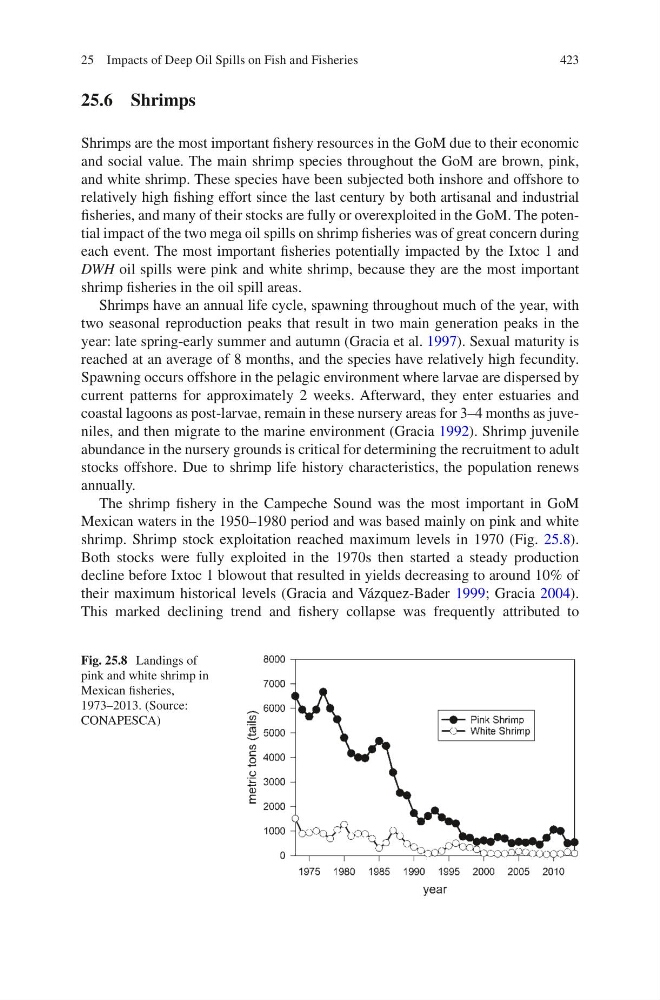
The shrimp fishery in the Campeche Sound was the most important in GoM
Mexican waters in the 1950–1980 period and was based mainly on pink and white
shrimp. Shrimp stock exploitation reached maximum levels in 1970 (Fig. 25.8).
Both stocks were fully exploited in the 1970s then started a steady production
decline before Ixtoc 1 blowout that resulted in yields decreasing to around 10% of
their maximum historical levels (Gracia and Vázquez-Bader 1999; Gracia 2004).
This marked declining trend and fishery collapse was frequently attributed to
Fig. 25.8 Landings of
pink and white shrimp in
Mexican fisheries,
1973–2013. (Source:
CONAPESCA)
25 Impacts of Deep Oil Spills on Fish and Fisheries
25.6 Shrimps
Shrimps are the most important fishery resources in the GoM due to their economic
and social value. The main shrimp species throughout the GoM are brown, pink,
and white shrimp. These species have been subjected both inshore and offshore to
relatively high fishing effort since the last century by both artisanal and industrial
fisheries, and many of their stocks are fully or overexploited in the GoM. The potential impact of the two mega oil spills on shrimp fisheries was of great concern during
each event. The most important fisheries potentially impacted by the Ixtoc 1 and
DWH oil spills were pink and white shrimp, because they are the most important
shrimp fisheries in the oil spill areas.
Shrimps have an annual life cycle, spawning throughout much of the year, with
two seasonal reproduction peaks that result in two main generation peaks in the
year: late spring-early summer and autumn (Gracia et al. 1997). Sexual maturity is
reached at an average of 8 months, and the species have relatively high fecundity.
Spawning occurs offshore in the pelagic environment where larvae are dispersed by
current patterns for approximately 2 weeks. Afterward, they enter estuaries and
coastal lagoons as post-larvae, remain in these nursery areas for 3–4 months as juveniles, and then migrate to the marine environment (Gracia 1992). Shrimp juvenile
abundance in the nursery grounds is critical for determining the recruitment to adult
stocks offshore. Due to shrimp life history characteristics, the population renews
annually.
The shrimp fishery in the Campeche Sound was the most important in GoM
Mexican waters in the 1950–1980 period and was based mainly on pink and white
shrimp. Shrimp stock exploitation reached maximum levels in 1970 (Fig. 25.8).
Both stocks were fully exploited in the 1970s then started a steady production
decline before Ixtoc 1 blowout that resulted in yields decreasing to around 10% of
their maximum historical levels (Gracia and Vázquez-Bader 1999; Gracia 2004).
This marked declining trend and fishery collapse was frequently attributed to
Fig. 25.8 Landings of
pink and white shrimp in
Mexican fisheries,
1973–2013. (Source:
CONAPESCA)
25 Impacts of Deep Oil Spills on Fish and Fisheries