

424
long- term effects of Ixtoc 1 oil spill and/or combined impacts of chronic pollution
related to oil industry activities in the Campeche Sound. However, in retrospect,
overfishing seems to be the main driving factor responsible for the decline. White
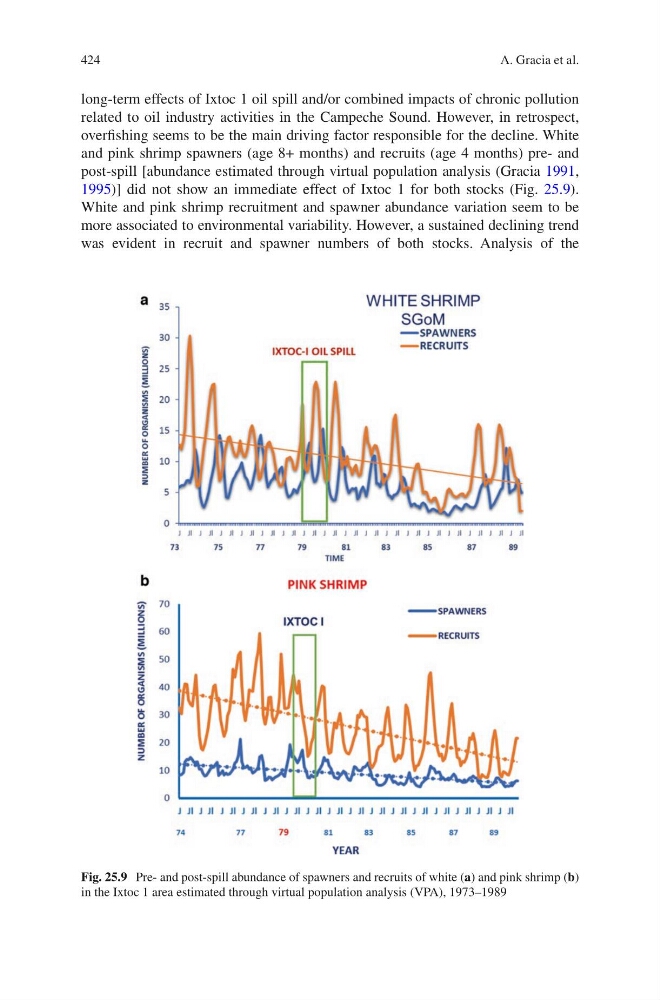
and pink shrimp spawners (age 8+ months) and recruits (age 4 months) pre- and
post-spill [abundance estimated through virtual population analysis (Gracia 1991,
1995)] did not show an immediate effect of Ixtoc 1 for both stocks (Fig. 25.9).
White and pink shrimp recruitment and spawner abundance variation seem to be
more associated to environmental variability. However, a sustained declining trend
was evident in recruit and spawner numbers of both stocks. Analysis of the
Fig. 25.9 Pre- and post-spill abundance of spawners and recruits of white (a) and pink shrimp (b)
in the Ixtoc 1 area estimated through virtual population analysis (VPA), 1973–1989
A. Gracia et al.
long- term effects of Ixtoc 1 oil spill and/or combined impacts of chronic pollution
related to oil industry activities in the Campeche Sound. However, in retrospect,
overfishing seems to be the main driving factor responsible for the decline. White
and pink shrimp spawners (age 8+ months) and recruits (age 4 months) pre- and
post-spill [abundance estimated through virtual population analysis (Gracia 1991,
1995)] did not show an immediate effect of Ixtoc 1 for both stocks (Fig. 25.9).
White and pink shrimp recruitment and spawner abundance variation seem to be
more associated to environmental variability. However, a sustained declining trend
was evident in recruit and spawner numbers of both stocks. Analysis of the
Fig. 25.9 Pre- and post-spill abundance of spawners and recruits of white (a) and pink shrimp (b)
in the Ixtoc 1 area estimated through virtual population analysis (VPA), 1973–1989
A. Gracia et al.