

131
8.4 Discussion
8.4.1 Effects of Pressure, Temperature, and Alkylation
on Partitioning of Organics
During a submarine oil spill as the oil moves buoyantly through the water column,
the gases dissolved in the oil (methane, ethane, propane, etc.) exsolve, creating a
three-phase system of oil, gas, and water containing distributed oil and gas components, whose concentration relationships are defined by a variety of partition
ratios: [X] oil /[X] water , [X] oil /[X] gas , and [X] water /[X] gas . This chapter considers the partitioning behavior of the biphasic equilibria between gas-charged oil and the water
phase under submarine oil spill conditions. The partition ratios (P ow ) of BTEX
compounds were found to increase up to three times, with increase in pressure
from 2 to 15 MPa (Jaggi et al. 2017) both with and without dispersant application.
However, only minor variations were observed in the P ow values (within the error
bars) for the experiments conducted with dead oil, as the pressure was increased
from 0.5 to 2.5 MPa at 20 °C (Jaggi et al. 2017).
Using the pressure/volume/temperature simulation software PVT-SIM, the
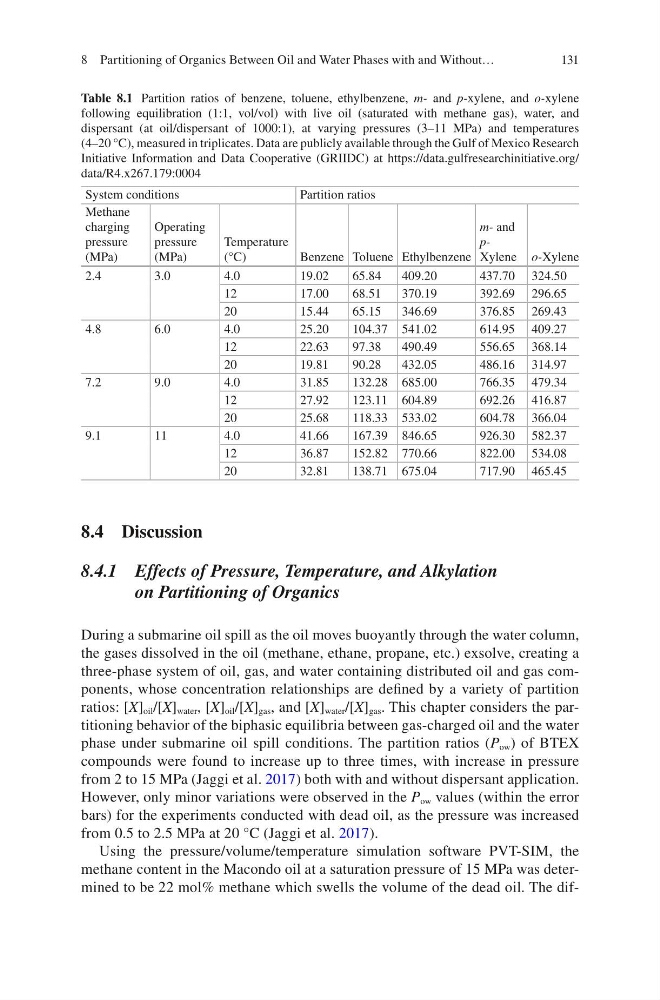
methane content in the Macondo oil at a saturation pressure of 15 MPa was determined to be 22 mol% methane which swells the volume of the dead oil. The difTable 8.1 Partition ratios of benzene, toluene, ethylbenzene, m- and p-xylene, and o-xylene
following equilibration (1:1, vol/vol) with live oil (saturated with methane gas), water, and
dispersant (at oil/dispersant of 1000:1), at varying pressures (3–11 MPa) and temperatures
(4–20 °C), measured in triplicates. Data are publicly available through the Gulf of Mexico Research
Initiative Information and Data Cooperative (GRIIDC) at https://data.gulfresearchinitiative.org/
data/R4.x267.179:0004
System conditions
Partition ratios
Methane
charging
pressure
(MPa)
Operating
pressure
(MPa)
Temperature
(°C)
Benzene Toluene Ethylbenzene
m- and
pXylene o-Xylene
2.4
3.0
4.0
19.02
65.84
409.20
437.70 324.50
12
17.00
68.51
370.19
392.69 296.65
20
15.44
65.15
346.69
376.85 269.43
4.8
6.0
4.0
25.20
104.37 541.02
614.95 409.27
12
22.63
97.38
490.49
556.65 368.14
20
19.81
90.28
432.05
486.16 314.97
7.2
9.0
4.0
31.85
132.28 685.00
766.35 479.34
12
27.92
123.11 604.89
692.26 416.87
20
25.68
118.33 533.02
604.78 366.04
9.1
11
4.0
41.66
167.39 846.65
926.30 582.37
12
36.87
152.82 770.66
822.00 534.08
20
32.81
138.71 675.04
717.90 465.45
8 Partitioning of Organics Between Oil and Water Phases with and Without…
8.4 Discussion
8.4.1 Effects of Pressure, Temperature, and Alkylation
on Partitioning of Organics
During a submarine oil spill as the oil moves buoyantly through the water column,
the gases dissolved in the oil (methane, ethane, propane, etc.) exsolve, creating a
three-phase system of oil, gas, and water containing distributed oil and gas components, whose concentration relationships are defined by a variety of partition
ratios: [X] oil /[X] water , [X] oil /[X] gas , and [X] water /[X] gas . This chapter considers the partitioning behavior of the biphasic equilibria between gas-charged oil and the water
phase under submarine oil spill conditions. The partition ratios (P ow ) of BTEX
compounds were found to increase up to three times, with increase in pressure
from 2 to 15 MPa (Jaggi et al. 2017) both with and without dispersant application.
However, only minor variations were observed in the P ow values (within the error
bars) for the experiments conducted with dead oil, as the pressure was increased
from 0.5 to 2.5 MPa at 20 °C (Jaggi et al. 2017).
Using the pressure/volume/temperature simulation software PVT-SIM, the
methane content in the Macondo oil at a saturation pressure of 15 MPa was determined to be 22 mol% methane which swells the volume of the dead oil. The difTable 8.1 Partition ratios of benzene, toluene, ethylbenzene, m- and p-xylene, and o-xylene
following equilibration (1:1, vol/vol) with live oil (saturated with methane gas), water, and
dispersant (at oil/dispersant of 1000:1), at varying pressures (3–11 MPa) and temperatures
(4–20 °C), measured in triplicates. Data are publicly available through the Gulf of Mexico Research
Initiative Information and Data Cooperative (GRIIDC) at https://data.gulfresearchinitiative.org/
data/R4.x267.179:0004
System conditions
Partition ratios
Methane
charging
pressure
(MPa)
Operating
pressure
(MPa)
Temperature
(°C)
Benzene Toluene Ethylbenzene
m- and
pXylene o-Xylene
2.4
3.0
4.0
19.02
65.84
409.20
437.70 324.50
12
17.00
68.51
370.19
392.69 296.65
20
15.44
65.15
346.69
376.85 269.43
4.8
6.0
4.0
25.20
104.37 541.02
614.95 409.27
12
22.63
97.38
490.49
556.65 368.14
20
19.81
90.28
432.05
486.16 314.97
7.2
9.0
4.0
31.85
132.28 685.00
766.35 479.34
12
27.92
123.11 604.89
692.26 416.87
20
25.68
118.33 533.02
604.78 366.04
9.1
11
4.0
41.66
167.39 846.65
926.30 582.37
12
36.87
152.82 770.66
822.00 534.08
20
32.81
138.71 675.04
717.90 465.45
8 Partitioning of Organics Between Oil and Water Phases with and Without…