

132
ference in the volume between live oil and dead oil was calculated to be up to 33%
at 20 °C. Since the differences between the calculated partition ratios of BTEX
between live and dead oil at 15 MPa were measured to be greater than 33%, the
swelling cannot account for the entirety of this behavior. The observed approximate tripling of partition ratios at 15 MPa with live oil relative to the partition
ratio at atmospheric pressure suggests that beyond swelling, there are other factors
at play. As expected from engineering considerations, with an increase in gas
charging pressure in the hydropneumatic accumulator, the amount of dissolved
solution gas (in this case methane) in the oil increases. The pressure-dependent
addition of methane to oil would principally reduce the oil polarity, increasing the
polarity contrast between oil and water. This increased contrast would then reduce
the tendency of investigated organics to concentrate in the water phase, causing an
increase in their partition ratios with higher system pressure. As indicated however, this effect would primarily be driven by pressure-dependent oil compositional change, as much more gas dissolves in the oil than in the water with
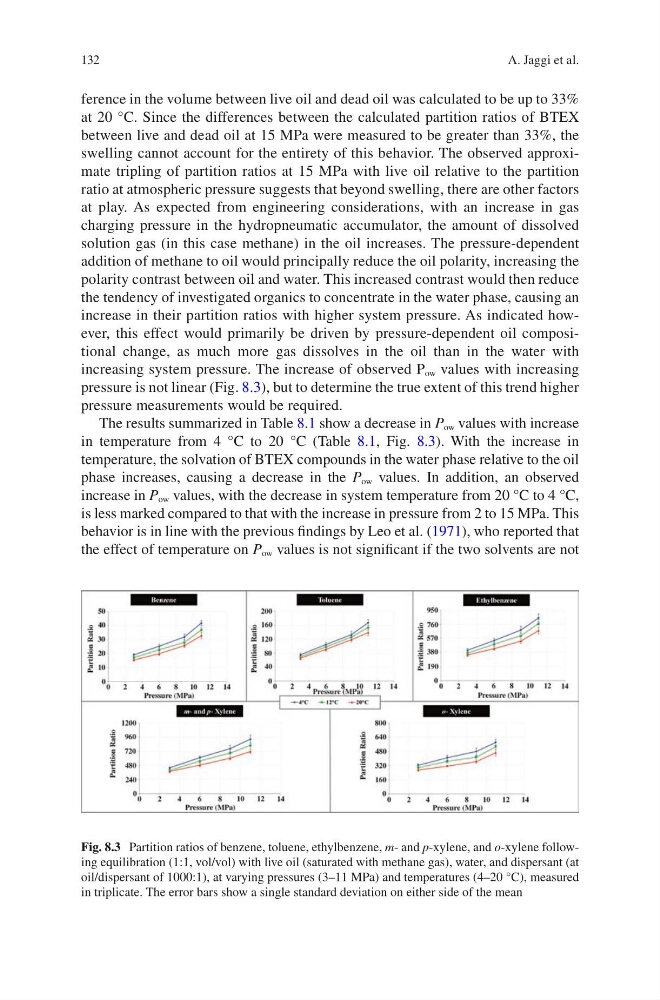
increasing system pressure. The increase of observed P ow values with increasing
pressure is not linear (Fig. 8.3), but to determine the true extent of this trend higher
pressure measurements would be required.
The results summarized in Table 8.1 show a decrease in P ow values with increase
in temperature from 4 °C to 20 °C (Table 8.1, Fig. 8.3). With the increase in
temperature, the solvation of BTEX compounds in the water phase relative to the oil
phase increases, causing a decrease in the P ow values. In addition, an observed
increase in P ow values, with the decrease in system temperature from 20 °C to 4 °C,
is less marked compared to that with the increase in pressure from 2 to 15 MPa. This
behavior is in line with the previous findings by Leo et al. (1971), who reported that
the effect of temperature on P ow values is not significant if the two solvents are not
Fig. 8.3 Partition ratios of benzene, toluene, ethylbenzene, m- and p-xylene, and o-xylene following equilibration (1:1, vol/vol) with live oil (saturated with methane gas), water, and dispersant (at
oil/dispersant of 1000:1), at varying pressures (3–11 MPa) and temperatures (4–20 °C), measured
in triplicate. The error bars show a single standard deviation on either side of the mean
A. Jaggi et al.
ference in the volume between live oil and dead oil was calculated to be up to 33%
at 20 °C. Since the differences between the calculated partition ratios of BTEX
between live and dead oil at 15 MPa were measured to be greater than 33%, the
swelling cannot account for the entirety of this behavior. The observed approximate tripling of partition ratios at 15 MPa with live oil relative to the partition
ratio at atmospheric pressure suggests that beyond swelling, there are other factors
at play. As expected from engineering considerations, with an increase in gas
charging pressure in the hydropneumatic accumulator, the amount of dissolved
solution gas (in this case methane) in the oil increases. The pressure-dependent
addition of methane to oil would principally reduce the oil polarity, increasing the
polarity contrast between oil and water. This increased contrast would then reduce
the tendency of investigated organics to concentrate in the water phase, causing an
increase in their partition ratios with higher system pressure. As indicated however, this effect would primarily be driven by pressure-dependent oil compositional change, as much more gas dissolves in the oil than in the water with
increasing system pressure. The increase of observed P ow values with increasing
pressure is not linear (Fig. 8.3), but to determine the true extent of this trend higher
pressure measurements would be required.
The results summarized in Table 8.1 show a decrease in P ow values with increase
in temperature from 4 °C to 20 °C (Table 8.1, Fig. 8.3). With the increase in
temperature, the solvation of BTEX compounds in the water phase relative to the oil
phase increases, causing a decrease in the P ow values. In addition, an observed
increase in P ow values, with the decrease in system temperature from 20 °C to 4 °C,
is less marked compared to that with the increase in pressure from 2 to 15 MPa. This
behavior is in line with the previous findings by Leo et al. (1971), who reported that
the effect of temperature on P ow values is not significant if the two solvents are not
Fig. 8.3 Partition ratios of benzene, toluene, ethylbenzene, m- and p-xylene, and o-xylene following equilibration (1:1, vol/vol) with live oil (saturated with methane gas), water, and dispersant (at
oil/dispersant of 1000:1), at varying pressures (3–11 MPa) and temperatures (4–20 °C), measured
in triplicate. The error bars show a single standard deviation on either side of the mean
A. Jaggi et al.