

130
chromatography- mass spectrometry (GC-MS) to minimize any evaporative loss
during sample handling. The equilibrated oil samples from the partition device
were also spiked with ethylbenzene-d10, with 50 μL of this oil subsequently being
diluted with 150 μL of dichloromethane and directly analyzed by GC-MS. All samples were analyzed in triplicate. The BTEX compounds were analyzed using an
Agilent 6890 N gas chromatograph equipped with a quadrupole mass spectrometer
(HP5973) using selected-ion monitoring mode (m/z 78, 91, and 98). The instrumental method is described in Jaggi et al. (2017).
8.3 Results
8.3.1 Partition Ratio Calculations
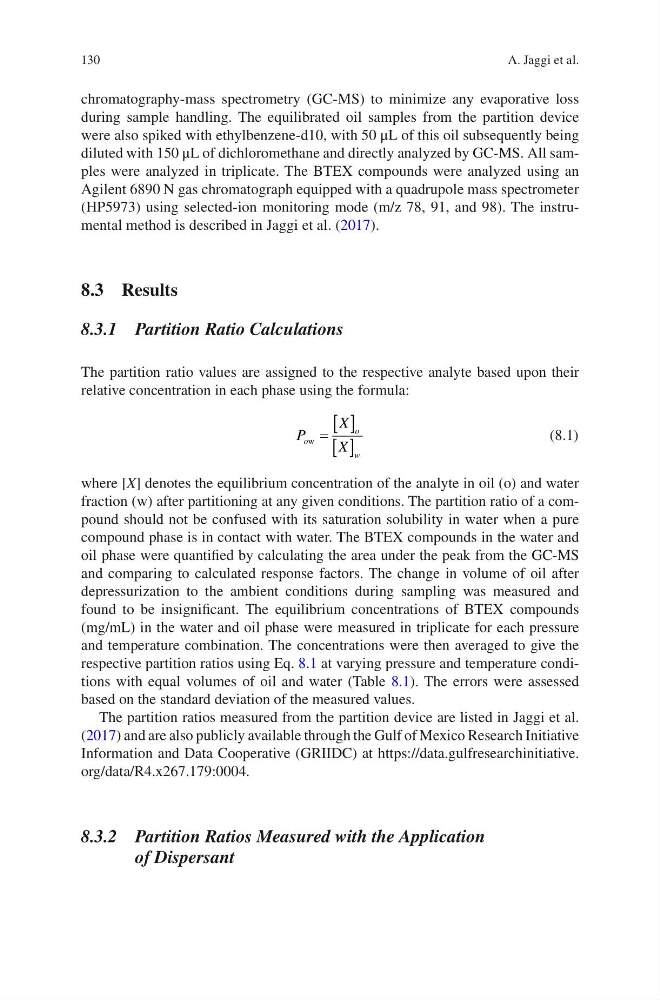
The partition ratio values are assigned to the respective analyte based upon their
relative concentration in each phase using the formula:
P
X
X
o
o
w
w =
[ ]
[ ]
(8.1)
where [X] denotes the equilibrium concentration of the analyte in oil (o) and water
fraction (w) after partitioning at any given conditions. The partition ratio of a compound should not be confused with its saturation solubility in water when a pure
compound phase is in contact with water. The BTEX compounds in the water and
oil phase were quantified by calculating the area under the peak from the GC-MS
and comparing to calculated response factors. The change in volume of oil after
depressurization to the ambient conditions during sampling was measured and
found to be insignificant. The equilibrium concentrations of BTEX compounds
(mg/mL) in the water and oil phase were measured in triplicate for each pressure
and temperature combination. The concentrations were then averaged to give the
respective partition ratios using Eq. 8.1 at varying pressure and temperature conditions with equal volumes of oil and water (Table 8.1). The errors were assessed
based on the standard deviation of the measured values.
The partition ratios measured from the partition device are listed in Jaggi et al.
(2017) and are also publicly available through the Gulf of Mexico Research Initiative
Information and Data Cooperative (GRIIDC) at https://data.gulfresearchinitiative.
org/data/R4.x267.179:0004.
8.3.2 Partition Ratios Measured with the Application
of Dispersant
A. Jaggi et al.
chromatography- mass spectrometry (GC-MS) to minimize any evaporative loss
during sample handling. The equilibrated oil samples from the partition device
were also spiked with ethylbenzene-d10, with 50 μL of this oil subsequently being
diluted with 150 μL of dichloromethane and directly analyzed by GC-MS. All samples were analyzed in triplicate. The BTEX compounds were analyzed using an
Agilent 6890 N gas chromatograph equipped with a quadrupole mass spectrometer
(HP5973) using selected-ion monitoring mode (m/z 78, 91, and 98). The instrumental method is described in Jaggi et al. (2017).
8.3 Results
8.3.1 Partition Ratio Calculations
The partition ratio values are assigned to the respective analyte based upon their
relative concentration in each phase using the formula:
P
X
X
o
o
w
w =
[ ]
[ ]
(8.1)
where [X] denotes the equilibrium concentration of the analyte in oil (o) and water
fraction (w) after partitioning at any given conditions. The partition ratio of a compound should not be confused with its saturation solubility in water when a pure
compound phase is in contact with water. The BTEX compounds in the water and
oil phase were quantified by calculating the area under the peak from the GC-MS
and comparing to calculated response factors. The change in volume of oil after
depressurization to the ambient conditions during sampling was measured and
found to be insignificant. The equilibrium concentrations of BTEX compounds
(mg/mL) in the water and oil phase were measured in triplicate for each pressure
and temperature combination. The concentrations were then averaged to give the
respective partition ratios using Eq. 8.1 at varying pressure and temperature conditions with equal volumes of oil and water (Table 8.1). The errors were assessed
based on the standard deviation of the measured values.
The partition ratios measured from the partition device are listed in Jaggi et al.
(2017) and are also publicly available through the Gulf of Mexico Research Initiative
Information and Data Cooperative (GRIIDC) at https://data.gulfresearchinitiative.
org/data/R4.x267.179:0004.
8.3.2 Partition Ratios Measured with the Application
of Dispersant
A. Jaggi et al.