

Result and discussion
64
6- Fourier-transform infrared spectroscopy (FT-IR) analysis
The FT-IR analytical technique was employed to investigate the functional groups present in
chitin and chitosan. The analysis was conducted at SaidalLab, using the PerkinElmer Spectrum
version 10.4.4 spectrometer, covering a frequency range of 4000-450 cm⁻¹. The obtained results
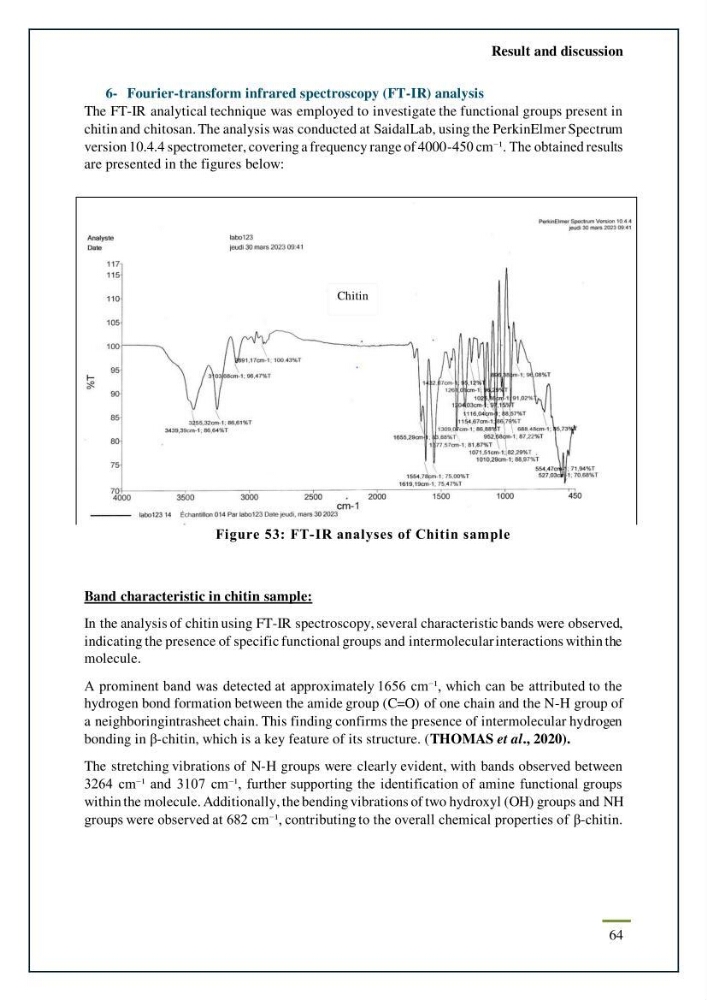
are presented in the figures below:
Band characteristic in chitin sample:
In the analysis of chitin using FT-IR spectroscopy, several characteristic bands were observed,
indicating the presence of specific functional groups and intermolecular interactions within the
molecule.
A prominent band was detected at approximately 1656 cm⁻¹, which can be attributed to the
hydrogen bond formation between the amide group (C=O) of one chain and the N-H group of
a neighboringintrasheet chain. This finding confirms the presence of intermolecular hydrogen
bonding in β-chitin, which is a key feature of its structure. (THOMAS et al., 2020).
The stretching vibrations of N-H groups were clearly evident, with bands observed between
3264 cm⁻¹ and 3107 cm⁻¹, further supporting the identification of amine functional groups
within the molecule. Additionally, the bending vibrations of two hydroxyl (OH) groups and NH
groups were observed at 682 cm⁻¹, contributing to the overall chemical properties of β-chitin.
Figure 53: FT-IR analyses of Chitin sample
Chitin
64
6- Fourier-transform infrared spectroscopy (FT-IR) analysis
The FT-IR analytical technique was employed to investigate the functional groups present in
chitin and chitosan. The analysis was conducted at SaidalLab, using the PerkinElmer Spectrum
version 10.4.4 spectrometer, covering a frequency range of 4000-450 cm⁻¹. The obtained results
are presented in the figures below:
Band characteristic in chitin sample:
In the analysis of chitin using FT-IR spectroscopy, several characteristic bands were observed,
indicating the presence of specific functional groups and intermolecular interactions within the
molecule.
A prominent band was detected at approximately 1656 cm⁻¹, which can be attributed to the
hydrogen bond formation between the amide group (C=O) of one chain and the N-H group of
a neighboringintrasheet chain. This finding confirms the presence of intermolecular hydrogen
bonding in β-chitin, which is a key feature of its structure. (THOMAS et al., 2020).
The stretching vibrations of N-H groups were clearly evident, with bands observed between
3264 cm⁻¹ and 3107 cm⁻¹, further supporting the identification of amine functional groups
within the molecule. Additionally, the bending vibrations of two hydroxyl (OH) groups and NH
groups were observed at 682 cm⁻¹, contributing to the overall chemical properties of β-chitin.
Figure 53: FT-IR analyses of Chitin sample
Chitin