

Result and discussion
65
Characteristics IR-bands of chitosan samples:
The FT-IR spectrum of the chitosan sample reveals several characteristic IR bands associated
with its chemical structure. The prominent peak observed at approximately 1650 cm⁻¹
corresponds to the amide I band, indicating the presence of the C=O stretching vibration in the
chitosan backbone. This band confirms the presence of acetyl groups in the chitosan molecule
suggesting effective deacetylation of chitosan. The peaks observed at around 1372 cm⁻¹ can be
assigned to the amide II and amide III bands, respectively, further supporting the identification
of amide functional groups in chitosan.
The deacetylation process involves the removal or conversion of acetyl groups to amino groups,
resulting in a higher degree of deacetylation in chitosan (MARGUERITE and FRANCISCO,
2019). As a consequence, the intensity or peak height of the bands at 3260 cm⁻¹ and 3107 cm⁻¹
decreases significantly or even disappears completely. This indicates that the N-H stretching
vibrations originating from the amino groups become less prominent or negligible, suggesting
a reduced presence of acetyl groups and an increase in the number of amino groups. (THOMAS
et al., 2020)
7- Degree of deacetylation of chitosan
Based on the FT-IR spectrum, a proposed equation by SABNIS and BLOCK (1997), and
several observations, can be inferred that the chitosan extracted from shrimp shells has a degree
of deacetylation (DDA) of approximately 71%.
The DDA results obtained in this study for chitosan are superior to the findings reported by
NURHAYATI and TANG in 2022. In their study, they conducted four experiments on chitin
deacetylation, resulting in a DDA range of 55% to 67%.
In comparison, the DDA value obtained in this study, approximately 71%, indicates a higher
level of deacetylation, suggesting a greater removal or conversion of acetyl groups to amino
groups in the chitosan sample. These results highlight the efficacy and success of the
deacetylation process in achieving a higher DDA in the chitosan extracted from shrimp shells,
which can have implications for its potential applications in various fields.
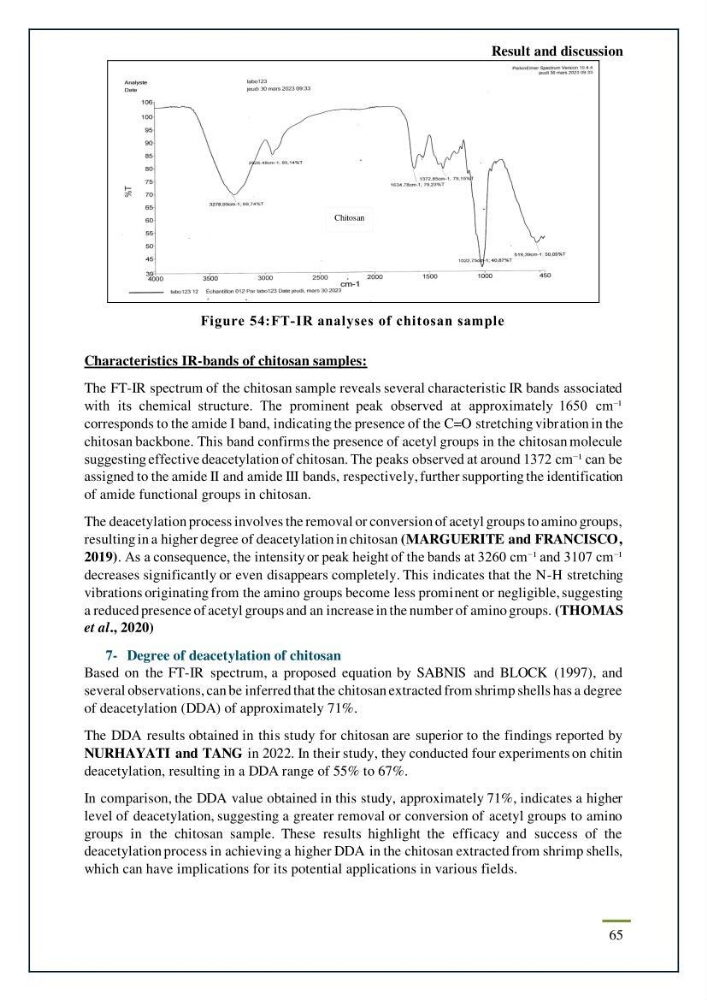
Figure 54:FT-IR analyses of chitosan sample
Chitosan
65
Characteristics IR-bands of chitosan samples:
The FT-IR spectrum of the chitosan sample reveals several characteristic IR bands associated
with its chemical structure. The prominent peak observed at approximately 1650 cm⁻¹
corresponds to the amide I band, indicating the presence of the C=O stretching vibration in the
chitosan backbone. This band confirms the presence of acetyl groups in the chitosan molecule
suggesting effective deacetylation of chitosan. The peaks observed at around 1372 cm⁻¹ can be
assigned to the amide II and amide III bands, respectively, further supporting the identification
of amide functional groups in chitosan.
The deacetylation process involves the removal or conversion of acetyl groups to amino groups,
resulting in a higher degree of deacetylation in chitosan (MARGUERITE and FRANCISCO,
2019). As a consequence, the intensity or peak height of the bands at 3260 cm⁻¹ and 3107 cm⁻¹
decreases significantly or even disappears completely. This indicates that the N-H stretching
vibrations originating from the amino groups become less prominent or negligible, suggesting
a reduced presence of acetyl groups and an increase in the number of amino groups. (THOMAS
et al., 2020)
7- Degree of deacetylation of chitosan
Based on the FT-IR spectrum, a proposed equation by SABNIS and BLOCK (1997), and
several observations, can be inferred that the chitosan extracted from shrimp shells has a degree
of deacetylation (DDA) of approximately 71%.
The DDA results obtained in this study for chitosan are superior to the findings reported by
NURHAYATI and TANG in 2022. In their study, they conducted four experiments on chitin
deacetylation, resulting in a DDA range of 55% to 67%.
In comparison, the DDA value obtained in this study, approximately 71%, indicates a higher
level of deacetylation, suggesting a greater removal or conversion of acetyl groups to amino
groups in the chitosan sample. These results highlight the efficacy and success of the
deacetylation process in achieving a higher DDA in the chitosan extracted from shrimp shells,
which can have implications for its potential applications in various fields.
Figure 54:FT-IR analyses of chitosan sample
Chitosan