

Result and discussion
63
5- Solubility
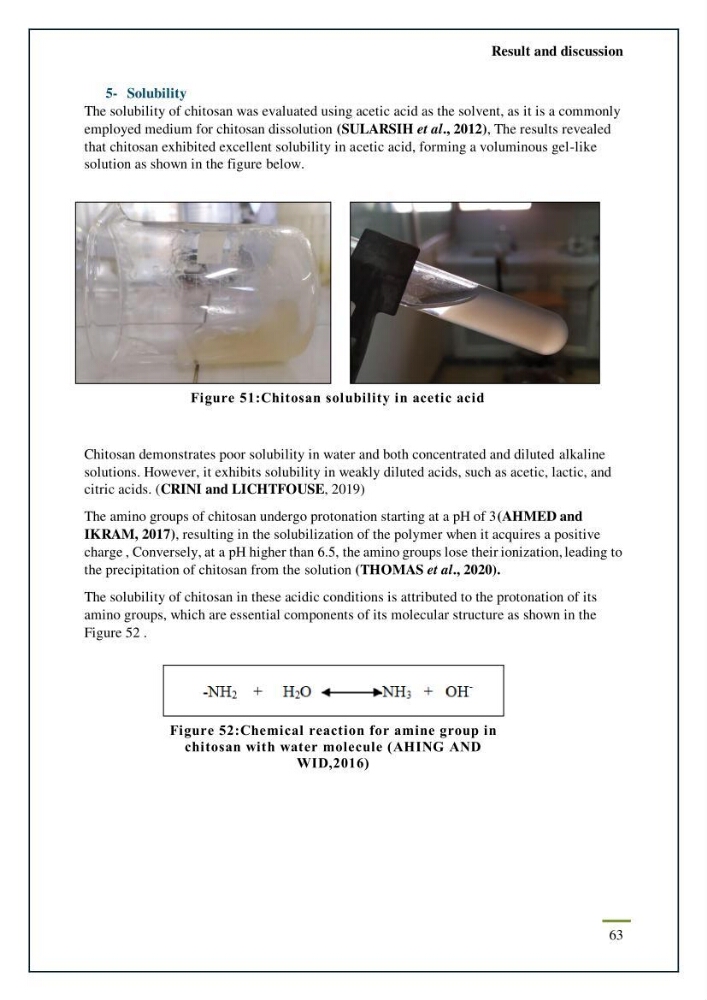
The solubility of chitosan was evaluated using acetic acid as the solvent, as it is a commonly
employed medium for chitosan dissolution (SULARSIH et al., 2012), The results revealed
that chitosan exhibited excellent solubility in acetic acid, forming a voluminous gel-like
solution as shown in the figure below.
Chitosan demonstrates poor solubility in water and both concentrated and diluted alkaline
solutions. However, it exhibits solubility in weakly diluted acids, such as acetic, lactic, and
citric acids. (CRINI and LICHTFOUSE, 2019)
The amino groups of chitosan undergo protonation starting at a pH of 3(AHMED and
IKRAM, 2017), resulting in the solubilization of the polymer when it acquires a positive
charge , Conversely, at a pH higher than 6.5, the amino groups lose their ionization, leading to
the precipitation of chitosan from the solution (THOMAS et al., 2020).
The solubility of chitosan in these acidic conditions is attributed to the protonation of its
amino groups, which are essential components of its molecular structure as shown in the
Figure 52 .
Figure 51:Chitosan solubility in acetic acid
Figure 52:Chemical reaction for amine group in
chitosan with water molecule (AHING AND
WID,2016)
63
5- Solubility
The solubility of chitosan was evaluated using acetic acid as the solvent, as it is a commonly
employed medium for chitosan dissolution (SULARSIH et al., 2012), The results revealed
that chitosan exhibited excellent solubility in acetic acid, forming a voluminous gel-like
solution as shown in the figure below.
Chitosan demonstrates poor solubility in water and both concentrated and diluted alkaline
solutions. However, it exhibits solubility in weakly diluted acids, such as acetic, lactic, and
citric acids. (CRINI and LICHTFOUSE, 2019)
The amino groups of chitosan undergo protonation starting at a pH of 3(AHMED and
IKRAM, 2017), resulting in the solubilization of the polymer when it acquires a positive
charge , Conversely, at a pH higher than 6.5, the amino groups lose their ionization, leading to
the precipitation of chitosan from the solution (THOMAS et al., 2020).
The solubility of chitosan in these acidic conditions is attributed to the protonation of its
amino groups, which are essential components of its molecular structure as shown in the
Figure 52 .
Figure 51:Chitosan solubility in acetic acid
Figure 52:Chemical reaction for amine group in
chitosan with water molecule (AHING AND
WID,2016)