

39
4. Water Binding Capacity (WBC)
WBC was calculated as follows:
4
í µí°í µí°í µí° % =
í µí°°í µí°í µí°í µí°í µí°« í µí°í µí°¨í µí°®í µí°§í µí° ( í µí° )
í µí°¢í µí°§í µí°¢í µí°í µí°¢í µí°í µí°¥ í µí°¬í µí°í µí°¦í µí°©í µí°¥í µí° í µí°°í µí°í µí°¢í µí° í µí°¡í µí° (í µí° )
× 100
5. Protein identification
The method used for protein identification is micro biuret method.
This method is based on the reaction between copper ions and peptide bonds in proteins, which
result in the formation of a purple-colored complex, the preparation of the solution is based on
pharmacopeia.
Preparation of the solution:
➢ Copper sulfate 5H2O:CuSO 4, 5H2O
➢ Double sodium and potassium tartrate: Double Na and K tartrate
➢ Soda:NaOH
➢ Potassium iodide: KI
➢ Distilled water
Procedure:
➢ Dissolve the copper sulphate and the tartrate in 250ml of distilled
water.
➢ Add the 15g of NaOH.
➢ Add the potassium iodide and complete to 500mL with distilled
water.
➢ Reagent to be kept in a dark place, in a polyethylene bottle
carefully closed.
Materials for the identification :
➢ Biuret reagent
➢ Chitosan solution
➢ Chitinpowder
➢ Egg white solution
➢ Distilled water
➢ Test tubes
B
A
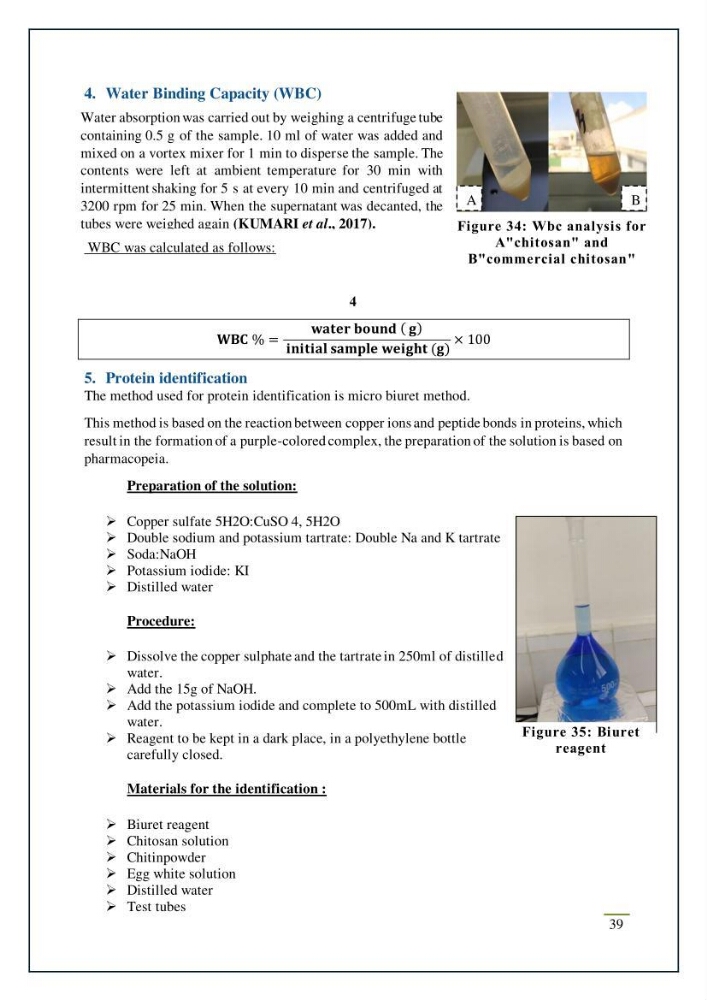
Water absorption was carried out by weighing a centrifuge tube
containing 0.5 g of the sample. 10 ml of water was added and
mixed on a vortex mixer for 1 min to disperse the sample. The
contents were left at ambient temperature for 30 min with
intermittent shaking for 5 s at every 10 min and centrifuged at
3200 rpm for 25 min. When the supernatant was decanted, the
tubes were weighed again (KUMARI et al., 2017).
Figure 35: Biuret
reagent
Figure 34: Wbc analysis for
A"chitosan" and
B"commercial chitosan"
4. Water Binding Capacity (WBC)
WBC was calculated as follows:
4
í µí°í µí°í µí° % =
í µí°°í µí°í µí°í µí°í µí°« í µí°í µí°¨í µí°®í µí°§í µí° ( í µí° )
í µí°¢í µí°§í µí°¢í µí°í µí°¢í µí°í µí°¥ í µí°¬í µí°í µí°¦í µí°©í µí°¥í µí° í µí°°í µí°í µí°¢í µí° í µí°¡í µí° (í µí° )
× 100
5. Protein identification
The method used for protein identification is micro biuret method.
This method is based on the reaction between copper ions and peptide bonds in proteins, which
result in the formation of a purple-colored complex, the preparation of the solution is based on
pharmacopeia.
Preparation of the solution:
➢ Copper sulfate 5H2O:CuSO 4, 5H2O
➢ Double sodium and potassium tartrate: Double Na and K tartrate
➢ Soda:NaOH
➢ Potassium iodide: KI
➢ Distilled water
Procedure:
➢ Dissolve the copper sulphate and the tartrate in 250ml of distilled
water.
➢ Add the 15g of NaOH.
➢ Add the potassium iodide and complete to 500mL with distilled
water.
➢ Reagent to be kept in a dark place, in a polyethylene bottle
carefully closed.
Materials for the identification :
➢ Biuret reagent
➢ Chitosan solution
➢ Chitinpowder
➢ Egg white solution
➢ Distilled water
➢ Test tubes
B
A
Water absorption was carried out by weighing a centrifuge tube
containing 0.5 g of the sample. 10 ml of water was added and
mixed on a vortex mixer for 1 min to disperse the sample. The
contents were left at ambient temperature for 30 min with
intermittent shaking for 5 s at every 10 min and centrifuged at
3200 rpm for 25 min. When the supernatant was decanted, the
tubes were weighed again (KUMARI et al., 2017).
Figure 35: Biuret
reagent
Figure 34: Wbc analysis for
A"chitosan" and
B"commercial chitosan"