

59
average weight of a smaller 63mm registered diameter pipeline is 3.8 kg/m. These figures have
been used to calculate the embodied energy associated with the water distribution network
(Appendix 4).
3.2.1.4.
Urbanization sector
Prior to calculating the energy required to manufacture of building materials, the UMA was
use to inventory the quantity of materials used in each wilaya by type of dwelling program,
based on the real estate stock and the information provided by dwelling program reports.
This inventory is described in the appendices (Appendix 4). Consequently, the resulting
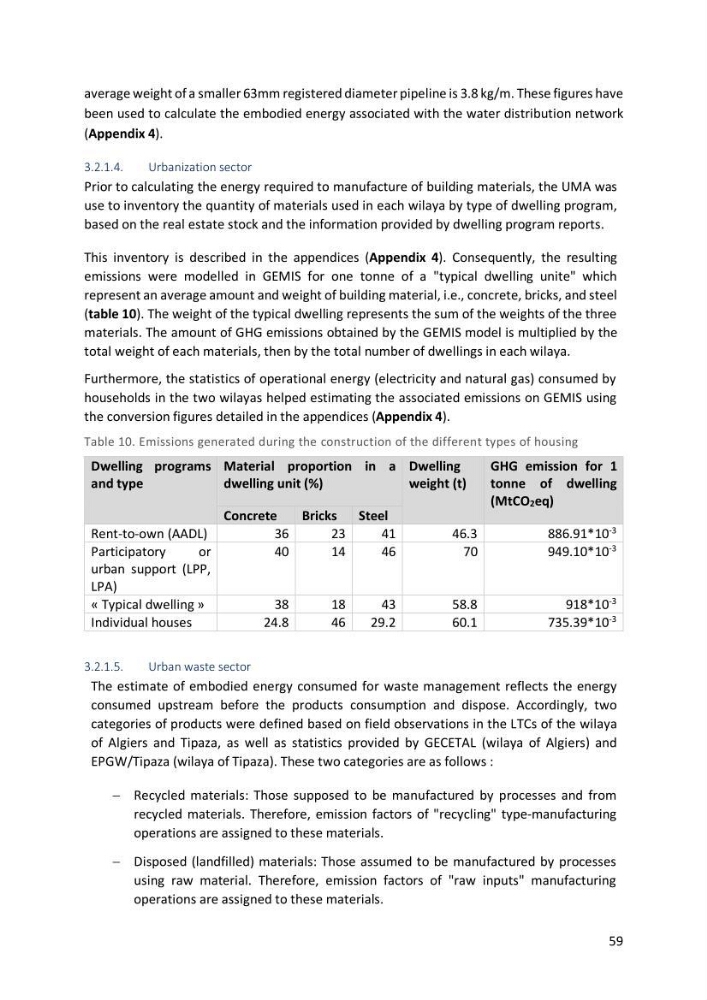
emissions were modelled in GEMIS for one tonne of a "typical dwelling unite" which
represent an average amount and weight of building material, i.e., concrete, bricks, and steel
(table 10). The weight of the typical dwelling represents the sum of the weights of the three
materials. The amount of GHG emissions obtained by the GEMIS model is multiplied by the
total weight of each materials, then by the total number of dwellings in each wilaya.
Furthermore, the statistics of operational energy (electricity and natural gas) consumed by
households in the two wilayas helped estimating the associated emissions on GEMIS using
the conversion figures detailed in the appendices (Appendix 4).
Table 10. Emissions generated during the construction of the different types of housing
Dwelling programs
and type
Material proportion in a
dwelling unit (%)
Dwelling
weight (t)
GHG emission for 1
tonne of dwelling
(MtCO2eq)
Concrete
Bricks
Steel
Rent-to-own (AADL)
36
23
41
46.3
886.91*10
-3
Participatory
or
urban support (LPP,
LPA)
40
14
46
70
949.10*10
-3
« Typical dwelling »
38
18
43
58.8
918*10
-3
Individual houses
24.8
46
29.2
60.1
735.39*10
-3
3.2.1.5.
Urban waste sector
The estimate of embodied energy consumed for waste management reflects the energy
consumed upstream before the products consumption and dispose. Accordingly, two
categories of products were defined based on field observations in the LTCs of the wilaya
of Algiers and Tipaza, as well as statistics provided by GECETAL (wilaya of Algiers) and
EPGW/Tipaza (wilaya of Tipaza). These two categories are as follows :
- Recycled materials: Those supposed to be manufactured by processes and from
recycled materials. Therefore, emission factors of "recycling" type-manufacturing
operations are assigned to these materials.
- Disposed (landfilled) materials: Those assumed to be manufactured by processes
using raw material. Therefore, emission factors of "raw inputs" manufacturing
operations are assigned to these materials.
average weight of a smaller 63mm registered diameter pipeline is 3.8 kg/m. These figures have
been used to calculate the embodied energy associated with the water distribution network
(Appendix 4).
3.2.1.4.
Urbanization sector
Prior to calculating the energy required to manufacture of building materials, the UMA was
use to inventory the quantity of materials used in each wilaya by type of dwelling program,
based on the real estate stock and the information provided by dwelling program reports.
This inventory is described in the appendices (Appendix 4). Consequently, the resulting
emissions were modelled in GEMIS for one tonne of a "typical dwelling unite" which
represent an average amount and weight of building material, i.e., concrete, bricks, and steel
(table 10). The weight of the typical dwelling represents the sum of the weights of the three
materials. The amount of GHG emissions obtained by the GEMIS model is multiplied by the
total weight of each materials, then by the total number of dwellings in each wilaya.
Furthermore, the statistics of operational energy (electricity and natural gas) consumed by
households in the two wilayas helped estimating the associated emissions on GEMIS using
the conversion figures detailed in the appendices (Appendix 4).
Table 10. Emissions generated during the construction of the different types of housing
Dwelling programs
and type
Material proportion in a
dwelling unit (%)
Dwelling
weight (t)
GHG emission for 1
tonne of dwelling
(MtCO2eq)
Concrete
Bricks
Steel
Rent-to-own (AADL)
36
23
41
46.3
886.91*10
-3
Participatory
or
urban support (LPP,
LPA)
40
14
46
70
949.10*10
-3
« Typical dwelling »
38
18
43
58.8
918*10
-3
Individual houses
24.8
46
29.2
60.1
735.39*10
-3
3.2.1.5.
Urban waste sector
The estimate of embodied energy consumed for waste management reflects the energy
consumed upstream before the products consumption and dispose. Accordingly, two
categories of products were defined based on field observations in the LTCs of the wilaya
of Algiers and Tipaza, as well as statistics provided by GECETAL (wilaya of Algiers) and
EPGW/Tipaza (wilaya of Tipaza). These two categories are as follows :
- Recycled materials: Those supposed to be manufactured by processes and from
recycled materials. Therefore, emission factors of "recycling" type-manufacturing
operations are assigned to these materials.
- Disposed (landfilled) materials: Those assumed to be manufactured by processes
using raw material. Therefore, emission factors of "raw inputs" manufacturing
operations are assigned to these materials.