

60
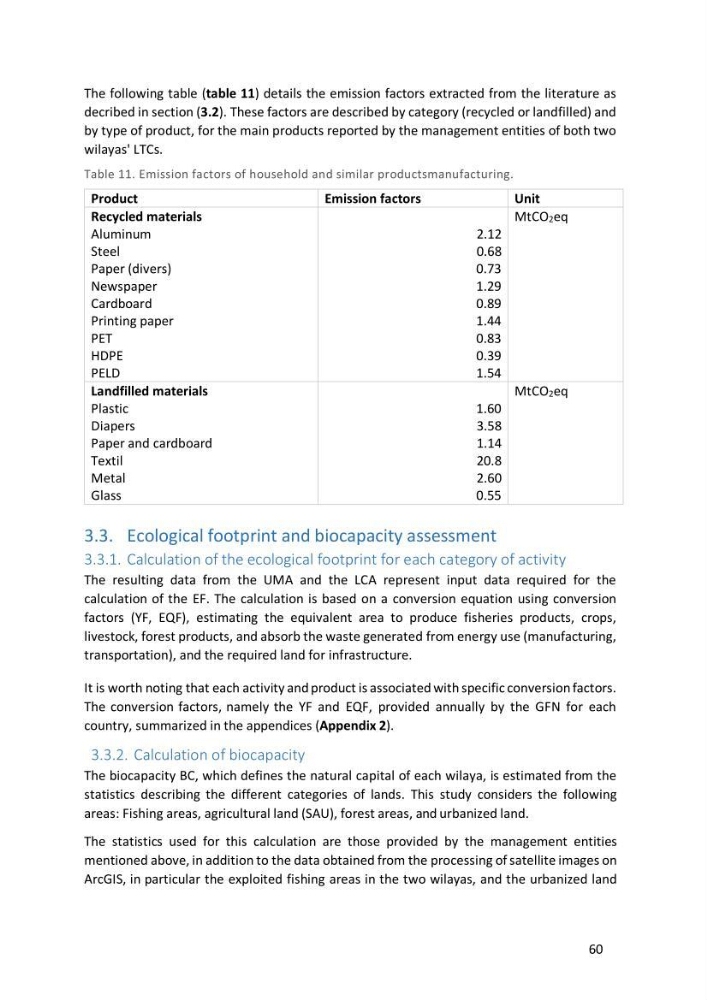
The following table (table 11) details the emission factors extracted from the literature as
decribed in section (3.2). These factors are described by category (recycled or landfilled) and
by type of product, for the main products reported by the management entities of both two
wilayas' LTCs.
Table 11. Emission factors of household and similar productsmanufacturing.
Product
Emission factors
Unit
Recycled materials
Aluminum
Steel
Paper (divers)
Newspaper
Cardboard
Printing paper
PET
HDPE
PELD
2.12
0.68
0.73
1.29
0.89
1.44
0.83
0.39
1.54
MtCO2eq
Landfilled materials
Plastic
Diapers
Paper and cardboard
Textil
Metal
Glass
1.60
3.58
1.14
20.8
2.60
0.55
MtCO2eq
3.3. Ecological footprint and biocapacity assessment
3.3.1. Calculation of the ecological footprint for each category of activity
The resulting data from the UMA and the LCA represent input data required for the
calculation of the EF. The calculation is based on a conversion equation using conversion
factors (YF, EQF), estimating the equivalent area to produce fisheries products, crops,
livestock, forest products, and absorb the waste generated from energy use (manufacturing,
transportation), and the required land for infrastructure.
It is worth noting that each activity and product is associated with specific conversion factors.
The conversion factors, namely the YF and EQF, provided annually by the GFN for each
country, summarized in the appendices (Appendix 2).
3.3.2. Calculation of biocapacity
The biocapacity BC, which defines the natural capital of each wilaya, is estimated from the
statistics describing the different categories of lands. This study considers the following
areas: Fishing areas, agricultural land (SAU), forest areas, and urbanized land.
The statistics used for this calculation are those provided by the management entities
mentioned above, in addition to the data obtained from the processing of satellite images on
ArcGIS, in particular the exploited fishing areas in the two wilayas, and the urbanized land
The following table (table 11) details the emission factors extracted from the literature as
decribed in section (3.2). These factors are described by category (recycled or landfilled) and
by type of product, for the main products reported by the management entities of both two
wilayas' LTCs.
Table 11. Emission factors of household and similar productsmanufacturing.
Product
Emission factors
Unit
Recycled materials
Aluminum
Steel
Paper (divers)
Newspaper
Cardboard
Printing paper
PET
HDPE
PELD
2.12
0.68
0.73
1.29
0.89
1.44
0.83
0.39
1.54
MtCO2eq
Landfilled materials
Plastic
Diapers
Paper and cardboard
Textil
Metal
Glass
1.60
3.58
1.14
20.8
2.60
0.55
MtCO2eq
3.3. Ecological footprint and biocapacity assessment
3.3.1. Calculation of the ecological footprint for each category of activity
The resulting data from the UMA and the LCA represent input data required for the
calculation of the EF. The calculation is based on a conversion equation using conversion
factors (YF, EQF), estimating the equivalent area to produce fisheries products, crops,
livestock, forest products, and absorb the waste generated from energy use (manufacturing,
transportation), and the required land for infrastructure.
It is worth noting that each activity and product is associated with specific conversion factors.
The conversion factors, namely the YF and EQF, provided annually by the GFN for each
country, summarized in the appendices (Appendix 2).
3.3.2. Calculation of biocapacity
The biocapacity BC, which defines the natural capital of each wilaya, is estimated from the
statistics describing the different categories of lands. This study considers the following
areas: Fishing areas, agricultural land (SAU), forest areas, and urbanized land.
The statistics used for this calculation are those provided by the management entities
mentioned above, in addition to the data obtained from the processing of satellite images on
ArcGIS, in particular the exploited fishing areas in the two wilayas, and the urbanized land