

analysis of variance (ANOVA) after checking the normality of
data and application of Tukey’s test if significant differences
(p˂0.05) exist. Further, multivariate analysis (principal component analysis PCA) was performed to follow the studied
heavy metal concentrations trend in various organs of mussels
from all sampling sites. Statistical analysis was carried out by
using the software package XLSTAT (2019.3.2 for Windows).
Individual Multimetal Bioaccumulation Index
To determine the mean charge of all the studied trace elements
in each tissue, the Individual Multimetal Bioaccumulation
Index (IMBI) was calculated as follows (Maes et al. 2005):
IMBI ¼
∑
n
i¼1
ci=cimax
n
ð1Þ
with n the total number of studied metals, Ci the individual
concentration of heavy metal i Cimax the found maximal concentration of heavy metal i, and 0 < IMBI < 1.
Health risk assessment
One of the objectives of this study is to evaluate health risk to
consumers of mussels for all studied sites. The critical values
of the heavy metals in mussel were measured in OST (the
overall soft tissue) expressed in wet weight. Thus, the concentration of heavy metals in mussels OST was performed using
heavy metal results of studied organs and their weight, then
the dry weight concentrations were converted to wet weight
basis.
Results
Physiological index
Condition index
The highest CI (condition index) values 27.64, 31.64, and
38.25 (Fig. 2a) have been recorded in the summer period at
the Figuier, Sercouf, and Algiers port, respectively. Then, CI
values decreased remarkably during the autumn and winter
seasons, reaching minimum values of 12.7, 18.24, and
18.39 at Figuier, Sercouf, and Algiers harbor, respectively.
During the spring season, CI increased rapidly in all studied
sites. During all sampling seasons, it should be noted that CI
values of mussel species Perna perna at Figuier were the
lowest compared with Mytilus galloprovincialis species distributed in the two other sites.
Gonad somatic index
The seasonal variation of GSI (gonad somatic index) presented in Fig. 2b is practically similar to the condition index pattern. High levels were found in summer either for Sercouf or
Algiers port showing respectively rate of 42.94 and
38.36, whereas a value of 22.73 was registered for
Figuier site in spring. GSI of mussels (at three sites)
decreased significantly over autumn and winter seasons.
This could be explained by the high gonad release
(spawning) before sampling. In spring period, GSI
values increased considerably in all the sites with
highest level registered at Algiers port.
Heavy metal concentrations in organs of mussels
(μg/g dry weight)
The cadmium (Cd)
The concentrations of cadmium in different organs of mussel
reported in Fig. 3 ranged from 0.1(gonad in autumn) to 0.7
(gill in winter) at Figuier, 0.14 (gonad in winter) to 2.6 (rest of
soft tissues in summer) at Sercouf, and 0.12 (gonad in spring)
to 0.66 (digestive gland in winter) at Algiers port.
For mussels collected at Figuier, far high Cd concentrations
were found in both organs gill (winter and autumn) and digestive gland (summer and spring) compared with the remainder
organs. During the four sampling seasons, moderate and low
Cd contents were detected in RST (rest of soft tissues) and
gonad, respectively.
For mussels of Sercouf, Cd contents in summer were significantly high in RST and high in digestive gland; however, they
were low in the gill and gonad. Similar high level of Cd was
observed in autumn for the gill and RST. The decrease order
of Cd concentration in the studied organs over winter and
spring was digestive gland ˃ RST ˃ gill ˃ gonad.
Cd levels in organs of mussels sampled at Algiers port were
much higher in the digestive gland throughout all sampling
seasons; they were high in RST (winter and spring) and gill
(spring) and moderate in the other seasons. Practically, low
concentrations were found in the gonad over all the sampling
seasons.
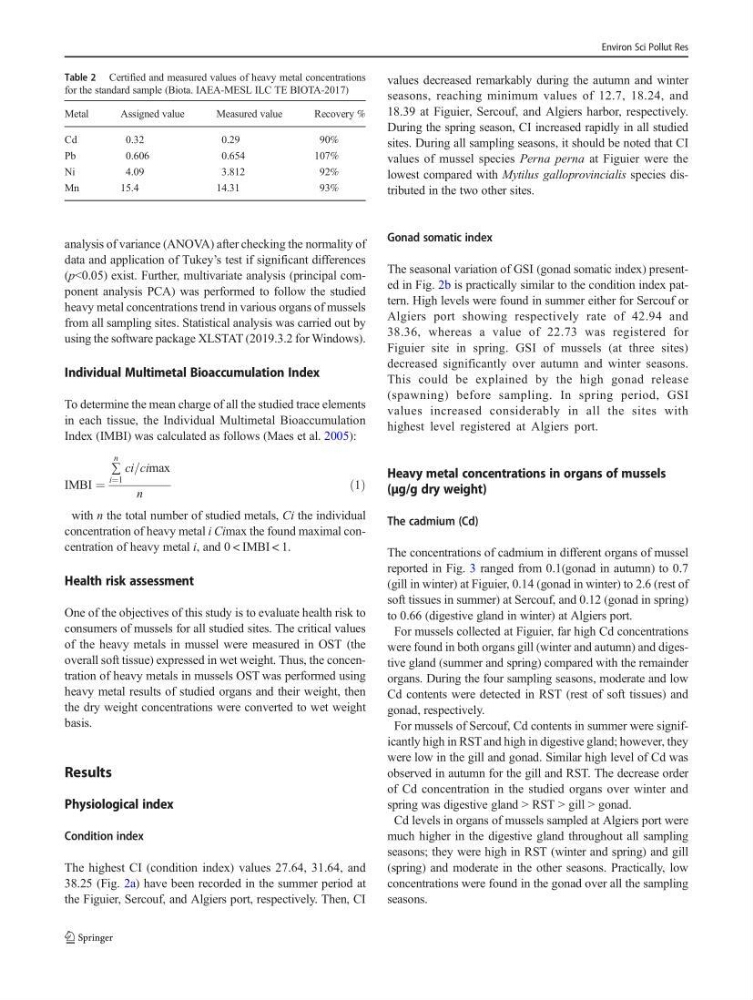
Table 2 Certified and measured values of heavy metal concentrations
for the standard sample (Biota. IAEA-MESL ILC TE BIOTA-2017)
Metal
Assigned value
Measured value
Recovery %
Cd
0.32
0.29
90%
Pb
0.606
0.654
107%
Ni
4.09
3.812
92%
Mn
15.4
14.31
93%
Environ Sci Pollut Res
data and application of Tukey’s test if significant differences
(p˂0.05) exist. Further, multivariate analysis (principal component analysis PCA) was performed to follow the studied
heavy metal concentrations trend in various organs of mussels
from all sampling sites. Statistical analysis was carried out by
using the software package XLSTAT (2019.3.2 for Windows).
Individual Multimetal Bioaccumulation Index
To determine the mean charge of all the studied trace elements
in each tissue, the Individual Multimetal Bioaccumulation
Index (IMBI) was calculated as follows (Maes et al. 2005):
IMBI ¼
∑
n
i¼1
ci=cimax
n
ð1Þ
with n the total number of studied metals, Ci the individual
concentration of heavy metal i Cimax the found maximal concentration of heavy metal i, and 0 < IMBI < 1.
Health risk assessment
One of the objectives of this study is to evaluate health risk to
consumers of mussels for all studied sites. The critical values
of the heavy metals in mussel were measured in OST (the
overall soft tissue) expressed in wet weight. Thus, the concentration of heavy metals in mussels OST was performed using
heavy metal results of studied organs and their weight, then
the dry weight concentrations were converted to wet weight
basis.
Results
Physiological index
Condition index
The highest CI (condition index) values 27.64, 31.64, and
38.25 (Fig. 2a) have been recorded in the summer period at
the Figuier, Sercouf, and Algiers port, respectively. Then, CI
values decreased remarkably during the autumn and winter
seasons, reaching minimum values of 12.7, 18.24, and
18.39 at Figuier, Sercouf, and Algiers harbor, respectively.
During the spring season, CI increased rapidly in all studied
sites. During all sampling seasons, it should be noted that CI
values of mussel species Perna perna at Figuier were the
lowest compared with Mytilus galloprovincialis species distributed in the two other sites.
Gonad somatic index
The seasonal variation of GSI (gonad somatic index) presented in Fig. 2b is practically similar to the condition index pattern. High levels were found in summer either for Sercouf or
Algiers port showing respectively rate of 42.94 and
38.36, whereas a value of 22.73 was registered for
Figuier site in spring. GSI of mussels (at three sites)
decreased significantly over autumn and winter seasons.
This could be explained by the high gonad release
(spawning) before sampling. In spring period, GSI
values increased considerably in all the sites with
highest level registered at Algiers port.
Heavy metal concentrations in organs of mussels
(μg/g dry weight)
The cadmium (Cd)
The concentrations of cadmium in different organs of mussel
reported in Fig. 3 ranged from 0.1(gonad in autumn) to 0.7
(gill in winter) at Figuier, 0.14 (gonad in winter) to 2.6 (rest of
soft tissues in summer) at Sercouf, and 0.12 (gonad in spring)
to 0.66 (digestive gland in winter) at Algiers port.
For mussels collected at Figuier, far high Cd concentrations
were found in both organs gill (winter and autumn) and digestive gland (summer and spring) compared with the remainder
organs. During the four sampling seasons, moderate and low
Cd contents were detected in RST (rest of soft tissues) and
gonad, respectively.
For mussels of Sercouf, Cd contents in summer were significantly high in RST and high in digestive gland; however, they
were low in the gill and gonad. Similar high level of Cd was
observed in autumn for the gill and RST. The decrease order
of Cd concentration in the studied organs over winter and
spring was digestive gland ˃ RST ˃ gill ˃ gonad.
Cd levels in organs of mussels sampled at Algiers port were
much higher in the digestive gland throughout all sampling
seasons; they were high in RST (winter and spring) and gill
(spring) and moderate in the other seasons. Practically, low
concentrations were found in the gonad over all the sampling
seasons.
Table 2 Certified and measured values of heavy metal concentrations
for the standard sample (Biota. IAEA-MESL ILC TE BIOTA-2017)
Metal
Assigned value
Measured value
Recovery %
Cd
0.32
0.29
90%
Pb
0.606
0.654
107%
Ni
4.09
3.812
92%
Mn
15.4
14.31
93%
Environ Sci Pollut Res