

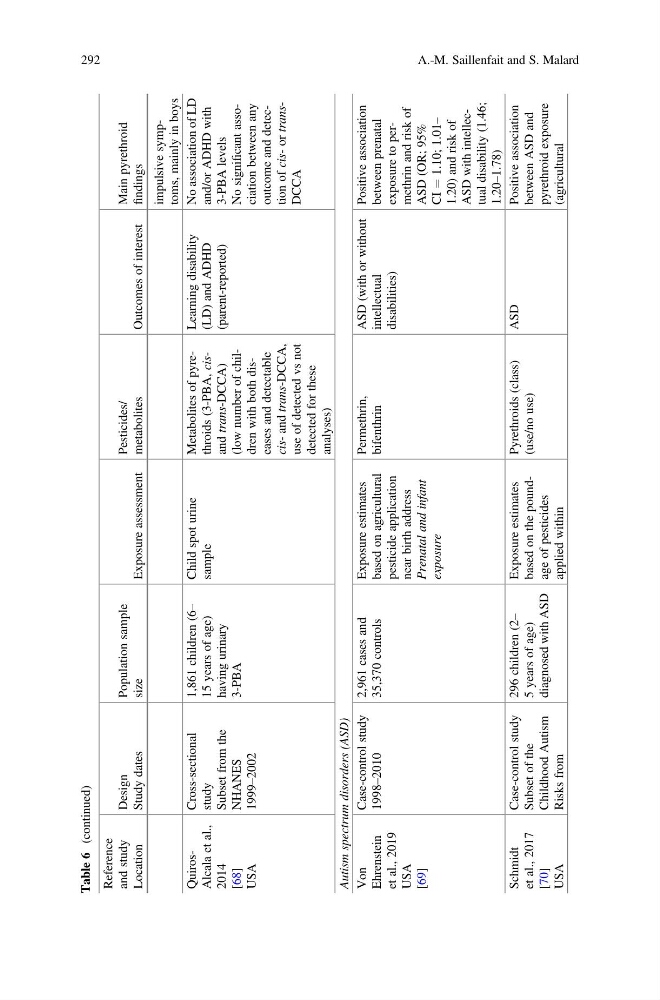
Table 6
(continued)
Reference
and study
Location
Design
Study dates
Population sample
size
Exposure assessment
Pesticides/
metabolites
Outcomes of interest
Main pyrethroid
findings
impulsive symptoms, mainly in boys
QuirosAlcala et al.,
2014
[68]
USA
Cross-sectional
study
Subset from the
NHANES
1999–2002
1,861 children (6–
15 years of age)
having urinary
3-PBA
Child spot urine
sample
Metabolites of pyrethroids (3-PBA, cisand trans-DCCA)
(low number of children with both diseases and detectable
cisand trans-DCCA,
use of detected vs not
detected for these
analyses)
Learning disability
(LD) and ADHD
(parent-reported)
No association of LD
and/or ADHD with
3-PBA levels
No significant association between any
outcome and detection of cisor transDCCA
Autism spectrum disorders (ASD)
Von
Ehrenstein
et al., 2019
USA
[69]
Case-control study
1998–2010
2,961 cases and
35,370 controls
Exposure estimates
based on agricultural
pesticide application
near birth address
Prenatal and infant
exposure
Permethrin,
bifenthrin
ASD (with or without
intellectual
disabilities)
Positive association
between prenatal
exposure to permethrin and risk of
ASD (OR; 95%
CI
¼ 1.10; 1.01–
1.20) and risk of
ASD with intellectual disability (1.46;
1.20–1.78)
Schmidt
et al., 2017
[70]
USA
Case-control study
Subset of the
Childhood Autism
Risks from
296 children (2–
5 years of age)
diagnosed with ASD
Exposure estimates
based on the poundage of pesticides
applied within
Pyrethroids (class)
(use/no use)
ASD
Positive association
between ASD and
pyrethroid exposure
(agricultural
292
A.-M. Saillenfait and S. Malard
(continued)
Reference
and study
Location
Design
Study dates
Population sample
size
Exposure assessment
Pesticides/
metabolites
Outcomes of interest
Main pyrethroid
findings
impulsive symptoms, mainly in boys
QuirosAlcala et al.,
2014
[68]
USA
Cross-sectional
study
Subset from the
NHANES
1999–2002
1,861 children (6–
15 years of age)
having urinary
3-PBA
Child spot urine
sample
Metabolites of pyrethroids (3-PBA, cisand trans-DCCA)
(low number of children with both diseases and detectable
cisand trans-DCCA,
use of detected vs not
detected for these
analyses)
Learning disability
(LD) and ADHD
(parent-reported)
No association of LD
and/or ADHD with
3-PBA levels
No significant association between any
outcome and detection of cisor transDCCA
Autism spectrum disorders (ASD)
Von
Ehrenstein
et al., 2019
USA
[69]
Case-control study
1998–2010
2,961 cases and
35,370 controls
Exposure estimates
based on agricultural
pesticide application
near birth address
Prenatal and infant
exposure
Permethrin,
bifenthrin
ASD (with or without
intellectual
disabilities)
Positive association
between prenatal
exposure to permethrin and risk of
ASD (OR; 95%
CI
¼ 1.10; 1.01–
1.20) and risk of
ASD with intellectual disability (1.46;
1.20–1.78)
Schmidt
et al., 2017
[70]
USA
Case-control study
Subset of the
Childhood Autism
Risks from
296 children (2–
5 years of age)
diagnosed with ASD
Exposure estimates
based on the poundage of pesticides
applied within
Pyrethroids (class)
(use/no use)
ASD
Positive association
between ASD and
pyrethroid exposure
(agricultural
292
A.-M. Saillenfait and S. Malard