

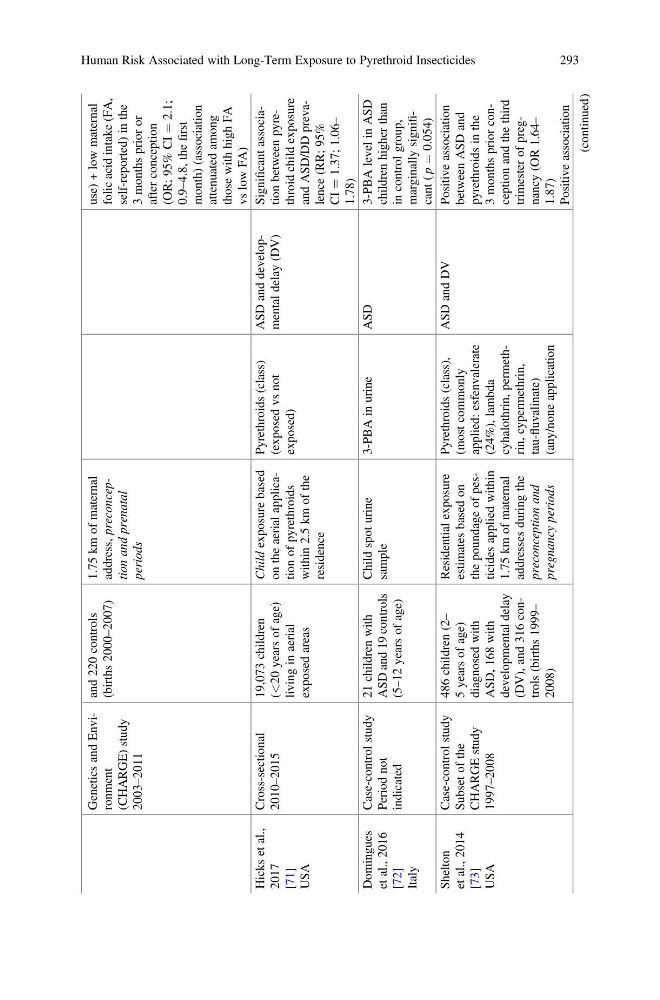
Genetics and Environment
(CHARGE) study
2003–2011
and 220 controls
(births 2000–2007)
1.75 km of maternal
address, preconception and prenatal
periods
use) + low maternal
folic acid intake (FA,
self-reported) in the
3 months prior or
after conception
(OR; 95% CI
¼ 2.1;
0.9–4.8, the
first
month) (association
attenuated among
those with high FA
vs low FA)
Hicks et al.,
2017
[71]
USA
Cross-sectional
2010–2015
19,073 children
(<20 years of age)
living in aerial
exposed areas
Child
exposure based
on the aerial application of pyrethroids
within 2.5 km of the
residence
Pyrethroids (class)
(exposed vs not
exposed)
ASD and developmental delay (DV)
Significant association between pyrethroid child exposure
and ASD/DD prevalence (RR; 95%
CI
¼ 1.37; 1.06–
1.78)
Domingues
et al., 2016
[72]
Italy
Case-control study
Period not
indicated
21 children with
ASD and 19 controls
(5–12 years of age)
Child spot urine
sample
3-PBA in urine
ASD
3-PBA level in ASD
children higher than
in control group,
marginally significant ( p
¼ 0.054)
Shelton
et al., 2014
[73]
USA
Case-control study
Subset of the
CHARGE study
1997–2008
486 children (2–
5 years of age)
diagnosed with
ASD, 168 with
developmental delay
(DV), and 316 controls (births 1999–
2008)
Residential exposure
estimates based on
the poundage of pesticides applied within
1.75 km of maternal
addresses during the
preconception and
pregnancy periods
Pyrethroids (class),
(most commonly
applied: esfenvalerate
(24%), lambda
cyhalothrin, permethrin, cypermethrin,
tau-fluvalinate)
(any/none application
ASD and DV
Positive association
between ASD and
pyrethroids in the
3 months prior conception and the third
trimester of pregnancy (OR 1.64–
1.87)
Positive association
(continued)
Human Risk Associated with Long-Term Exposure to Pyrethroid Insecticides
293
(CHARGE) study
2003–2011
and 220 controls
(births 2000–2007)
1.75 km of maternal
address, preconception and prenatal
periods
use) + low maternal
folic acid intake (FA,
self-reported) in the
3 months prior or
after conception
(OR; 95% CI
¼ 2.1;
0.9–4.8, the
first
month) (association
attenuated among
those with high FA
vs low FA)
Hicks et al.,
2017
[71]
USA
Cross-sectional
2010–2015
19,073 children
(<20 years of age)
living in aerial
exposed areas
Child
exposure based
on the aerial application of pyrethroids
within 2.5 km of the
residence
Pyrethroids (class)
(exposed vs not
exposed)
ASD and developmental delay (DV)
Significant association between pyrethroid child exposure
and ASD/DD prevalence (RR; 95%
CI
¼ 1.37; 1.06–
1.78)
Domingues
et al., 2016
[72]
Italy
Case-control study
Period not
indicated
21 children with
ASD and 19 controls
(5–12 years of age)
Child spot urine
sample
3-PBA in urine
ASD
3-PBA level in ASD
children higher than
in control group,
marginally significant ( p
¼ 0.054)
Shelton
et al., 2014
[73]
USA
Case-control study
Subset of the
CHARGE study
1997–2008
486 children (2–
5 years of age)
diagnosed with
ASD, 168 with
developmental delay
(DV), and 316 controls (births 1999–
2008)
Residential exposure
estimates based on
the poundage of pesticides applied within
1.75 km of maternal
addresses during the
preconception and
pregnancy periods
Pyrethroids (class),
(most commonly
applied: esfenvalerate
(24%), lambda
cyhalothrin, permethrin, cypermethrin,
tau-fluvalinate)
(any/none application
ASD and DV
Positive association
between ASD and
pyrethroids in the
3 months prior conception and the third
trimester of pregnancy (OR 1.64–
1.87)
Positive association
(continued)
Human Risk Associated with Long-Term Exposure to Pyrethroid Insecticides
293