

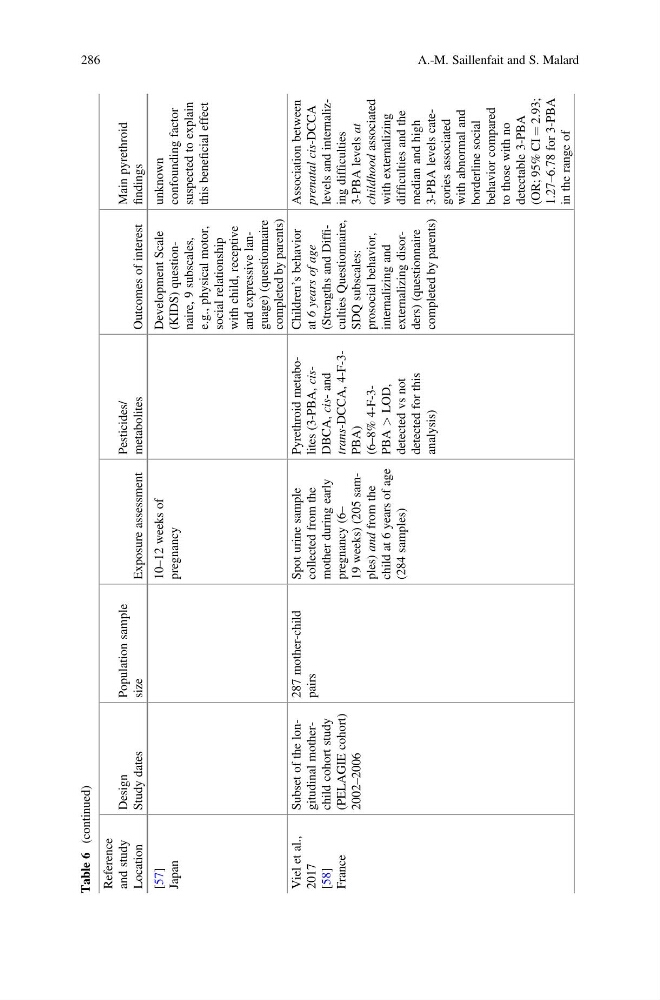
Table 6
(continued)
Reference
and study
Location
Design
Study dates
Population sample
size
Exposure assessment
Pesticides/
metabolites
Outcomes of interest
Main pyrethroid
findings
[57]
Japan
10–12 weeks of
pregnancy
Development Scale
(KIDS) questionnaire, 9 subscales,
e.g., physical motor,
social relationship
with child, receptive
and expressive language) (questionnaire
completed by parents)
unknown
confounding factor
suspected to explain
this beneficial effect
Viel et al.,
2017
[58]
France
Subset of the longitudinal motherchild cohort study
(PELAGIE cohort)
2002–2006
287 mother-child
pairs
Spot urine sample
collected from the
mother during early
pregnancy (6–
19 weeks) (205 samples) and
from the
child at 6 years of age
(284 samples)
Pyrethroid metabolites (3-PBA, cisDBCA, cisand
trans-DCCA,
4-F-3PBA)
(6–8% 4-F-3PBA
> LOD,
detected vs not
detected for this
analysis)
Children’s behavior
at 6 years of age
(Strengths and Difficulties Questionnaire,
SDQ subscales:
prosocial behavior,
internalizing and
externalizing disorders) (questionnaire
completed by parents)
Association between
prenatal cis-DCCA
levels and internalizing difficulties
3-PBA levels at
childhood
associated
with externalizing
difficulties and the
median and high
3-PBA levels categories associated
with abnormal and
borderline social
behavior compared
to those with no
detectable 3-PBA
(OR; 95% CI
¼ 2.93;
1.27–6.78 for 3-PBA
in the range of
286
A.-M. Saillenfait and S. Malard
(continued)
Reference
and study
Location
Design
Study dates
Population sample
size
Exposure assessment
Pesticides/
metabolites
Outcomes of interest
Main pyrethroid
findings
[57]
Japan
10–12 weeks of
pregnancy
Development Scale
(KIDS) questionnaire, 9 subscales,
e.g., physical motor,
social relationship
with child, receptive
and expressive language) (questionnaire
completed by parents)
unknown
confounding factor
suspected to explain
this beneficial effect
Viel et al.,
2017
[58]
France
Subset of the longitudinal motherchild cohort study
(PELAGIE cohort)
2002–2006
287 mother-child
pairs
Spot urine sample
collected from the
mother during early
pregnancy (6–
19 weeks) (205 samples) and
from the
child at 6 years of age
(284 samples)
Pyrethroid metabolites (3-PBA, cisDBCA, cisand
trans-DCCA,
4-F-3PBA)
(6–8% 4-F-3PBA
> LOD,
detected vs not
detected for this
analysis)
Children’s behavior
at 6 years of age
(Strengths and Difficulties Questionnaire,
SDQ subscales:
prosocial behavior,
internalizing and
externalizing disorders) (questionnaire
completed by parents)
Association between
prenatal cis-DCCA
levels and internalizing difficulties
3-PBA levels at
childhood
associated
with externalizing
difficulties and the
median and high
3-PBA levels categories associated
with abnormal and
borderline social
behavior compared
to those with no
detectable 3-PBA
(OR; 95% CI
¼ 2.93;
1.27–6.78 for 3-PBA
in the range of
286
A.-M. Saillenfait and S. Malard