

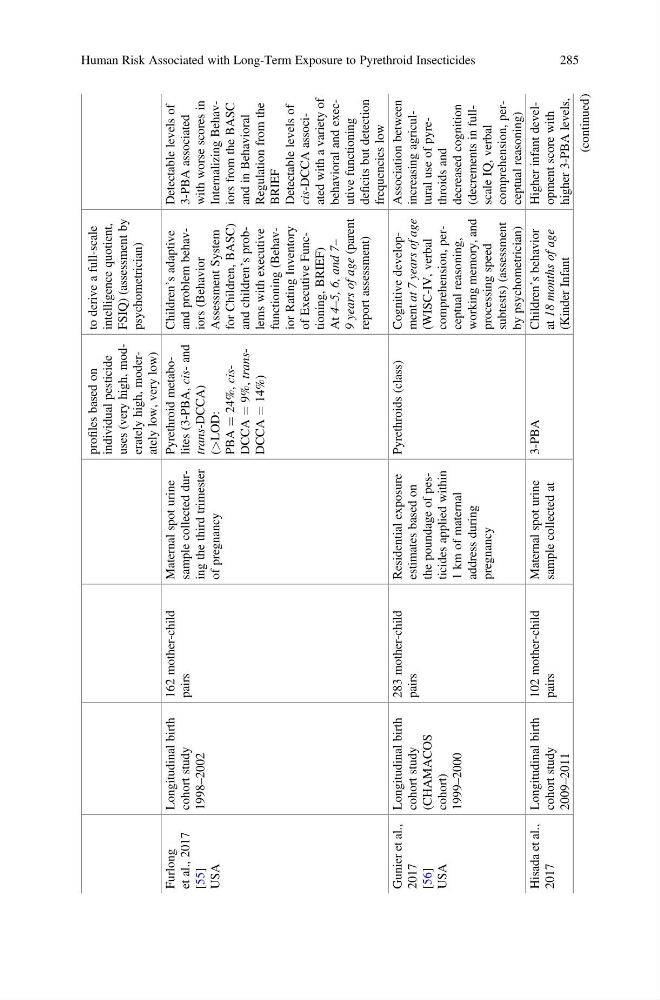
profiles based on
individual pesticide
uses (very high, moderately high, moderately low, very low)
to derive a full-scale
intelligence quotient,
FSIQ) (assessment by
psychometrician)
Furlong
et al., 2017
[55]
USA
Longitudinal birth
cohort study
1998–2002
162 mother-child
pairs
Maternal spot urine
sample collected during the third trimester
of pregnancy
Pyrethroid metabolites (3-PBA, cisand
trans-DCCA)
(>LOD:
PBA
¼ 24%, cisDCCA
¼ 9%, transDCCA
¼ 14%)
Children’s adaptive
and problem behaviors (Behavior
Assessment System
for Children, BASC)
and children’s problems with executive
functioning (Behavior Rating Inventory
of Executive Functioning, BRIEF)
At 4–5, 6, and 7–
9 years of age
(parent
report assessment)
Detectable levels of
3-PBA associated
with worse scores in
Internalizing Behaviors from the BASC
and in Behavioral
Regulation from the
BRIEF
Detectable levels of
cis-DCCA
associated with a variety of
behavioral and executive functioning
deficits but detection
frequencies low
Gunier et al.,
2017
[56]
USA
Longitudinal birth
cohort study
(CHAMACOS
cohort)
1999–2000
283 mother-child
pairs
Residential exposure
estimates based on
the poundage of pesticides applied within
1 km of maternal
address during
pregnancy
Pyrethroids (class)
Cognitive development at 7 years of age
(WISC-IV, verbal
comprehension, perceptual reasoning,
working memory, and
processing speed
subtests) (assessment
by psychometrician)
Association between
increasing agricultural use of pyrethroids and
decreased cognition
(decrements in fullscale IQ, verbal
comprehension, perceptual reasoning)
Hisada et al.,
2017
Longitudinal birth
cohort study
2009–2011
102 mother-child
pairs
Maternal spot urine
sample collected at
3-PBA
Children’s behavior
at 18 months of age
(Kinder Infant
Higher infant development score with
higher 3-PBA levels,
(continued)
Human Risk Associated with Long-Term Exposure to Pyrethroid Insecticides
285
individual pesticide
uses (very high, moderately high, moderately low, very low)
to derive a full-scale
intelligence quotient,
FSIQ) (assessment by
psychometrician)
Furlong
et al., 2017
[55]
USA
Longitudinal birth
cohort study
1998–2002
162 mother-child
pairs
Maternal spot urine
sample collected during the third trimester
of pregnancy
Pyrethroid metabolites (3-PBA, cisand
trans-DCCA)
(>LOD:
PBA
¼ 24%, cisDCCA
¼ 9%, transDCCA
¼ 14%)
Children’s adaptive
and problem behaviors (Behavior
Assessment System
for Children, BASC)
and children’s problems with executive
functioning (Behavior Rating Inventory
of Executive Functioning, BRIEF)
At 4–5, 6, and 7–
9 years of age
(parent
report assessment)
Detectable levels of
3-PBA associated
with worse scores in
Internalizing Behaviors from the BASC
and in Behavioral
Regulation from the
BRIEF
Detectable levels of
cis-DCCA
associated with a variety of
behavioral and executive functioning
deficits but detection
frequencies low
Gunier et al.,
2017
[56]
USA
Longitudinal birth
cohort study
(CHAMACOS
cohort)
1999–2000
283 mother-child
pairs
Residential exposure
estimates based on
the poundage of pesticides applied within
1 km of maternal
address during
pregnancy
Pyrethroids (class)
Cognitive development at 7 years of age
(WISC-IV, verbal
comprehension, perceptual reasoning,
working memory, and
processing speed
subtests) (assessment
by psychometrician)
Association between
increasing agricultural use of pyrethroids and
decreased cognition
(decrements in fullscale IQ, verbal
comprehension, perceptual reasoning)
Hisada et al.,
2017
Longitudinal birth
cohort study
2009–2011
102 mother-child
pairs
Maternal spot urine
sample collected at
3-PBA
Children’s behavior
at 18 months of age
(Kinder Infant
Higher infant development score with
higher 3-PBA levels,
(continued)
Human Risk Associated with Long-Term Exposure to Pyrethroid Insecticides
285