

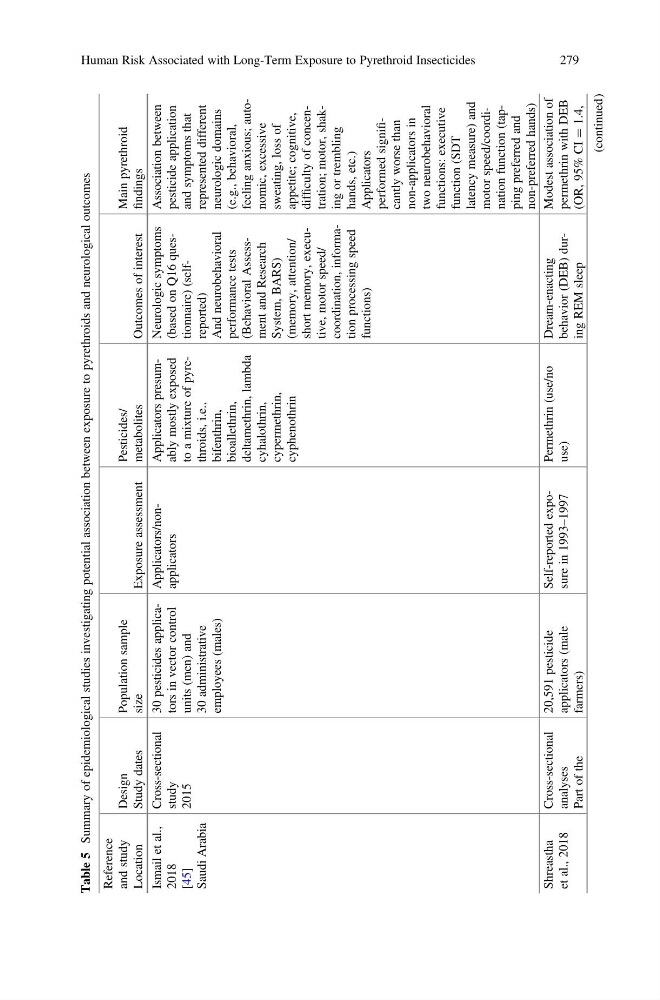
Table 5
Summary of epidemiological studies investigating potential association between exposure to pyrethroids and neurological outcomes
Reference
and study
Location
Design
Study dates
Population sample
size
Exposure assessment
Pesticides/
metabolites
Outcomes of interest
Main pyrethroid
findings
Ismail et al.,
2018
[45]
Saudi Arabia
Cross-sectional
study
2015
30 pesticides applicators in vector control
units (men) and
30 administrative
employees (males)
Applicators/nonapplicators
Applicators presumably mostly exposed
to a mixture of pyrethroids, i.e.,
bifenthrin,
bioallethrin,
deltamethrin, lambda
cyhalothrin,
cypermethrin,
cyphenothrin
Neurologic symptoms
(based on Q16 questionnaire) (selfreported)
And neurobehavioral
performance tests
(Behavioral Assessment and Research
System, BARS)
(memory, attention/
short memory, executive, motor speed/
coordination, information processing speed
functions)
Association between
pesticide application
and symptoms that
represented different
neurologic domains
(e.g., behavioral,
feeling anxious; autonomic, excessive
sweating, loss of
appetite; cognitive,
difficulty of concentration; motor, shaking or trembling
hands, etc.)
Applicators
performed significantly worse than
non-applicators in
two neurobehavioral
functions: executive
function (SDT
latency measure) and
motor speed/coordination function (tapping preferred and
non-preferred hands)
Shreastha
et al., 2018
Cross-sectional
analyses
Part of the
20,591 pesticide
applicators (male
farmers)
Self-reported exposure in 1993–1997
Permethrin (use/no
use)
Dream-enacting
behavior (DEB) during REM sleep
Modest association of
permethrin with DEB
(OR, 95% CI
¼ 1.4,
(continued)
Human Risk Associated with Long-Term Exposure to Pyrethroid Insecticides
279
Summary of epidemiological studies investigating potential association between exposure to pyrethroids and neurological outcomes
Reference
and study
Location
Design
Study dates
Population sample
size
Exposure assessment
Pesticides/
metabolites
Outcomes of interest
Main pyrethroid
findings
Ismail et al.,
2018
[45]
Saudi Arabia
Cross-sectional
study
2015
30 pesticides applicators in vector control
units (men) and
30 administrative
employees (males)
Applicators/nonapplicators
Applicators presumably mostly exposed
to a mixture of pyrethroids, i.e.,
bifenthrin,
bioallethrin,
deltamethrin, lambda
cyhalothrin,
cypermethrin,
cyphenothrin
Neurologic symptoms
(based on Q16 questionnaire) (selfreported)
And neurobehavioral
performance tests
(Behavioral Assessment and Research
System, BARS)
(memory, attention/
short memory, executive, motor speed/
coordination, information processing speed
functions)
Association between
pesticide application
and symptoms that
represented different
neurologic domains
(e.g., behavioral,
feeling anxious; autonomic, excessive
sweating, loss of
appetite; cognitive,
difficulty of concentration; motor, shaking or trembling
hands, etc.)
Applicators
performed significantly worse than
non-applicators in
two neurobehavioral
functions: executive
function (SDT
latency measure) and
motor speed/coordination function (tapping preferred and
non-preferred hands)
Shreastha
et al., 2018
Cross-sectional
analyses
Part of the
20,591 pesticide
applicators (male
farmers)
Self-reported exposure in 1993–1997
Permethrin (use/no
use)
Dream-enacting
behavior (DEB) during REM sleep
Modest association of
permethrin with DEB
(OR, 95% CI
¼ 1.4,
(continued)
Human Risk Associated with Long-Term Exposure to Pyrethroid Insecticides
279