

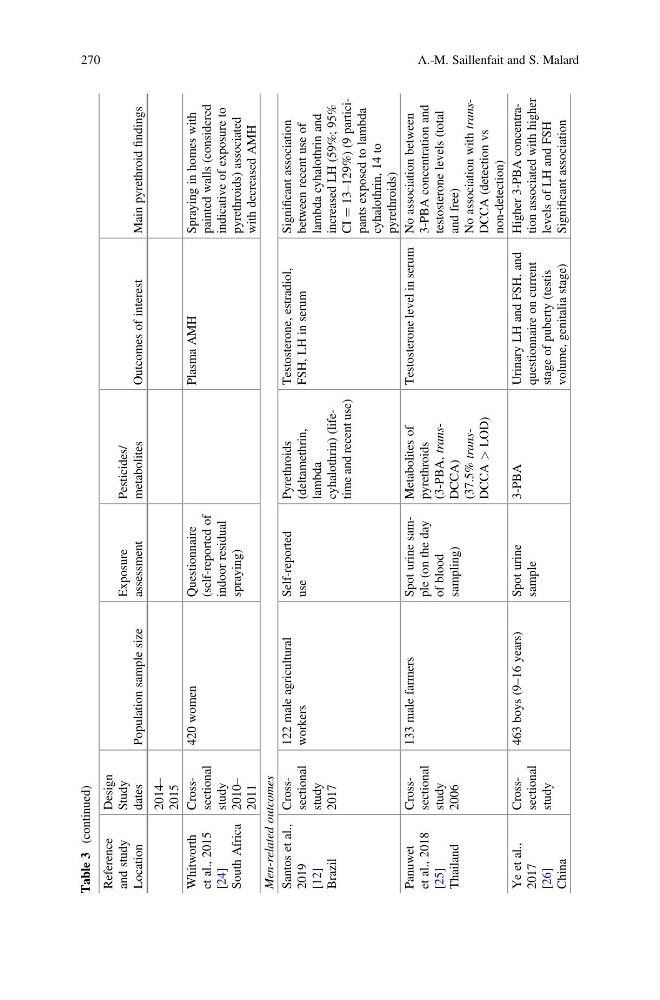
Table 3
(continued)
Reference
and study
Location
Design
Study
dates
Population sample size
Exposure
assessment
Pesticides/
metabolites
Outcomes of interest
Main pyrethroid
findings
2014–
2015
Whitworth
et al., 2015
[24]
South Africa
Crosssectional
study
2010–
2011
420 women
Questionnaire
(self-reported of
indoor residual
spraying)
Plasma AMH
Spraying in homes with
painted walls (considered
indicative of exposure to
pyrethroids) associated
with decreased AMH
Men-related outcomes
Santos et al.,
2019
[12]
Brazil
Crosssectional
study
2017
122 male agricultural
workers
Self-reported
use
Pyrethroids
(deltamethrin,
lambda
cyhalothrin) (lifetime and recent use)
Testosterone, estradiol,
FSH, LH in serum
Significant association
between recent use of
lambda cyhalothrin and
increased LH (59%; 95%
CI
¼ 13–129%) (9 participants exposed to lambda
cyhalothrin, 14 to
pyrethroids)
Panuwet
et al., 2018
[25]
Thailand
Crosssectional
study
2006
133 male farmers
Spot urine sample (on the day
of blood
sampling)
Metabolites of
pyrethroids
(3-PBA, transDCCA)
(37.5% transDCCA
> LOD)
Testosterone level in serum No association between
3-PBA concentration and
testosterone levels (total
and free)
No association with transDCCA (detection vs
non-detection)
Ye et al.,
2017
[26]
China
Crosssectional
study
463 boys (9–16 years)
Spot urine
sample
3-PBA
Urinary LH and FSH, and
questionnaire on current
stage of puberty (testis
volume, genitalia stage)
Higher 3-PBA concentration associated with higher
levels of LH and FSH
Significant association
270
A.-M. Saillenfait and S. Malard
(continued)
Reference
and study
Location
Design
Study
dates
Population sample size
Exposure
assessment
Pesticides/
metabolites
Outcomes of interest
Main pyrethroid
findings
2014–
2015
Whitworth
et al., 2015
[24]
South Africa
Crosssectional
study
2010–
2011
420 women
Questionnaire
(self-reported of
indoor residual
spraying)
Plasma AMH
Spraying in homes with
painted walls (considered
indicative of exposure to
pyrethroids) associated
with decreased AMH
Men-related outcomes
Santos et al.,
2019
[12]
Brazil
Crosssectional
study
2017
122 male agricultural
workers
Self-reported
use
Pyrethroids
(deltamethrin,
lambda
cyhalothrin) (lifetime and recent use)
Testosterone, estradiol,
FSH, LH in serum
Significant association
between recent use of
lambda cyhalothrin and
increased LH (59%; 95%
CI
¼ 13–129%) (9 participants exposed to lambda
cyhalothrin, 14 to
pyrethroids)
Panuwet
et al., 2018
[25]
Thailand
Crosssectional
study
2006
133 male farmers
Spot urine sample (on the day
of blood
sampling)
Metabolites of
pyrethroids
(3-PBA, transDCCA)
(37.5% transDCCA
> LOD)
Testosterone level in serum No association between
3-PBA concentration and
testosterone levels (total
and free)
No association with transDCCA (detection vs
non-detection)
Ye et al.,
2017
[26]
China
Crosssectional
study
463 boys (9–16 years)
Spot urine
sample
3-PBA
Urinary LH and FSH, and
questionnaire on current
stage of puberty (testis
volume, genitalia stage)
Higher 3-PBA concentration associated with higher
levels of LH and FSH
Significant association
270
A.-M. Saillenfait and S. Malard