

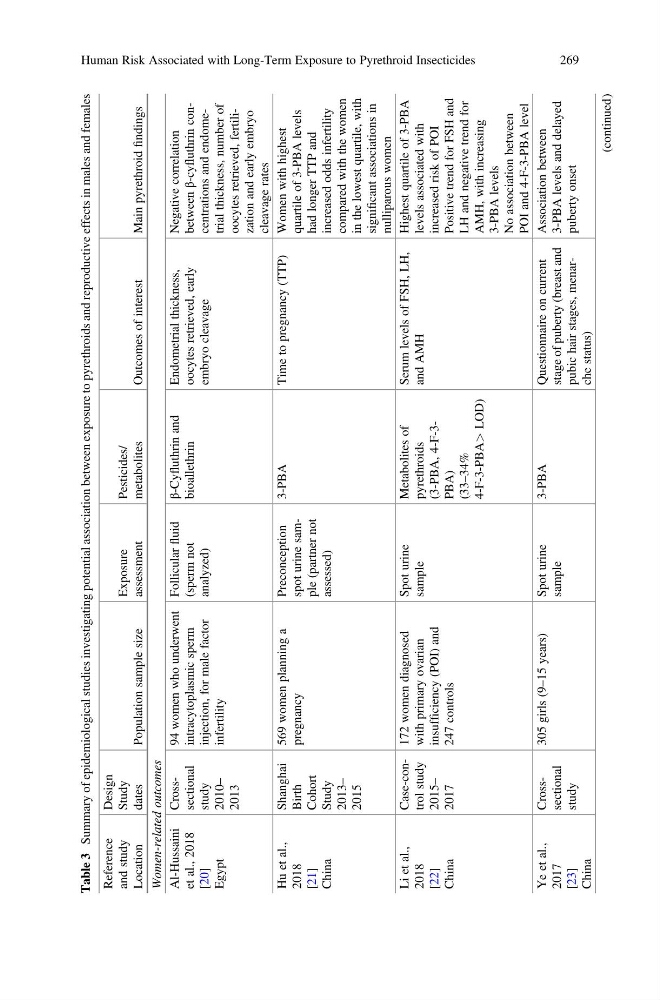
Table 3
Summary of epidemiological studies investigating potential association between exposure to pyrethroids and reproductive effects in males and females
Reference
and study
Location
Design
Study
dates
Population sample size
Exposure
assessment
Pesticides/
metabolites
Outcomes of interest
Main pyrethroid
findings
Women-related outcomes
Al-Hussaini
et al., 2018
[20]
Egypt
Crosssectional
study
2010–
2013
94 women who underwent
intracytoplasmic sperm
injection, for male factor
infertility
Follicular
fluid
(sperm not
analyzed)
β-Cyfluthrin and
bioallethrin
Endometrial thickness,
oocytes retrieved, early
embryo cleavage
Negative correlation
between
β-cyfluthrin concentrations and endometrial thickness, number of
oocytes retrieved, fertilization and early embryo
cleavage rates
Hu et al.,
2018
[21]
China
Shanghai
Birth
Cohort
Study
2013–
2015
569 women planning a
pregnancy
Preconception
spot urine sample (partner not
assessed)
3-PBA
Time to pregnancy (TTP)
Women with highest
quartile of 3-PBA levels
had longer TTP and
increased odds infertility
compared with the women
in the lowest quartile, with
significant associations in
nulliparous women
Li et al.,
2018
[22]
China
Case-control study
2015–
2017
172 women diagnosed
with primary ovarian
insufficiency (POI) and
247 controls
Spot urine
sample
Metabolites of
pyrethroids
(3-PBA, 4-F-3PBA)
(33–34%
4-F-3-PBA> LOD)
Serum levels of FSH, LH,
and AMH
Highest quartile of 3-PBA
levels associated with
increased risk of POI
Positive trend for FSH and
LH and negative trend for
AMH, with increasing
3-PBA levels
No association between
POI and 4-F-3-PBA level
Ye et al.,
2017
[23]
China
Crosssectional
study
305 girls (9–15 years)
Spot urine
sample
3-PBA
Questionnaire on current
stage of puberty (breast and
pubic hair stages, menarche status)
Association between
3-PBA levels and delayed
puberty onset
(continued)
Human Risk Associated with Long-Term Exposure to Pyrethroid Insecticides
269
Summary of epidemiological studies investigating potential association between exposure to pyrethroids and reproductive effects in males and females
Reference
and study
Location
Design
Study
dates
Population sample size
Exposure
assessment
Pesticides/
metabolites
Outcomes of interest
Main pyrethroid
findings
Women-related outcomes
Al-Hussaini
et al., 2018
[20]
Egypt
Crosssectional
study
2010–
2013
94 women who underwent
intracytoplasmic sperm
injection, for male factor
infertility
Follicular
fluid
(sperm not
analyzed)
β-Cyfluthrin and
bioallethrin
Endometrial thickness,
oocytes retrieved, early
embryo cleavage
Negative correlation
between
β-cyfluthrin concentrations and endometrial thickness, number of
oocytes retrieved, fertilization and early embryo
cleavage rates
Hu et al.,
2018
[21]
China
Shanghai
Birth
Cohort
Study
2013–
2015
569 women planning a
pregnancy
Preconception
spot urine sample (partner not
assessed)
3-PBA
Time to pregnancy (TTP)
Women with highest
quartile of 3-PBA levels
had longer TTP and
increased odds infertility
compared with the women
in the lowest quartile, with
significant associations in
nulliparous women
Li et al.,
2018
[22]
China
Case-control study
2015–
2017
172 women diagnosed
with primary ovarian
insufficiency (POI) and
247 controls
Spot urine
sample
Metabolites of
pyrethroids
(3-PBA, 4-F-3PBA)
(33–34%
4-F-3-PBA> LOD)
Serum levels of FSH, LH,
and AMH
Highest quartile of 3-PBA
levels associated with
increased risk of POI
Positive trend for FSH and
LH and negative trend for
AMH, with increasing
3-PBA levels
No association between
POI and 4-F-3-PBA level
Ye et al.,
2017
[23]
China
Crosssectional
study
305 girls (9–15 years)
Spot urine
sample
3-PBA
Questionnaire on current
stage of puberty (breast and
pubic hair stages, menarche status)
Association between
3-PBA levels and delayed
puberty onset
(continued)
Human Risk Associated with Long-Term Exposure to Pyrethroid Insecticides
269