

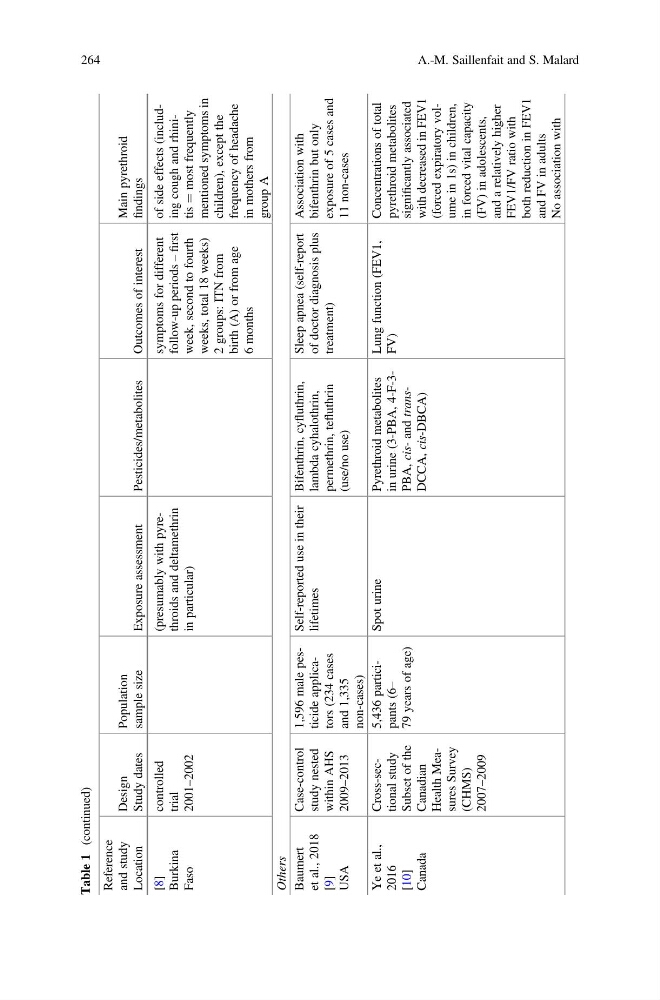
Table 1
(continued)
Reference
and study
Location
Design
Study dates
Population
sample size
Exposure assessment
Pesticides/metabolites
Outcomes of interest
Main pyrethroid
findings
[8]
Burkina
Faso
controlled
trial
2001–2002
(presumably with pyrethroids and deltamethrin
in particular)
symptoms for different
follow-up periods
– first
week, second to fourth
weeks, total 18 weeks)
2 groups: ITN from
birth (A) or from age
6 months
of side effects (including cough and rhinitis
¼ most frequently
mentioned symptoms in
children), except the
frequency of headache
in mothers from
group A
Others
Baumert
et al., 2018
[9]
USA
Case-control
study nested
within AHS
2009–2013
1,596 male pesticide applicators (234 cases
and 1,335
non-cases)
Self-reported use in their
lifetimes
Bifenthrin, cyfluthrin,
lambda cyhalothrin,
permethrin, tefluthrin
(use/no use)
Sleep apnea (self-report
of doctor diagnosis plus
treatment)
Association with
bifenthrin but only
exposure of 5 cases and
11 non-cases
Ye et al.,
2016
[10]
Canada
Cross-sectional study
Subset of the
Canadian
Health Measures Survey
(CHMS)
2007–2009
5,436 participants (6–
79 years of age)
Spot urine
Pyrethroid metabolites
in urine (3-PBA, 4-F-3PBA, cisand transDCCA, cis-DBCA)
Lung function (FEV1,
FV)
Concentrations of total
pyrethroid metabolites
significantly associated
with decreased in FEV1
(forced expiratory volume in 1s) in children,
in forced vital capacity
(FV) in adolescents,
and a relatively higher
FEV1/FV ratio with
both reduction in FEV1
and FV in adults
No association with
264
A.-M. Saillenfait and S. Malard
(continued)
Reference
and study
Location
Design
Study dates
Population
sample size
Exposure assessment
Pesticides/metabolites
Outcomes of interest
Main pyrethroid
findings
[8]
Burkina
Faso
controlled
trial
2001–2002
(presumably with pyrethroids and deltamethrin
in particular)
symptoms for different
follow-up periods
– first
week, second to fourth
weeks, total 18 weeks)
2 groups: ITN from
birth (A) or from age
6 months
of side effects (including cough and rhinitis
¼ most frequently
mentioned symptoms in
children), except the
frequency of headache
in mothers from
group A
Others
Baumert
et al., 2018
[9]
USA
Case-control
study nested
within AHS
2009–2013
1,596 male pesticide applicators (234 cases
and 1,335
non-cases)
Self-reported use in their
lifetimes
Bifenthrin, cyfluthrin,
lambda cyhalothrin,
permethrin, tefluthrin
(use/no use)
Sleep apnea (self-report
of doctor diagnosis plus
treatment)
Association with
bifenthrin but only
exposure of 5 cases and
11 non-cases
Ye et al.,
2016
[10]
Canada
Cross-sectional study
Subset of the
Canadian
Health Measures Survey
(CHMS)
2007–2009
5,436 participants (6–
79 years of age)
Spot urine
Pyrethroid metabolites
in urine (3-PBA, 4-F-3PBA, cisand transDCCA, cis-DBCA)
Lung function (FEV1,
FV)
Concentrations of total
pyrethroid metabolites
significantly associated
with decreased in FEV1
(forced expiratory volume in 1s) in children,
in forced vital capacity
(FV) in adolescents,
and a relatively higher
FEV1/FV ratio with
both reduction in FEV1
and FV in adults
No association with
264
A.-M. Saillenfait and S. Malard