

Codex Alimentarius (WHO/FAO), the US Environmental Protection Agency
(US EPA), European pesticides database, Japan Food Chemical Research Foundation (JFCRF), and Agência Nacional de Vigilância Sanitária (ANVISA) are the main
pesticide regulatory agencies worldwide; however, a unanimous decision regarding
acceptable pesticide levels has not been reached yet. The MRL values for bifenthrin
in tomatoes can range from 0.02 to 0.5 mg kg
À1 ; according to the regulatory
agencies, Codex Alimentarius and European pesticides database, MRL is
0.3 mg kg
À1 , JFCRF is 0.5 mg kg
À1 , ANVISA is 0.02 mg kg
À1 , and EPA is
0.15 mg kg
À1 .
For decades, developed countries have been monitoring the levels of pesticide
residues on food products. Conversely, such effort is practically nonexistent in
developing countries, mainly because of the high cost involved in the analysis.
Analysis of pesticide residues in food produced in Togo (Africa) [28], in Ghana
(Africa) [29], and in Bolívia (América do Sul) [30] reported data on pesticide
residues exceeding the MRL and ADI values, increasing the potential risks to
consumers, and thus confirming the urgency on guaranteeing food safety through
effective pesticide monitoring programs [11].
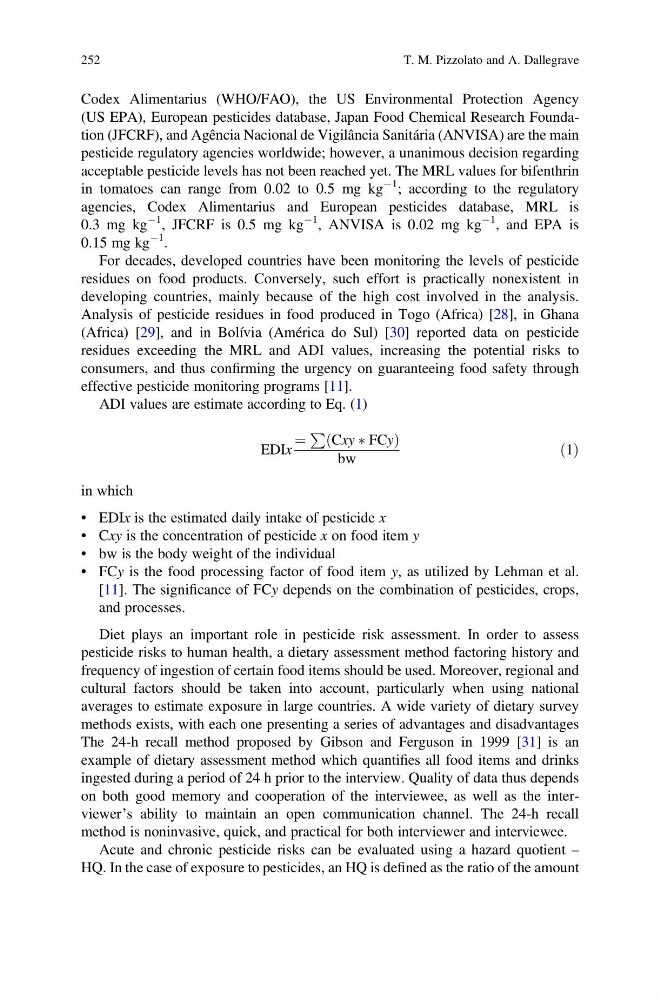
ADI values are estimate according to Eq. (1)
EDIx
¼
P
Cxy à FCy
ð
Þ
bw
ð1Þ
in which
• EDIx is the estimated daily intake of pesticide x
• Cxy is the concentration of pesticide x on food item y
• bw is the body weight of the individual
• FCy is the food processing factor of food item y, as utilized by Lehman et al.
[11]. The significance of FCy depends on the combination of pesticides, crops,
and processes.
Diet plays an important role in pesticide risk assessment. In order to assess
pesticide risks to human health, a dietary assessment method factoring history and
frequency of ingestion of certain food items should be used. Moreover, regional and
cultural factors should be taken into account, particularly when using national
averages to estimate exposure in large countries. A wide variety of dietary survey
methods exists, with each one presenting a series of advantages and disadvantages
The 24-h recall method proposed by Gibson and Ferguson in 1999 [31] is an
example of dietary assessment method which quantifies all food items and drinks
ingested during a period of 24 h prior to the interview. Quality of data thus depends
on both good memory and cooperation of the interviewee, as well as the interviewer’s ability to maintain an open communication channel. The 24-h recall
method is noninvasive, quick, and practical for both interviewer and interviewee.
Acute and chronic pesticide risks can be evaluated using a hazard quotient –
HQ. In the case of exposure to pesticides, an HQ is defined as the ratio of the amount
252
T. M. Pizzolato and A. Dallegrave
(US EPA), European pesticides database, Japan Food Chemical Research Foundation (JFCRF), and Agência Nacional de Vigilância Sanitária (ANVISA) are the main
pesticide regulatory agencies worldwide; however, a unanimous decision regarding
acceptable pesticide levels has not been reached yet. The MRL values for bifenthrin
in tomatoes can range from 0.02 to 0.5 mg kg
À1 ; according to the regulatory
agencies, Codex Alimentarius and European pesticides database, MRL is
0.3 mg kg
À1 , JFCRF is 0.5 mg kg
À1 , ANVISA is 0.02 mg kg
À1 , and EPA is
0.15 mg kg
À1 .
For decades, developed countries have been monitoring the levels of pesticide
residues on food products. Conversely, such effort is practically nonexistent in
developing countries, mainly because of the high cost involved in the analysis.
Analysis of pesticide residues in food produced in Togo (Africa) [28], in Ghana
(Africa) [29], and in Bolívia (América do Sul) [30] reported data on pesticide
residues exceeding the MRL and ADI values, increasing the potential risks to
consumers, and thus confirming the urgency on guaranteeing food safety through
effective pesticide monitoring programs [11].
ADI values are estimate according to Eq. (1)
EDIx
¼
P
Cxy à FCy
ð
Þ
bw
ð1Þ
in which
• EDIx is the estimated daily intake of pesticide x
• Cxy is the concentration of pesticide x on food item y
• bw is the body weight of the individual
• FCy is the food processing factor of food item y, as utilized by Lehman et al.
[11]. The significance of FCy depends on the combination of pesticides, crops,
and processes.
Diet plays an important role in pesticide risk assessment. In order to assess
pesticide risks to human health, a dietary assessment method factoring history and
frequency of ingestion of certain food items should be used. Moreover, regional and
cultural factors should be taken into account, particularly when using national
averages to estimate exposure in large countries. A wide variety of dietary survey
methods exists, with each one presenting a series of advantages and disadvantages
The 24-h recall method proposed by Gibson and Ferguson in 1999 [31] is an
example of dietary assessment method which quantifies all food items and drinks
ingested during a period of 24 h prior to the interview. Quality of data thus depends
on both good memory and cooperation of the interviewee, as well as the interviewer’s ability to maintain an open communication channel. The 24-h recall
method is noninvasive, quick, and practical for both interviewer and interviewee.
Acute and chronic pesticide risks can be evaluated using a hazard quotient –
HQ. In the case of exposure to pesticides, an HQ is defined as the ratio of the amount
252
T. M. Pizzolato and A. Dallegrave