

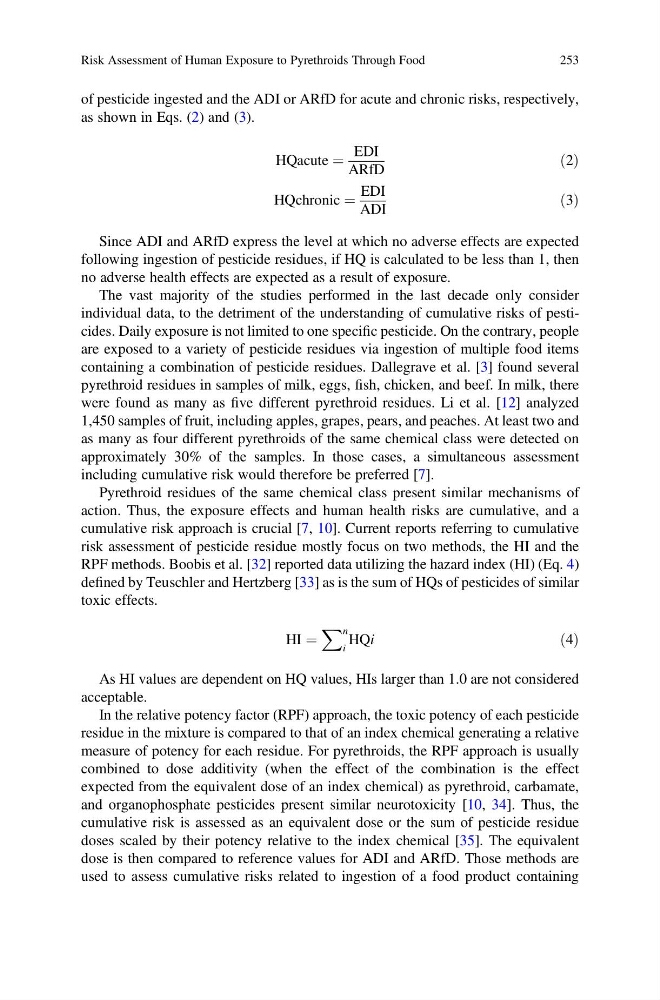
of pesticide ingested and the ADI or ARfD for acute and chronic risks, respectively,
as shown in Eqs. (2) and (3).
HQacute ¼
EDI
ARfD
ð2Þ
HQchronic ¼
EDI
ADI
ð3Þ
Since ADI and ARfD express the level at which no adverse effects are expected
following ingestion of pesticide residues, if HQ is calculated to be less than 1, then
no adverse health effects are expected as a result of exposure.
The vast majority of the studies performed in the last decade only consider
individual data, to the detriment of the understanding of cumulative risks of pesticides. Daily exposure is not limited to one specific pesticide. On the contrary, people
are exposed to a variety of pesticide residues via ingestion of multiple food items
containing a combination of pesticide residues. Dallegrave et al. [3] found several
pyrethroid residues in samples of milk, eggs, fish, chicken, and beef. In milk, there
were found as many as five different pyrethroid residues. Li et al. [12] analyzed
1,450 samples of fruit, including apples, grapes, pears, and peaches. At least two and
as many as four different pyrethroids of the same chemical class were detected on
approximately 30% of the samples. In those cases, a simultaneous assessment
including cumulative risk would therefore be preferred [7].
Pyrethroid residues of the same chemical class present similar mechanisms of
action. Thus, the exposure effects and human health risks are cumulative, and a
cumulative risk approach is crucial [7, 10]. Current reports referring to cumulative
risk assessment of pesticide residue mostly focus on two methods, the HI and the
RPF methods. Boobis et al. [32] reported data utilizing the hazard index (HI) (Eq. 4)
defined by Teuschler and Hertzberg [33] as is the sum of HQs of pesticides of similar
toxic effects.
HI ¼
X n
i
HQi
ð4Þ
As HI values are dependent on HQ values, HIs larger than 1.0 are not considered
acceptable.
In the relative potency factor (RPF) approach, the toxic potency of each pesticide
residue in the mixture is compared to that of an index chemical generating a relative
measure of potency for each residue. For pyrethroids, the RPF approach is usually
combined to dose additivity (when the effect of the combination is the effect
expected from the equivalent dose of an index chemical) as pyrethroid, carbamate,
and organophosphate pesticides present similar neurotoxicity [10, 34]. Thus, the
cumulative risk is assessed as an equivalent dose or the sum of pesticide residue
doses scaled by their potency relative to the index chemical [35]. The equivalent
dose is then compared to reference values for ADI and ARfD. Those methods are
used to assess cumulative risks related to ingestion of a food product containing
Risk Assessment of Human Exposure to Pyrethroids Through Food
253
as shown in Eqs. (2) and (3).
HQacute ¼
EDI
ARfD
ð2Þ
HQchronic ¼
EDI
ADI
ð3Þ
Since ADI and ARfD express the level at which no adverse effects are expected
following ingestion of pesticide residues, if HQ is calculated to be less than 1, then
no adverse health effects are expected as a result of exposure.
The vast majority of the studies performed in the last decade only consider
individual data, to the detriment of the understanding of cumulative risks of pesticides. Daily exposure is not limited to one specific pesticide. On the contrary, people
are exposed to a variety of pesticide residues via ingestion of multiple food items
containing a combination of pesticide residues. Dallegrave et al. [3] found several
pyrethroid residues in samples of milk, eggs, fish, chicken, and beef. In milk, there
were found as many as five different pyrethroid residues. Li et al. [12] analyzed
1,450 samples of fruit, including apples, grapes, pears, and peaches. At least two and
as many as four different pyrethroids of the same chemical class were detected on
approximately 30% of the samples. In those cases, a simultaneous assessment
including cumulative risk would therefore be preferred [7].
Pyrethroid residues of the same chemical class present similar mechanisms of
action. Thus, the exposure effects and human health risks are cumulative, and a
cumulative risk approach is crucial [7, 10]. Current reports referring to cumulative
risk assessment of pesticide residue mostly focus on two methods, the HI and the
RPF methods. Boobis et al. [32] reported data utilizing the hazard index (HI) (Eq. 4)
defined by Teuschler and Hertzberg [33] as is the sum of HQs of pesticides of similar
toxic effects.
HI ¼
X n
i
HQi
ð4Þ
As HI values are dependent on HQ values, HIs larger than 1.0 are not considered
acceptable.
In the relative potency factor (RPF) approach, the toxic potency of each pesticide
residue in the mixture is compared to that of an index chemical generating a relative
measure of potency for each residue. For pyrethroids, the RPF approach is usually
combined to dose additivity (when the effect of the combination is the effect
expected from the equivalent dose of an index chemical) as pyrethroid, carbamate,
and organophosphate pesticides present similar neurotoxicity [10, 34]. Thus, the
cumulative risk is assessed as an equivalent dose or the sum of pesticide residue
doses scaled by their potency relative to the index chemical [35]. The equivalent
dose is then compared to reference values for ADI and ARfD. Those methods are
used to assess cumulative risks related to ingestion of a food product containing
Risk Assessment of Human Exposure to Pyrethroids Through Food
253