

3 Human Contamination
Recent research unanimously identifies ingestion of contaminated food products as
the most relevant factor of human health damages caused by pyrethroids. When
ingested, pyrethroids are immediately metabolized via hydrolysis of the ester,
forming the corresponding carboxylic acids, oxidation and glucuronidation, and
expelled in urine as conjugates. The main metabolites of pyrethroids in urine are
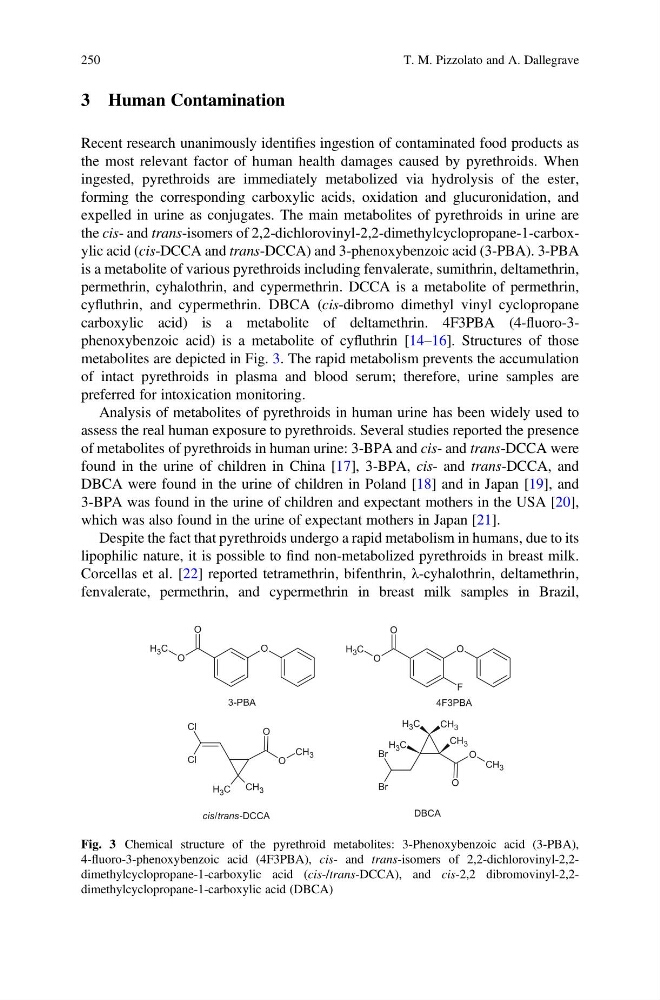
the cis- and trans-isomers of 2,2-dichlorovinyl-2,2-dimethylcyclopropane-1-carboxylic acid (cis-DCCA and trans-DCCA) and 3-phenoxybenzoic acid (3-PBA). 3-PBA
is a metabolite of various pyrethroids including fenvalerate, sumithrin, deltamethrin,
permethrin, cyhalothrin, and cypermethrin. DCCA is a metabolite of permethrin,
cyfluthrin, and cypermethrin. DBCA (cis-dibromo dimethyl vinyl cyclopropane
carboxylic acid) is a metabolite of deltamethrin. 4F3PBA (4-fluoro-3phenoxybenzoic acid) is a metabolite of cyfluthrin [14–16]. Structures of those
metabolites are depicted in Fig. 3. The rapid metabolism prevents the accumulation
of intact pyrethroids in plasma and blood serum; therefore, urine samples are
preferred for intoxication monitoring.
Analysis of metabolites of pyrethroids in human urine has been widely used to
assess the real human exposure to pyrethroids. Several studies reported the presence
of metabolites of pyrethroids in human urine: 3-BPA and cis- and trans-DCCA were
found in the urine of children in China [17], 3-BPA, cis- and trans-DCCA, and
DBCA were found in the urine of children in Poland [18] and in Japan [19], and
3-BPA was found in the urine of children and expectant mothers in the USA [20],
which was also found in the urine of expectant mothers in Japan [21].
Despite the fact that pyrethroids undergo a rapid metabolism in humans, due to its
lipophilic nature, it is possible to find non-metabolized pyrethroids in breast milk.
Corcellas et al. [22] reported tetramethrin, bifenthrin, λ-cyhalothrin, deltamethrin,
fenvalerate, permethrin, and cypermethrin in breast milk samples in Brazil,
Cl
Cl
C
H 3
CH 3
O
CH 3
O
O
O
C
H 3
O
O
O
C
H 3
O
F
Br
Br
CH 3
C
H 3
CH 3
C
H 3
O
CH 3
O
3-PBA
4F3PBA
DBCA
cis/trans-DCCA
Fig. 3 Chemical structure of the pyrethroid metabolites: 3-Phenoxybenzoic acid (3-PBA),
4-fluoro-3-phenoxybenzoic acid (4F3PBA), cis- and trans-isomers of 2,2-dichlorovinyl-2,2dimethylcyclopropane-1-carboxylic acid (cis-/trans-DCCA), and cis-2,2 dibromovinyl-2,2dimethylcyclopropane-1-carboxylic acid (DBCA)
250
T. M. Pizzolato and A. Dallegrave
Recent research unanimously identifies ingestion of contaminated food products as
the most relevant factor of human health damages caused by pyrethroids. When
ingested, pyrethroids are immediately metabolized via hydrolysis of the ester,
forming the corresponding carboxylic acids, oxidation and glucuronidation, and
expelled in urine as conjugates. The main metabolites of pyrethroids in urine are
the cis- and trans-isomers of 2,2-dichlorovinyl-2,2-dimethylcyclopropane-1-carboxylic acid (cis-DCCA and trans-DCCA) and 3-phenoxybenzoic acid (3-PBA). 3-PBA
is a metabolite of various pyrethroids including fenvalerate, sumithrin, deltamethrin,
permethrin, cyhalothrin, and cypermethrin. DCCA is a metabolite of permethrin,
cyfluthrin, and cypermethrin. DBCA (cis-dibromo dimethyl vinyl cyclopropane
carboxylic acid) is a metabolite of deltamethrin. 4F3PBA (4-fluoro-3phenoxybenzoic acid) is a metabolite of cyfluthrin [14–16]. Structures of those
metabolites are depicted in Fig. 3. The rapid metabolism prevents the accumulation
of intact pyrethroids in plasma and blood serum; therefore, urine samples are
preferred for intoxication monitoring.
Analysis of metabolites of pyrethroids in human urine has been widely used to
assess the real human exposure to pyrethroids. Several studies reported the presence
of metabolites of pyrethroids in human urine: 3-BPA and cis- and trans-DCCA were
found in the urine of children in China [17], 3-BPA, cis- and trans-DCCA, and
DBCA were found in the urine of children in Poland [18] and in Japan [19], and
3-BPA was found in the urine of children and expectant mothers in the USA [20],
which was also found in the urine of expectant mothers in Japan [21].
Despite the fact that pyrethroids undergo a rapid metabolism in humans, due to its
lipophilic nature, it is possible to find non-metabolized pyrethroids in breast milk.
Corcellas et al. [22] reported tetramethrin, bifenthrin, λ-cyhalothrin, deltamethrin,
fenvalerate, permethrin, and cypermethrin in breast milk samples in Brazil,
Cl
Cl
C
H 3
CH 3
O
CH 3
O
O
O
C
H 3
O
O
O
C
H 3
O
F
Br
Br
CH 3
C
H 3
CH 3
C
H 3
O
CH 3
O
3-PBA
4F3PBA
DBCA
cis/trans-DCCA
Fig. 3 Chemical structure of the pyrethroid metabolites: 3-Phenoxybenzoic acid (3-PBA),
4-fluoro-3-phenoxybenzoic acid (4F3PBA), cis- and trans-isomers of 2,2-dichlorovinyl-2,2dimethylcyclopropane-1-carboxylic acid (cis-/trans-DCCA), and cis-2,2 dibromovinyl-2,2dimethylcyclopropane-1-carboxylic acid (DBCA)
250
T. M. Pizzolato and A. Dallegrave