

Toxicity tests in laboratory animals revealed the occurrence of two syndromes,
namely, T and CS syndromes, related to type I and type II pyrethroids, respectively.
Neurotoxic symptoms caused by type I pyrethroids include shivering, irritability,
high fever, comatosis, and death. Type II pyrethroids may cause salivation, involuntary movements, violent trembling, comatosis, and death. Exposure to certain
pyrethroids, e.g., fempropatrin and esfenvalerate, leads to both T and CS syndromes.
Mammalian toxicity is low, and specific enzymatic systems allow mammals to
recover from contamination by pyrethroids in 24–48 h. Conversely, such degradation route is not present in insects, causing a higher insect toxicity [13].
Type I
Type II
bifenthrin
cypermethrin
permethrin
cyfluthrin
transfluthrin
cyhalothrin
tetramethrin
deltamethrin
Cl
O
O
CH 3
C
H 3
C
H 3
F
F
F
Cl
Cl
O
O
CH 3
C
H 3
N
O
Cl
Cl
O
O
CH 3
C
H 3
O
Cl
Cl
O
O
CH 3
C
H 3
N
O
F
Cl
Cl
O
O
CH 3
C
H 3
F
F
F
F
Cl
O
O
CH 3
C
H 3
N
O
F
F
F
C
H 3
CH 3
O
O
CH 3
C
H 3
N
O
O
Br
Br
O
O
CH 3
C
H 3
N
O
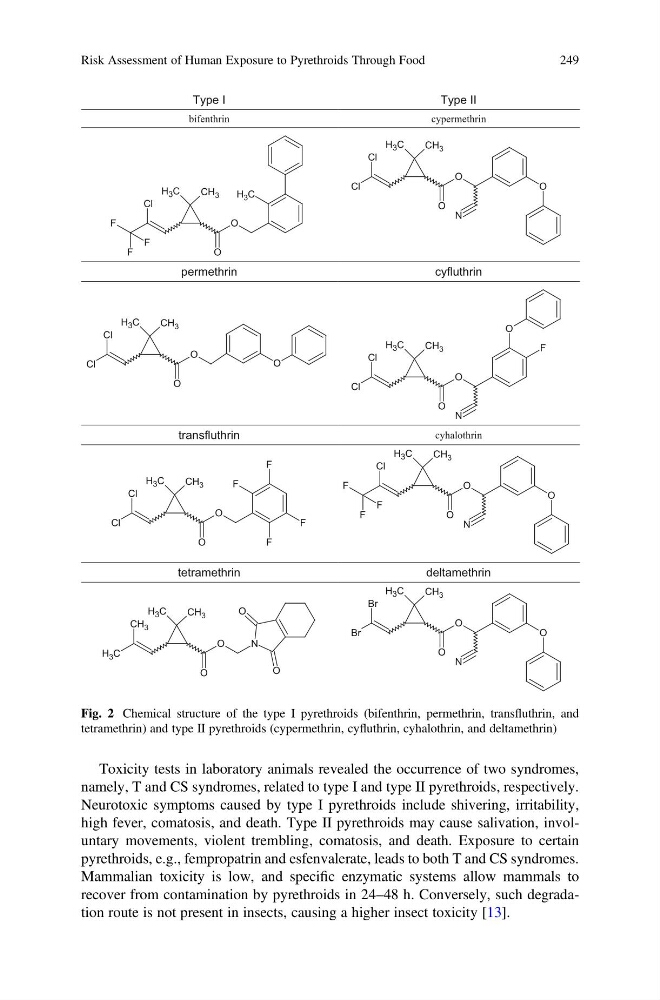
Fig. 2 Chemical structure of the type I pyrethroids (bifenthrin, permethrin, transfluthrin, and
tetramethrin) and type II pyrethroids (cypermethrin, cyfluthrin, cyhalothrin, and deltamethrin)
Risk Assessment of Human Exposure to Pyrethroids Through Food
249
namely, T and CS syndromes, related to type I and type II pyrethroids, respectively.
Neurotoxic symptoms caused by type I pyrethroids include shivering, irritability,
high fever, comatosis, and death. Type II pyrethroids may cause salivation, involuntary movements, violent trembling, comatosis, and death. Exposure to certain
pyrethroids, e.g., fempropatrin and esfenvalerate, leads to both T and CS syndromes.
Mammalian toxicity is low, and specific enzymatic systems allow mammals to
recover from contamination by pyrethroids in 24–48 h. Conversely, such degradation route is not present in insects, causing a higher insect toxicity [13].
Type I
Type II
bifenthrin
cypermethrin
permethrin
cyfluthrin
transfluthrin
cyhalothrin
tetramethrin
deltamethrin
Cl
O
O
CH 3
C
H 3
C
H 3
F
F
F
Cl
Cl
O
O
CH 3
C
H 3
N
O
Cl
Cl
O
O
CH 3
C
H 3
O
Cl
Cl
O
O
CH 3
C
H 3
N
O
F
Cl
Cl
O
O
CH 3
C
H 3
F
F
F
F
Cl
O
O
CH 3
C
H 3
N
O
F
F
F
C
H 3
CH 3
O
O
CH 3
C
H 3
N
O
O
Br
Br
O
O
CH 3
C
H 3
N
O
Fig. 2 Chemical structure of the type I pyrethroids (bifenthrin, permethrin, transfluthrin, and
tetramethrin) and type II pyrethroids (cypermethrin, cyfluthrin, cyhalothrin, and deltamethrin)
Risk Assessment of Human Exposure to Pyrethroids Through Food
249