

when the calculated risk exceeds the acceptable values. Thus, the probabilistic
model is expected to surpass the deterministic model in the near future [10]
(https://www.epa.gov/expobox/exposure-assessment-tools-tiers-and-types-determin
istic-and-probabilistic-assessments. Accessed 18 Apr 2019).
Global exposure to pyrethroids through food consumption is reaching alarming
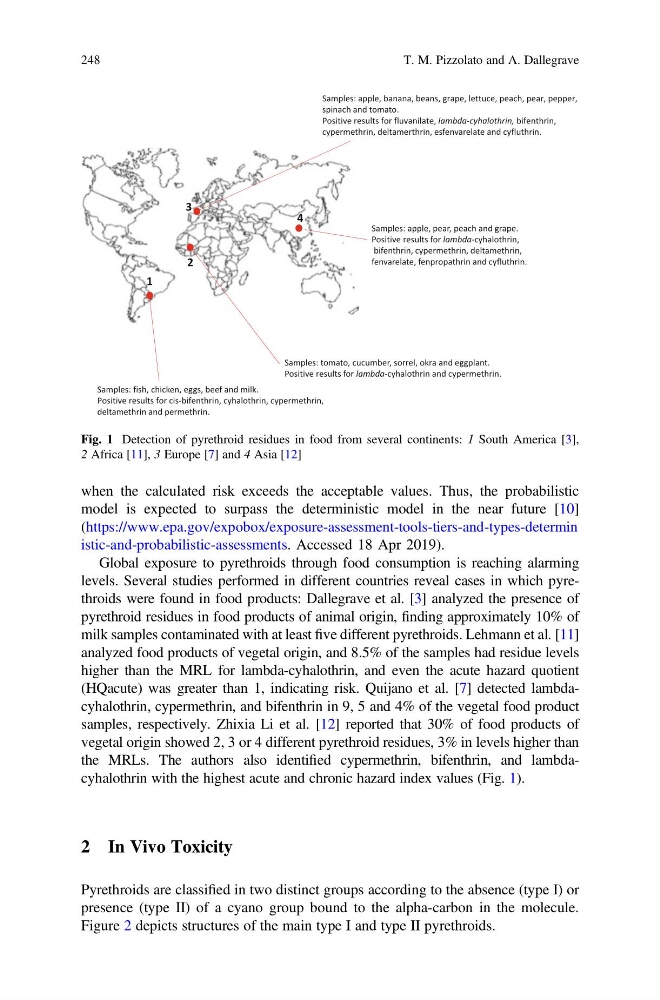
levels. Several studies performed in different countries reveal cases in which pyrethroids were found in food products: Dallegrave et al. [3] analyzed the presence of
pyrethroid residues in food products of animal origin, finding approximately 10% of
milk samples contaminated with at least five different pyrethroids. Lehmann et al. [11]
analyzed food products of vegetal origin, and 8.5% of the samples had residue levels
higher than the MRL for lambda-cyhalothrin, and even the acute hazard quotient
(HQacute) was greater than 1, indicating risk. Quijano et al. [7] detected lambdacyhalothrin, cypermethrin, and bifenthrin in 9, 5 and 4% of the vegetal food product
samples, respectively. Zhixia Li et al. [12] reported that 30% of food products of
vegetal origin showed 2, 3 or 4 different pyrethroid residues, 3% in levels higher than
the MRLs. The authors also identified cypermethrin, bifenthrin, and lambdacyhalothrin with the highest acute and chronic hazard index values (Fig. 1).
2 In Vivo Toxicity
Pyrethroids are classified in two distinct groups according to the absence (type I) or
presence (type II) of a cyano group bound to the alpha-carbon in the molecule.
Figure 2 depicts structures of the main type I and type II pyrethroids.
Samples: tomato, cucumber, sorrel, okra and eggplant.
Positive results for lambda-cyhalothrin and cypermethrin.
Samples: apple, banana, beans, grape, lettuce, peach, pear, pepper,
spinach and tomato.
Positive results for fluvanilate, lambda-cyhalothrin, bifenthrin,
cypermethrin, deltamerthrin, esfenvarelate and cyfluthrin.
Samples: apple, pear, peach and grape.
Positive results for lambda-cyhalothrin,
bifenthrin, cypermethrin, deltamethrin,
fenvarelate, fenpropathrin and cyfluthrin.
Samples: fish, chicken, eggs, beef and milk.
Positive results for cis-bifenthrin, cyhalothrin, cypermethrin,
deltamethrin and permethrin.
1
2
3
4
Fig. 1 Detection of pyrethroid residues in food from several continents: 1 South America [3],
2 Africa [11], 3 Europe [7] and 4 Asia [12]
248
T. M. Pizzolato and A. Dallegrave
model is expected to surpass the deterministic model in the near future [10]
(https://www.epa.gov/expobox/exposure-assessment-tools-tiers-and-types-determin
istic-and-probabilistic-assessments. Accessed 18 Apr 2019).
Global exposure to pyrethroids through food consumption is reaching alarming
levels. Several studies performed in different countries reveal cases in which pyrethroids were found in food products: Dallegrave et al. [3] analyzed the presence of
pyrethroid residues in food products of animal origin, finding approximately 10% of
milk samples contaminated with at least five different pyrethroids. Lehmann et al. [11]
analyzed food products of vegetal origin, and 8.5% of the samples had residue levels
higher than the MRL for lambda-cyhalothrin, and even the acute hazard quotient
(HQacute) was greater than 1, indicating risk. Quijano et al. [7] detected lambdacyhalothrin, cypermethrin, and bifenthrin in 9, 5 and 4% of the vegetal food product
samples, respectively. Zhixia Li et al. [12] reported that 30% of food products of
vegetal origin showed 2, 3 or 4 different pyrethroid residues, 3% in levels higher than
the MRLs. The authors also identified cypermethrin, bifenthrin, and lambdacyhalothrin with the highest acute and chronic hazard index values (Fig. 1).
2 In Vivo Toxicity
Pyrethroids are classified in two distinct groups according to the absence (type I) or
presence (type II) of a cyano group bound to the alpha-carbon in the molecule.
Figure 2 depicts structures of the main type I and type II pyrethroids.
Samples: tomato, cucumber, sorrel, okra and eggplant.
Positive results for lambda-cyhalothrin and cypermethrin.
Samples: apple, banana, beans, grape, lettuce, peach, pear, pepper,
spinach and tomato.
Positive results for fluvanilate, lambda-cyhalothrin, bifenthrin,
cypermethrin, deltamerthrin, esfenvarelate and cyfluthrin.
Samples: apple, pear, peach and grape.
Positive results for lambda-cyhalothrin,
bifenthrin, cypermethrin, deltamethrin,
fenvarelate, fenpropathrin and cyfluthrin.
Samples: fish, chicken, eggs, beef and milk.
Positive results for cis-bifenthrin, cyhalothrin, cypermethrin,
deltamethrin and permethrin.
1
2
3
4
Fig. 1 Detection of pyrethroid residues in food from several continents: 1 South America [3],
2 Africa [11], 3 Europe [7] and 4 Asia [12]
248
T. M. Pizzolato and A. Dallegrave