

included barbel and carp, when possible, or catfish, gudgeon or trout. Pyrethroids
were found in all the samples. Total concentrations ranged from 12 to 4,940 ng/g lw.
The most contaminated sample was reservoir trout. However, carp appeared to
be the species with a higher pyrethroid bioaccumulation capacity. Previously
reported levels in exposed rainbow trout were in the same order of magnitude:
30–40 ng/g wet weight (ww) of cis-cypermethrin, deltamethrin, fenvalerate and
cis-permethrin [44].
Bifenthrin, cyhalothrin and cypermethrin were quantifiable in all the Iberian fish
samples [43]. Fluvalinate, phenothrin and resmethrin were not detected. Fenvalerate,
tetramethrin, permethrin were present in 80–90% of the samples, cyfluthrin in 57%
of the samples and permethrin in 31% of them.
Permethrin dominated the pyrethroid profiles in the Ebro and Llobregat
river basins, while cypermethrin and tetramethrin dominated the profiles in the
Guadalquivir and Jucar basins. This could reflect the local use of pesticides as
the closest rivers, Ebro and Llobregat, showed similar profiles. The presence of
pyrethroids banned from agricultural uses by the Council Directive 91/414/EEC
(e.g. bifenthrin) supports the hypothesis that non-agrarian sectors are an important
source of pyrethroids in the environment. On the other hand, interspecies profile
variation was reported within a sampling point. The authors suggested different
bioaccumulations depending on the species due to differences in their metabolism or
dietary habits.
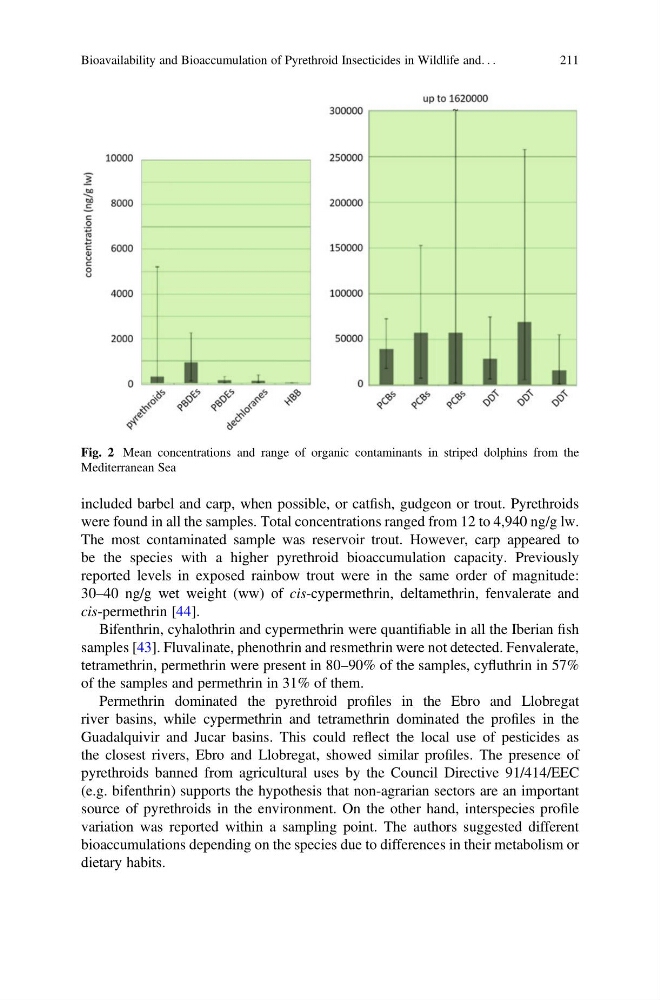
Fig. 2 Mean concentrations and range of organic contaminants in striped dolphins from the
Mediterranean Sea
Bioavailability and Bioaccumulation of Pyrethroid Insecticides in Wildlife and. . .
211
were found in all the samples. Total concentrations ranged from 12 to 4,940 ng/g lw.
The most contaminated sample was reservoir trout. However, carp appeared to
be the species with a higher pyrethroid bioaccumulation capacity. Previously
reported levels in exposed rainbow trout were in the same order of magnitude:
30–40 ng/g wet weight (ww) of cis-cypermethrin, deltamethrin, fenvalerate and
cis-permethrin [44].
Bifenthrin, cyhalothrin and cypermethrin were quantifiable in all the Iberian fish
samples [43]. Fluvalinate, phenothrin and resmethrin were not detected. Fenvalerate,
tetramethrin, permethrin were present in 80–90% of the samples, cyfluthrin in 57%
of the samples and permethrin in 31% of them.
Permethrin dominated the pyrethroid profiles in the Ebro and Llobregat
river basins, while cypermethrin and tetramethrin dominated the profiles in the
Guadalquivir and Jucar basins. This could reflect the local use of pesticides as
the closest rivers, Ebro and Llobregat, showed similar profiles. The presence of
pyrethroids banned from agricultural uses by the Council Directive 91/414/EEC
(e.g. bifenthrin) supports the hypothesis that non-agrarian sectors are an important
source of pyrethroids in the environment. On the other hand, interspecies profile
variation was reported within a sampling point. The authors suggested different
bioaccumulations depending on the species due to differences in their metabolism or
dietary habits.
Fig. 2 Mean concentrations and range of organic contaminants in striped dolphins from the
Mediterranean Sea
Bioavailability and Bioaccumulation of Pyrethroid Insecticides in Wildlife and. . .
211