

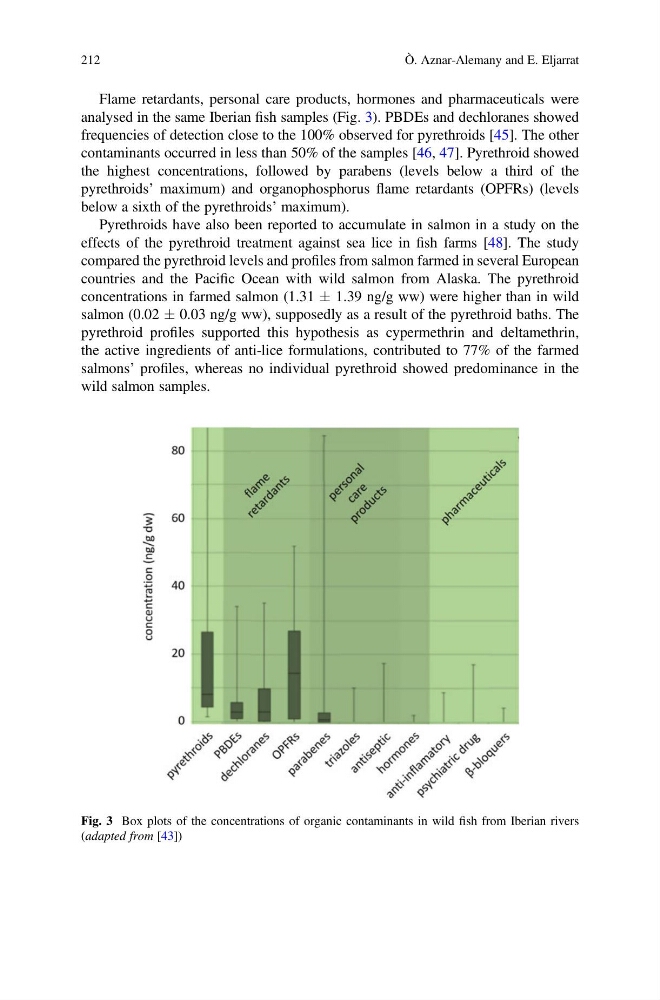
Flame retardants, personal care products, hormones and pharmaceuticals were
analysed in the same Iberian fish samples (Fig. 3). PBDEs and dechloranes showed
frequencies of detection close to the 100% observed for pyrethroids [45]. The other
contaminants occurred in less than 50% of the samples [46, 47]. Pyrethroid showed
the highest concentrations, followed by parabens (levels below a third of the
pyrethroids’ maximum) and organophosphorus flame retardants (OPFRs) (levels
below a sixth of the pyrethroids’ maximum).
Pyrethroids have also been reported to accumulate in salmon in a study on the
effects of the pyrethroid treatment against sea lice in fish farms [48]. The study
compared the pyrethroid levels and profiles from salmon farmed in several European
countries and the Pacific Ocean with wild salmon from Alaska. The pyrethroid
concentrations in farmed salmon (1.31 Æ 1.39 ng/g ww) were higher than in wild
salmon (0.02 Æ 0.03 ng/g ww), supposedly as a result of the pyrethroid baths. The
pyrethroid profiles supported this hypothesis as cypermethrin and deltamethrin,
the active ingredients of anti-lice formulations, contributed to 77% of the farmed
salmons’ profiles, whereas no individual pyrethroid showed predominance in the
wild salmon samples.
Fig. 3 Box plots of the concentrations of organic contaminants in wild fish from Iberian rivers
(adapted from [43])
212
Ò. Aznar-Alemany and E. Eljarrat
analysed in the same Iberian fish samples (Fig. 3). PBDEs and dechloranes showed
frequencies of detection close to the 100% observed for pyrethroids [45]. The other
contaminants occurred in less than 50% of the samples [46, 47]. Pyrethroid showed
the highest concentrations, followed by parabens (levels below a third of the
pyrethroids’ maximum) and organophosphorus flame retardants (OPFRs) (levels
below a sixth of the pyrethroids’ maximum).
Pyrethroids have also been reported to accumulate in salmon in a study on the
effects of the pyrethroid treatment against sea lice in fish farms [48]. The study
compared the pyrethroid levels and profiles from salmon farmed in several European
countries and the Pacific Ocean with wild salmon from Alaska. The pyrethroid
concentrations in farmed salmon (1.31 Æ 1.39 ng/g ww) were higher than in wild
salmon (0.02 Æ 0.03 ng/g ww), supposedly as a result of the pyrethroid baths. The
pyrethroid profiles supported this hypothesis as cypermethrin and deltamethrin,
the active ingredients of anti-lice formulations, contributed to 77% of the farmed
salmons’ profiles, whereas no individual pyrethroid showed predominance in the
wild salmon samples.
Fig. 3 Box plots of the concentrations of organic contaminants in wild fish from Iberian rivers
(adapted from [43])
212
Ò. Aznar-Alemany and E. Eljarrat