

below 1, there is no environmental risk. By tradition, the ecotoxicological threshold
used is the no-observed effect concentration (NOEC) value corresponding to the
species most sensitive to the assessed chemical based on laboratory tests.
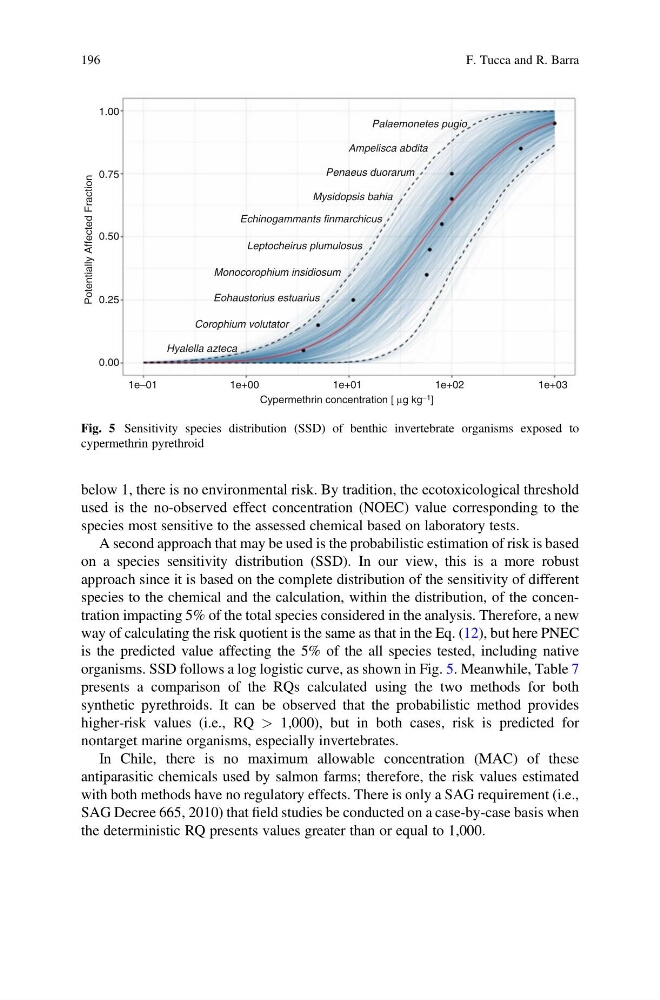
A second approach that may be used is the probabilistic estimation of risk is based
on a species sensitivity distribution (SSD). In our view, this is a more robust
approach since it is based on the complete distribution of the sensitivity of different
species to the chemical and the calculation, within the distribution, of the concentration impacting 5% of the total species considered in the analysis. Therefore, a new
way of calculating the risk quotient is the same as that in the Eq. (12), but here PNEC
is the predicted value affecting the 5% of the all species tested, including native
organisms. SSD follows a log logistic curve, as shown in Fig. 5. Meanwhile, Table 7
presents a comparison of the RQs calculated using the two methods for both
synthetic pyrethroids. It can be observed that the probabilistic method provides
higher-risk values (i.e., RQ > 1,000), but in both cases, risk is predicted for
nontarget marine organisms, especially invertebrates.
In Chile, there is no maximum allowable concentration (MAC) of these
antiparasitic chemicals used by salmon farms; therefore, the risk values estimated
with both methods have no regulatory effects. There is only a SAG requirement (i.e.,
SAG Decree 665, 2010) that field studies be conducted on a case-by-case basis when
the deterministic RQ presents values greater than or equal to 1,000.
1.00
0.75
Palaemonetes pugio
Ampelisca abdita
Penaeus duorarum
Mysidopsis bahia
Echinogammants finmarchicus
Leptocheirus plumulosus
Monocorophium insidiosum
Eohaustorius estuarius
Corophium volutator
Hyalella azteca
Cypermethrin concentration [ µg kg –1 ]
0.50
Potentially Affected Fraction
0.25
0.00
1e–01
1e+00
1e+01
1e+02
1e+03
Fig. 5 Sensitivity species distribution (SSD) of benthic invertebrate organisms exposed to
cypermethrin pyrethroid
196
F. Tucca and R. Barra
used is the no-observed effect concentration (NOEC) value corresponding to the
species most sensitive to the assessed chemical based on laboratory tests.
A second approach that may be used is the probabilistic estimation of risk is based
on a species sensitivity distribution (SSD). In our view, this is a more robust
approach since it is based on the complete distribution of the sensitivity of different
species to the chemical and the calculation, within the distribution, of the concentration impacting 5% of the total species considered in the analysis. Therefore, a new
way of calculating the risk quotient is the same as that in the Eq. (12), but here PNEC
is the predicted value affecting the 5% of the all species tested, including native
organisms. SSD follows a log logistic curve, as shown in Fig. 5. Meanwhile, Table 7
presents a comparison of the RQs calculated using the two methods for both
synthetic pyrethroids. It can be observed that the probabilistic method provides
higher-risk values (i.e., RQ > 1,000), but in both cases, risk is predicted for
nontarget marine organisms, especially invertebrates.
In Chile, there is no maximum allowable concentration (MAC) of these
antiparasitic chemicals used by salmon farms; therefore, the risk values estimated
with both methods have no regulatory effects. There is only a SAG requirement (i.e.,
SAG Decree 665, 2010) that field studies be conducted on a case-by-case basis when
the deterministic RQ presents values greater than or equal to 1,000.
1.00
0.75
Palaemonetes pugio
Ampelisca abdita
Penaeus duorarum
Mysidopsis bahia
Echinogammants finmarchicus
Leptocheirus plumulosus
Monocorophium insidiosum
Eohaustorius estuarius
Corophium volutator
Hyalella azteca
Cypermethrin concentration [ µg kg –1 ]
0.50
Potentially Affected Fraction
0.25
0.00
1e–01
1e+00
1e+01
1e+02
1e+03
Fig. 5 Sensitivity species distribution (SSD) of benthic invertebrate organisms exposed to
cypermethrin pyrethroid
196
F. Tucca and R. Barra