

3 Effect Assessment: Nontarget Marine Species Sensitivity
3.1 Studies on the Effects of Pyrethroid Insecticides on Native
Organisms
Effects of pyrethroids on nontarget marine species have been widely reported in
literature (e.g., [7, 8, 13]), including lethal and chronic copepod [9, 10], crustacean
[12, 82], and bivalve responses [83, 84]. Furthermore, it is known that low doses of
pyrethroids can be highly effective on aquatic organisms, with crustaceans the group
that is most vulnerable to the action of these chemicals. Pyrethroids are recognized as
slightly toxic to birds and mammals [32]. Moreover, pyrethroids are unlikely to be
accumulated in fish and aquatic food chains since they are rapidly metabolized [7, 8].
Synthetic pyrethroids used as chemotherapeutic treatments on farmed fish can
lead to potential negative environmental effects and harm nontarget organisms (e.g.,
[7, 8, 12, 13, 77, 78]), including even commercially important crab species in larval
stages [82]. In Chile, there was a discussion on the impacts of pyrethroids on mussel
physiology, since salmon and shellfish farms are established in the same areas,
meaning that cultured shellfish are potential nontarget receptors of pyrethroid
treatments.
4 Risk Assessment
4.1 Assessing the Risks of the Use of Pyrethroids
in the Chilean Marine Environment
To conduct a risk assessment, two methodological schemes are proposed, the first a
deterministic approach, as required by Chilean authorities, and the second a probabilistic approach. Risk assessment procedures basically consist of both an exposure
assessment, that is, a determination of the Predicted Environmental Concentrations
(PEC, predictive model) or Measured Environmental Concentration (MEC, experimental field measurements) of pyrethroids and a comparison these data with ecotoxicological thresholds such as the predicted no-effect concentration (PNEC) for
different species from different trophic levels by calculating a risk quotient
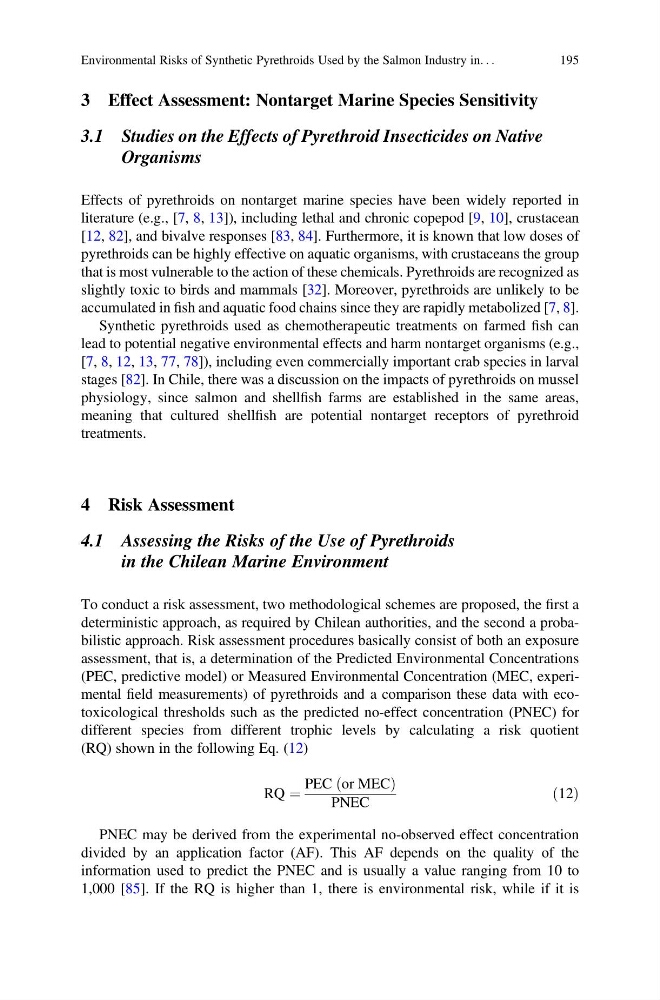
(RQ) shown in the following Eq. (12)
RQ ¼
PEC or MEC
ð
Þ
PNEC
ð12Þ
PNEC may be derived from the experimental no-observed effect concentration
divided by an application factor (AF). This AF depends on the quality of the
information used to predict the PNEC and is usually a value ranging from 10 to
1,000 [85]. If the RQ is higher than 1, there is environmental risk, while if it is
Environmental Risks of Synthetic Pyrethroids Used by the Salmon Industry in. . .
195
3.1 Studies on the Effects of Pyrethroid Insecticides on Native
Organisms
Effects of pyrethroids on nontarget marine species have been widely reported in
literature (e.g., [7, 8, 13]), including lethal and chronic copepod [9, 10], crustacean
[12, 82], and bivalve responses [83, 84]. Furthermore, it is known that low doses of
pyrethroids can be highly effective on aquatic organisms, with crustaceans the group
that is most vulnerable to the action of these chemicals. Pyrethroids are recognized as
slightly toxic to birds and mammals [32]. Moreover, pyrethroids are unlikely to be
accumulated in fish and aquatic food chains since they are rapidly metabolized [7, 8].
Synthetic pyrethroids used as chemotherapeutic treatments on farmed fish can
lead to potential negative environmental effects and harm nontarget organisms (e.g.,
[7, 8, 12, 13, 77, 78]), including even commercially important crab species in larval
stages [82]. In Chile, there was a discussion on the impacts of pyrethroids on mussel
physiology, since salmon and shellfish farms are established in the same areas,
meaning that cultured shellfish are potential nontarget receptors of pyrethroid
treatments.
4 Risk Assessment
4.1 Assessing the Risks of the Use of Pyrethroids
in the Chilean Marine Environment
To conduct a risk assessment, two methodological schemes are proposed, the first a
deterministic approach, as required by Chilean authorities, and the second a probabilistic approach. Risk assessment procedures basically consist of both an exposure
assessment, that is, a determination of the Predicted Environmental Concentrations
(PEC, predictive model) or Measured Environmental Concentration (MEC, experimental field measurements) of pyrethroids and a comparison these data with ecotoxicological thresholds such as the predicted no-effect concentration (PNEC) for
different species from different trophic levels by calculating a risk quotient
(RQ) shown in the following Eq. (12)
RQ ¼
PEC or MEC
ð
Þ
PNEC
ð12Þ
PNEC may be derived from the experimental no-observed effect concentration
divided by an application factor (AF). This AF depends on the quality of the
information used to predict the PNEC and is usually a value ranging from 10 to
1,000 [85]. If the RQ is higher than 1, there is environmental risk, while if it is
Environmental Risks of Synthetic Pyrethroids Used by the Salmon Industry in. . .
195