

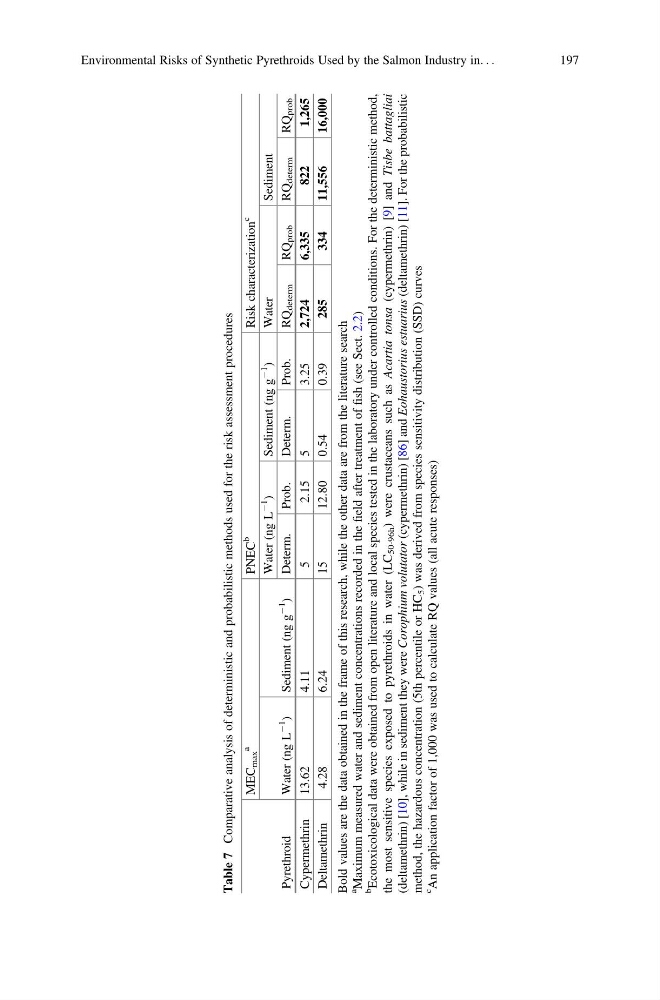
Table 7
Comparative analysis of deterministic and probabilistic methods used for the risk assessment procedures
Pyrethroid
MEC
max
a
PNEC
b
Risk characterization
c
Water (ng L
À1
)
Sediment (ng g
À1
)
Water (ng L
À1
)
Sediment (ng g
À1
)
Water
Sediment
Determ.
Prob.
Determ.
Prob.
RQ
determ
RQ
prob
RQ
determ
RQ
prob
Cypermethrin
13.62
4.11
5
2.15
5
3.25
2,724
6,335
822
1,265
Deltamethrin
4.28
6.24
15
12.80
0.54
0.39
285
334
11,556
16,000
Bold values are the data obtained in the frame of this research, while the other data are from the literature search
a
Maximum measured water and sediment concentrations recorded in the
field after treatment of
fish (see Sect. 2.2)
b
Ecotoxicological data were obtained from open literature and local species tested in the laboratory under controlled conditions. For the deterministic method,
the most sensitive species exposed to pyrethroids in water (LC
50-96h ) were crustaceans such as Acartia tonsa
(cypermethrin) [9] and Tisbe battagliai
(deltamethrin) [10], while in sediment they were Corophium volutator
(cypermethrin) [86] and Eohaustorius estuarius
(deltamethrin) [11]. For the probabilistic
method, the hazardous concentration (5th percentile or HC
5 ) was derived from species sensitivity distribution (SSD) curves
c
An application factor of 1,000 was used to calculate RQ values (all acute responses)
Environmental Risks of Synthetic Pyrethroids Used by the Salmon Industry in. . .
197
Comparative analysis of deterministic and probabilistic methods used for the risk assessment procedures
Pyrethroid
MEC
max
a
PNEC
b
Risk characterization
c
Water (ng L
À1
)
Sediment (ng g
À1
)
Water (ng L
À1
)
Sediment (ng g
À1
)
Water
Sediment
Determ.
Prob.
Determ.
Prob.
RQ
determ
RQ
prob
RQ
determ
RQ
prob
Cypermethrin
13.62
4.11
5
2.15
5
3.25
2,724
6,335
822
1,265
Deltamethrin
4.28
6.24
15
12.80
0.54
0.39
285
334
11,556
16,000
Bold values are the data obtained in the frame of this research, while the other data are from the literature search
a
Maximum measured water and sediment concentrations recorded in the
field after treatment of
fish (see Sect. 2.2)
b
Ecotoxicological data were obtained from open literature and local species tested in the laboratory under controlled conditions. For the deterministic method,
the most sensitive species exposed to pyrethroids in water (LC
50-96h ) were crustaceans such as Acartia tonsa
(cypermethrin) [9] and Tisbe battagliai
(deltamethrin) [10], while in sediment they were Corophium volutator
(cypermethrin) [86] and Eohaustorius estuarius
(deltamethrin) [11]. For the probabilistic
method, the hazardous concentration (5th percentile or HC
5 ) was derived from species sensitivity distribution (SSD) curves
c
An application factor of 1,000 was used to calculate RQ values (all acute responses)
Environmental Risks of Synthetic Pyrethroids Used by the Salmon Industry in. . .
197