

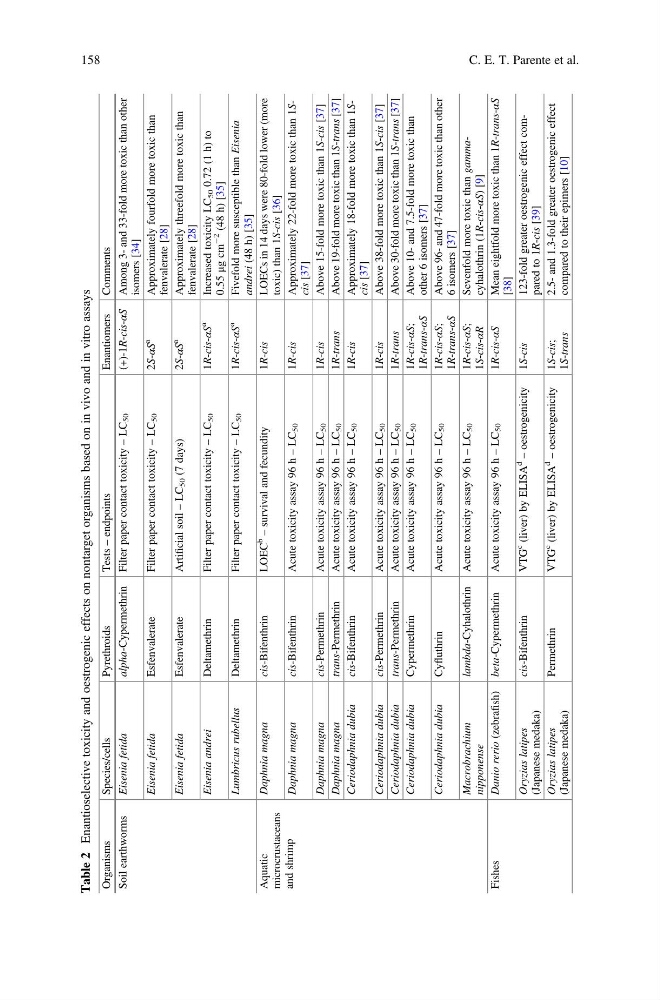
Table 2
Enantioselective toxicity and oestrogenic effects on nontarget organisms based on in vivo and in vitro assays
Organisms
Species/cells
Pyrethroids
Tests
– endpoints
Enantiomers
Comments
Soil earthworms
Eisenia fetida
alpha-Cypermethrin
Filter paper contact toxicity
– LC
50
(+)-1R-cis-αS Among 3- and 33-fold more toxic than other
isomers [34]
Eisenia fetida
Esfenvalerate
Filter paper contact toxicity
– LC
50
2S-αS
a
Approximately fourfold more toxic than
fenvalerate [28]
Eisenia fetida
Esfenvalerate
Artificial soil
– LC
50 (7 days)
2S-αS
a
Approximately threefold more toxic than
fenvalerate [28]
Eisenia andrei
Deltamethrin
Filter paper contact toxicity
– LC
50
1R-cis-αS
a
Increased toxicity LC
50 0.72 (1 h) to
0.55
μg cm
À2
(48 h) [35]
Lumbricus rubellus
Deltamethrin
Filter paper contact toxicity
– LC
50
1R-cis-αS
a
Fivefold more susceptible than Eisenia
andrei
(48 h) [35]
Aquatic
microcrustaceans
and shrimp
Daphnia magna
cis-Bifenthrin
LOEC
b
– survival and fecundity
1R-cis
LOECs in 14 days were 80-fold lower (more
toxic) than 1S-cis [36]
Daphnia magna
cis-Bifenthrin
Acute toxicity assay 96 h
– LC
50
1R-cis
Approximately 22-fold more toxic than 1Scis
[37]
Daphnia magna
cis-Permethrin
Acute toxicity assay 96 h
– LC
50
1R-cis
Above 15-fold more toxic than 1S-cis [37]
Daphnia magna
trans-Permethrin
Acute toxicity assay 96 h
– LC
50
1R-trans
Above 19-fold more toxic than 1S-trans [37]
Ceriodaphnia dubia
cis-Bifenthrin
Acute toxicity assay 96 h
– LC
50
1R-cis
Approximately 18-fold more toxic than 1Scis
[37]
Ceriodaphnia dubia
cis-Permethrin
Acute toxicity assay 96 h
– LC
50
1R-cis
Above 38-fold more toxic than 1S-cis [37]
Ceriodaphnia dubia
trans-Permethrin
Acute toxicity assay 96 h
– LC
50
1R-trans
Above 30-fold more toxic than 1S-trans [37]
Ceriodaphnia dubia
Cypermethrin
Acute toxicity assay 96 h
– LC
50
1R-cis-αS;
1R-trans-αS
Above 10- and 7.5-fold more toxic than
other 6 isomers [37]
Ceriodaphnia dubia
Cyfluthrin
Acute toxicity assay 96 h
– LC
50
1R-cis-αS;
1R-trans-αS
Above 96- and 47-fold more toxic than other
6 isomers [37]
Macrobrachium
nipponense
lambda-Cyhalothrin
Acute toxicity assay 96 h
– LC
50
1R-cis-αS;
1S-cis-αR
Sevenfold more toxic than gammacyhalothrin (1R-cis-αS) [9]
Fishes
Danio rerio
(zebrafish) beta-Cypermethrin
Acute toxicity assay 96 h
– LC
50
1R-cis-αS
Mean eightfold more toxic than 1R-trans-αS
[38]
Oryzias latipes
(Japanese medaka)
cis-Bifenthrin
VTG
c
(liver) by ELISA
d
– oestrogenicity
1S-cis
123-fold greater oestrogenic effect compared to 1R-cis [39]
Oryzias latipes
(Japanese medaka)
Permethrin
VTG
c
(liver) by ELISA
d
– oestrogenicity
1S-cis;
1S-trans
2.5- and 1.3-fold greater oestrogenic effect
compared to their epimers [10]
158
C. E. T. Parente et al.
Enantioselective toxicity and oestrogenic effects on nontarget organisms based on in vivo and in vitro assays
Organisms
Species/cells
Pyrethroids
Tests
– endpoints
Enantiomers
Comments
Soil earthworms
Eisenia fetida
alpha-Cypermethrin
Filter paper contact toxicity
– LC
50
(+)-1R-cis-αS Among 3- and 33-fold more toxic than other
isomers [34]
Eisenia fetida
Esfenvalerate
Filter paper contact toxicity
– LC
50
2S-αS
a
Approximately fourfold more toxic than
fenvalerate [28]
Eisenia fetida
Esfenvalerate
Artificial soil
– LC
50 (7 days)
2S-αS
a
Approximately threefold more toxic than
fenvalerate [28]
Eisenia andrei
Deltamethrin
Filter paper contact toxicity
– LC
50
1R-cis-αS
a
Increased toxicity LC
50 0.72 (1 h) to
0.55
μg cm
À2
(48 h) [35]
Lumbricus rubellus
Deltamethrin
Filter paper contact toxicity
– LC
50
1R-cis-αS
a
Fivefold more susceptible than Eisenia
andrei
(48 h) [35]
Aquatic
microcrustaceans
and shrimp
Daphnia magna
cis-Bifenthrin
LOEC
b
– survival and fecundity
1R-cis
LOECs in 14 days were 80-fold lower (more
toxic) than 1S-cis [36]
Daphnia magna
cis-Bifenthrin
Acute toxicity assay 96 h
– LC
50
1R-cis
Approximately 22-fold more toxic than 1Scis
[37]
Daphnia magna
cis-Permethrin
Acute toxicity assay 96 h
– LC
50
1R-cis
Above 15-fold more toxic than 1S-cis [37]
Daphnia magna
trans-Permethrin
Acute toxicity assay 96 h
– LC
50
1R-trans
Above 19-fold more toxic than 1S-trans [37]
Ceriodaphnia dubia
cis-Bifenthrin
Acute toxicity assay 96 h
– LC
50
1R-cis
Approximately 18-fold more toxic than 1Scis
[37]
Ceriodaphnia dubia
cis-Permethrin
Acute toxicity assay 96 h
– LC
50
1R-cis
Above 38-fold more toxic than 1S-cis [37]
Ceriodaphnia dubia
trans-Permethrin
Acute toxicity assay 96 h
– LC
50
1R-trans
Above 30-fold more toxic than 1S-trans [37]
Ceriodaphnia dubia
Cypermethrin
Acute toxicity assay 96 h
– LC
50
1R-cis-αS;
1R-trans-αS
Above 10- and 7.5-fold more toxic than
other 6 isomers [37]
Ceriodaphnia dubia
Cyfluthrin
Acute toxicity assay 96 h
– LC
50
1R-cis-αS;
1R-trans-αS
Above 96- and 47-fold more toxic than other
6 isomers [37]
Macrobrachium
nipponense
lambda-Cyhalothrin
Acute toxicity assay 96 h
– LC
50
1R-cis-αS;
1S-cis-αR
Sevenfold more toxic than gammacyhalothrin (1R-cis-αS) [9]
Fishes
Danio rerio
(zebrafish) beta-Cypermethrin
Acute toxicity assay 96 h
– LC
50
1R-cis-αS
Mean eightfold more toxic than 1R-trans-αS
[38]
Oryzias latipes
(Japanese medaka)
cis-Bifenthrin
VTG
c
(liver) by ELISA
d
– oestrogenicity
1S-cis
123-fold greater oestrogenic effect compared to 1R-cis [39]
Oryzias latipes
(Japanese medaka)
Permethrin
VTG
c
(liver) by ELISA
d
– oestrogenicity
1S-cis;
1S-trans
2.5- and 1.3-fold greater oestrogenic effect
compared to their epimers [10]
158
C. E. T. Parente et al.