

In recent decades, the wide occurrence of pyrethroids in different environmental
matrices, such as soil, surface waters and sediments, has driven further investigations
that characterize the major metabolic pathways in nontarget organisms [10, 32,
33]. In addition, stereoselective toxicity has stimulated studies to assess adverse
effects on diverse model organisms and mammalian cells, including human cell
lines. Table 2 presents in vivo and in vitro assays with nontarget organisms after
exposure to pyrethroid enantiomers.
3.1 Soil Organisms
Enantioselective degradation is expected in soils due to the presence of enzymes
capable of metabolizing pyrethroids in soil microbiota [43]. Among degradation
pathways in soils, the main routes occur through oxidation of the alkyl portion and
aromatic rings, as well as the cleavage of the ester linkage by hydrolysis [43, 44].
Previous studies addressing diastereomeric degradation in soils reported greater
persistence of cis-isomers [43–45]. At the enantiomeric level, the 1R-cis-αS enantiomers of cypermethrin were less persistent in soils compared to their epimer
(1S-cis-αR) [46, 47]. These results are in agreement with the long half-life observed
for 1S-cis-αR enantiomers compared to 1R-cis-αS after application of alphacypermethrin in edible plants (cabbage, cucumber, rape, tomato and pepper) [48].
Selective degradation was also observed for trans-enantiomers: 1S-transpermethrin and 1R-trans-αS enantiomers of cypermethrin and cyfluthrin [49]. The
authors emphasized that 1R-trans-αS enantiomers were least persistent in alkaline
and acid soils, although they have high insecticidal activity. Faster mineralization
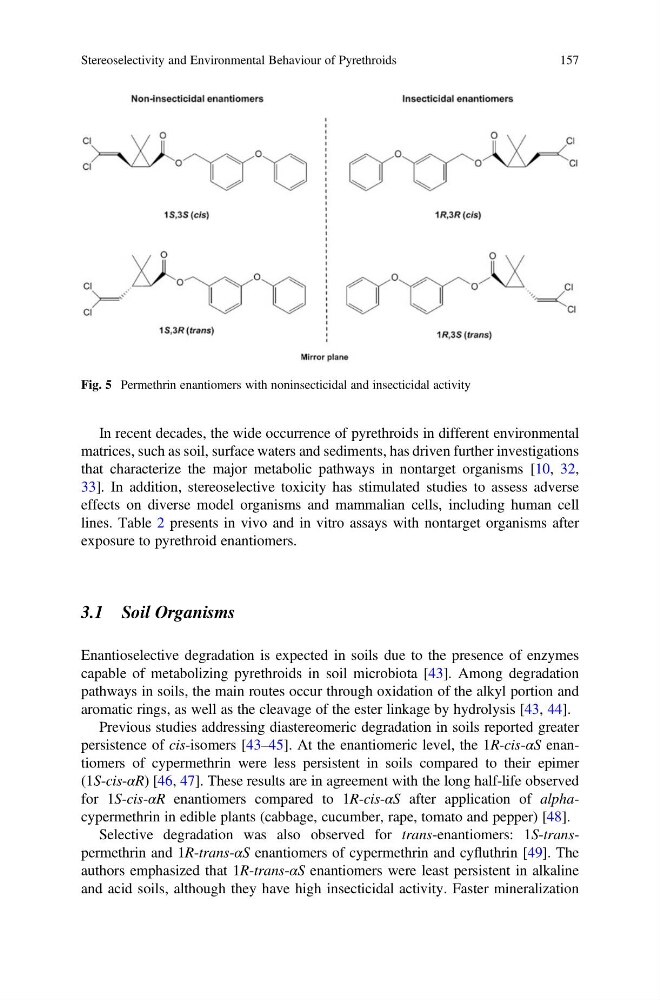
Fig. 5 Permethrin enantiomers with noninsecticidal and insecticidal activity
Stereoselectivity and Environmental Behaviour of Pyrethroids
157
matrices, such as soil, surface waters and sediments, has driven further investigations
that characterize the major metabolic pathways in nontarget organisms [10, 32,
33]. In addition, stereoselective toxicity has stimulated studies to assess adverse
effects on diverse model organisms and mammalian cells, including human cell
lines. Table 2 presents in vivo and in vitro assays with nontarget organisms after
exposure to pyrethroid enantiomers.
3.1 Soil Organisms
Enantioselective degradation is expected in soils due to the presence of enzymes
capable of metabolizing pyrethroids in soil microbiota [43]. Among degradation
pathways in soils, the main routes occur through oxidation of the alkyl portion and
aromatic rings, as well as the cleavage of the ester linkage by hydrolysis [43, 44].
Previous studies addressing diastereomeric degradation in soils reported greater
persistence of cis-isomers [43–45]. At the enantiomeric level, the 1R-cis-αS enantiomers of cypermethrin were less persistent in soils compared to their epimer
(1S-cis-αR) [46, 47]. These results are in agreement with the long half-life observed
for 1S-cis-αR enantiomers compared to 1R-cis-αS after application of alphacypermethrin in edible plants (cabbage, cucumber, rape, tomato and pepper) [48].
Selective degradation was also observed for trans-enantiomers: 1S-transpermethrin and 1R-trans-αS enantiomers of cypermethrin and cyfluthrin [49]. The
authors emphasized that 1R-trans-αS enantiomers were least persistent in alkaline
and acid soils, although they have high insecticidal activity. Faster mineralization
Fig. 5 Permethrin enantiomers with noninsecticidal and insecticidal activity
Stereoselectivity and Environmental Behaviour of Pyrethroids
157