

312
J. Bieser et al.
49.4 Results
We investigated the model ensemble for six major air pollutants: NO 2 , NO, CO, O 3 ,
SO 2 , PM 2.5 . For these species we calculated two aggregated measures to determine
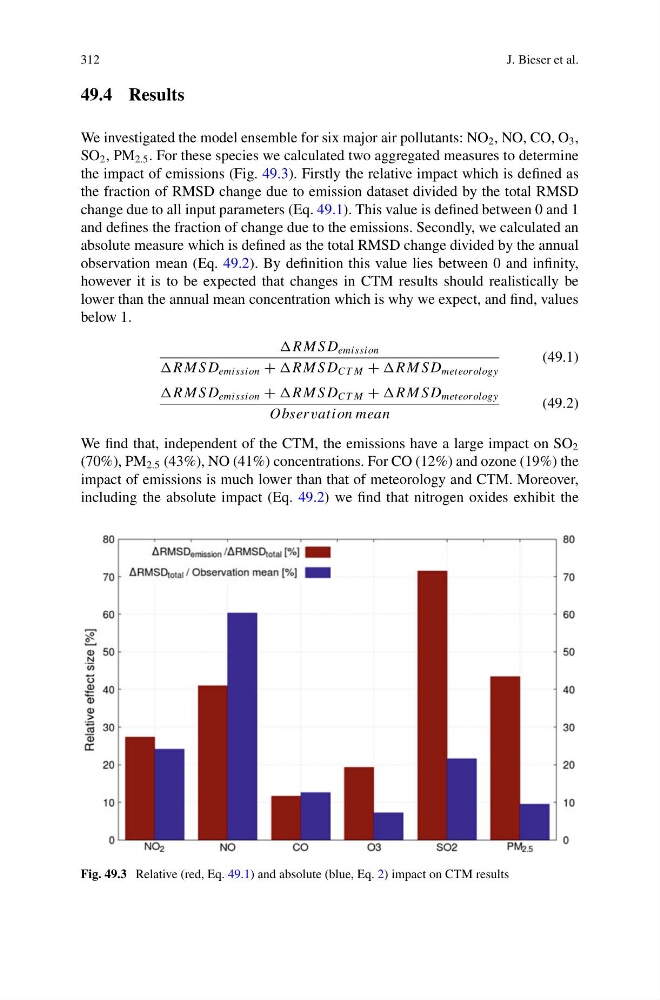
the impact of emissions (Fig. 49.3). Firstly the relative impact which is defined as
the fraction of RMSD change due to emission dataset divided by the total RMSD
change due to all input parameters (Eq. 49.1). This value is defined between 0 and 1
and defines the fraction of change due to the emissions. Secondly, we calculated an
absolute measure which is defined as the total RMSD change divided by the annual
observation mean (Eq. 49.2). By definition this value lies between 0 and infinity,
however it is to be expected that changes in CTM results should realistically be
lower than the annual mean concentration which is why we expect, and find, values
below 1.
R M S D emission
R M S D emission + R M S D CT M + R M S D meteor ology
(49.1)
R M S D emission + R M S D CT M + R M S D meteor ology
Observation mean
(49.2)
We find that, independent of the CTM, the emissions have a large impact on SO 2
(70%), PM 2.5 (43%), NO (41%) concentrations. For CO (12%) and ozone (19%) the
impact of emissions is much lower than that of meteorology and CTM. Moreover,
including the absolute impact (Eq. 49.2) we find that nitrogen oxides exhibit the
Fig. 49.3 Relative (red, Eq. 49.1) and absolute (blue, Eq. 2) impact on CTM results
J. Bieser et al.
49.4 Results
We investigated the model ensemble for six major air pollutants: NO 2 , NO, CO, O 3 ,
SO 2 , PM 2.5 . For these species we calculated two aggregated measures to determine
the impact of emissions (Fig. 49.3). Firstly the relative impact which is defined as
the fraction of RMSD change due to emission dataset divided by the total RMSD
change due to all input parameters (Eq. 49.1). This value is defined between 0 and 1
and defines the fraction of change due to the emissions. Secondly, we calculated an
absolute measure which is defined as the total RMSD change divided by the annual
observation mean (Eq. 49.2). By definition this value lies between 0 and infinity,
however it is to be expected that changes in CTM results should realistically be
lower than the annual mean concentration which is why we expect, and find, values
below 1.
R M S D emission
R M S D emission + R M S D CT M + R M S D meteor ology
(49.1)
R M S D emission + R M S D CT M + R M S D meteor ology
Observation mean
(49.2)
We find that, independent of the CTM, the emissions have a large impact on SO 2
(70%), PM 2.5 (43%), NO (41%) concentrations. For CO (12%) and ozone (19%) the
impact of emissions is much lower than that of meteorology and CTM. Moreover,
including the absolute impact (Eq. 49.2) we find that nitrogen oxides exhibit the
Fig. 49.3 Relative (red, Eq. 49.1) and absolute (blue, Eq. 2) impact on CTM results