

228
P. Makar et al.
(A) Ammonia bidirectional fluxes, improved plume rise algorithms, and the 12-bin
particle size distribution were adopted.
(B) Forest fire emissions were added, with a parallel forest fire forecast during the
second half of the study period.
(C) All simulations made use of the model’s direct and indirect effect feedback
capability; emitted pollutants were allowed to affect the weather.
(D) Improved organic aerosol and on-line photolysis rate calculations were added.
(E) A sophisticated parameterization for forest canopy shading and turbulence was
added [8].
(F) Further improvements to the emissions were incorporated, based on satellitederived spatial allocation and new inventories.
(G) The simulation setup was modified to allow the weather generated in the 10 km
GEM-MACH simulation to directly impact the 2.5 km GEM-MACH simulation, allowing the larger domain feedback effects to reach the smaller scales.
The improved experimental forecast system was used to provide four daily 2.5 km
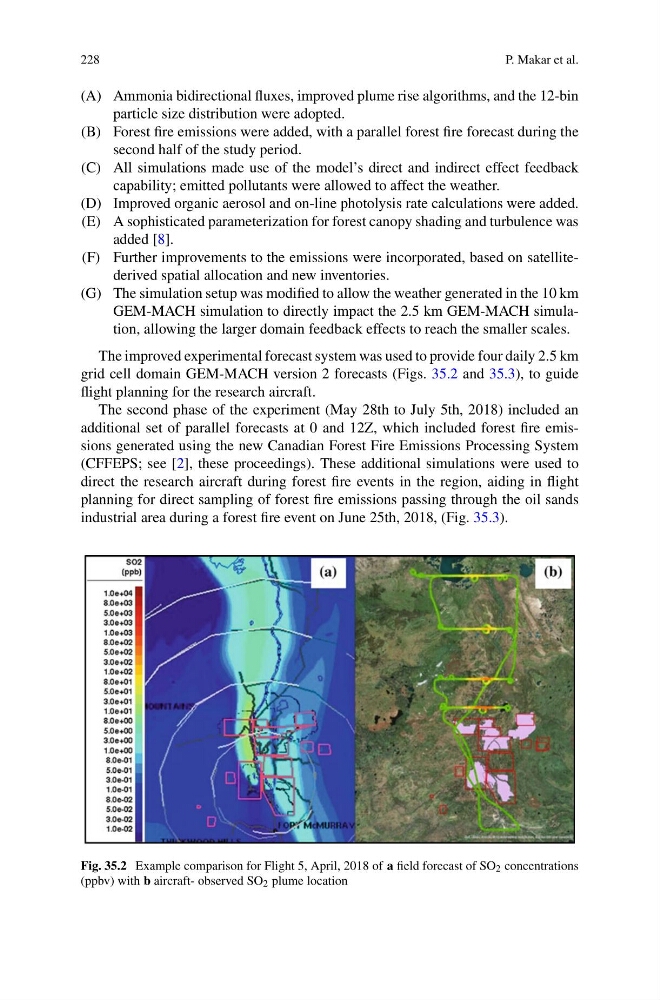
grid cell domain GEM-MACH version 2 forecasts (Figs. 35.2 and 35.3), to guide
flight planning for the research aircraft.
The second phase of the experiment (May 28th to July 5th, 2018) included an
additional set of parallel forecasts at 0 and 12Z, which included forest fire emissions generated using the new Canadian Forest Fire Emissions Processing System
(CFFEPS; see [2], these proceedings). These additional simulations were used to
direct the research aircraft during forest fire events in the region, aiding in flight
planning for direct sampling of forest fire emissions passing through the oil sands
industrial area during a forest fire event on June 25th, 2018, (Fig. 35.3).
Fig. 35.2 Example comparison for Flight 5, April, 2018 of a field forecast of SO 2 concentrations
(ppbv) with b aircraft- observed SO 2 plume location
P. Makar et al.
(A) Ammonia bidirectional fluxes, improved plume rise algorithms, and the 12-bin
particle size distribution were adopted.
(B) Forest fire emissions were added, with a parallel forest fire forecast during the
second half of the study period.
(C) All simulations made use of the model’s direct and indirect effect feedback
capability; emitted pollutants were allowed to affect the weather.
(D) Improved organic aerosol and on-line photolysis rate calculations were added.
(E) A sophisticated parameterization for forest canopy shading and turbulence was
added [8].
(F) Further improvements to the emissions were incorporated, based on satellitederived spatial allocation and new inventories.
(G) The simulation setup was modified to allow the weather generated in the 10 km
GEM-MACH simulation to directly impact the 2.5 km GEM-MACH simulation, allowing the larger domain feedback effects to reach the smaller scales.
The improved experimental forecast system was used to provide four daily 2.5 km
grid cell domain GEM-MACH version 2 forecasts (Figs. 35.2 and 35.3), to guide
flight planning for the research aircraft.
The second phase of the experiment (May 28th to July 5th, 2018) included an
additional set of parallel forecasts at 0 and 12Z, which included forest fire emissions generated using the new Canadian Forest Fire Emissions Processing System
(CFFEPS; see [2], these proceedings). These additional simulations were used to
direct the research aircraft during forest fire events in the region, aiding in flight
planning for direct sampling of forest fire emissions passing through the oil sands
industrial area during a forest fire event on June 25th, 2018, (Fig. 35.3).
Fig. 35.2 Example comparison for Flight 5, April, 2018 of a field forecast of SO 2 concentrations
(ppbv) with b aircraft- observed SO 2 plume location