

Solutions
83
© Dunod – La photocopie non autorisée est un délit.
(3.1)
u
x
t
x t
=
= +
d
d
La solution de l’équation ci-dessus est : x Ae t
t
=
− − 1
La constante A peut être déterminée par les conditions initiales :
x
Ae
t
t
0
0
0
1
=
− − A
x
t
e t
=
+ +
0
0
1
0
Par conséquent : x
x
t
e
t
t t
=
+ +
(
)
− −
−
(
)
0
0
1
1
0
Cette dernière équation est la version lagrangienne de la particule fluide satisfaisant
x x
0 à t t
0 .
(3.2) Le vecteur vitesse de translation au point (1, 2, 1) et au temps t = 3 s peut être donné
par :
U
i
j
k
i
= × ×
(
) + × ×
(
) + × × + ×
(
) =
+
3 1 4
2 1 2
2 1 2 3 3
12
4 4
13
j
k
+
Le vecteur vitesse rotationnelle est :
= ∇ ∧
(
) =
∂
∂
∂
∂
∂
∂
∧
=
∂
∂
−
∂
1
2
1
2
1
2
U
x
y
z
u
u
u
u
y
u
x
y
z
z
y
∂ ∂
−
∂
∂
−
∂
∂
(
) −
∂
∂
−
∂
∂
z
i
u
z
u
x
j
u
x
u
y
k
x
z
y
x
{ {
}
=
∂
+
(
)
∂
−
∂ (
)
∂
+
∂ (
)
∂
−
i
z y
t
y
x y
z
j
x y
z
2
2
3
2
2
3 2
∂ ∂
+
(
)
∂
+
∂ (
)
∂
−
∂ (
)
∂
2
3
2
2
3 2
z y
t
x
k
x y
x
x y
y
D’où :
= + −
(
)
z i
y
xy k
3
et au point (1, 2, 1) et à t = 3 s,
= −
i
k
4
Le vecteur tourbillon quant à lui est égal à :
Ω
=
=
−
2
2 8
i
k
(3.3)
1.La vitesse est :
U
u
u
U
l
x
y
x
y
=
+
=
+
(
)
2
2
0
2
2 1 2
/
U U
0
x
y
l
2
2 1 2
1
+
(
) =
/
x
y
l
2
2
2
+
(
) =
.
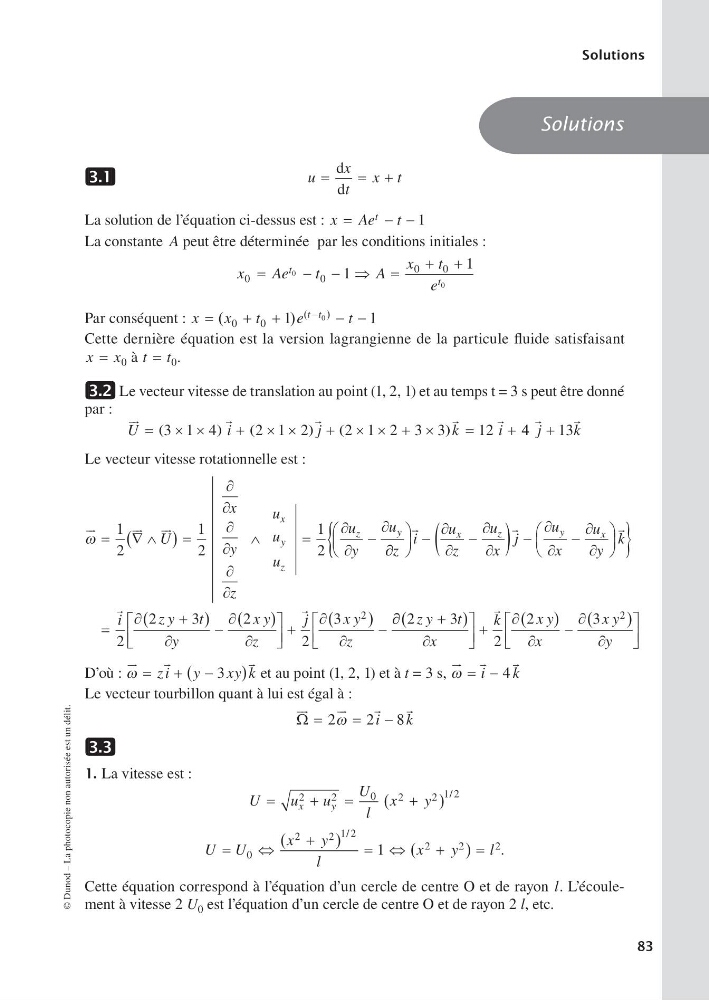
Cette équation correspond à l’équation d’un cercle de centre O et de rayon l. L’écoulement à vitesse 2 U 0 est l’équation d’un cercle de centre O et de rayon 2 l, etc.
Solutions
9782100549337-Livre.indb 83
31/07/11 12:59
83
© Dunod – La photocopie non autorisée est un délit.
(3.1)
u
x
t
x t
=
= +
d
d
La solution de l’équation ci-dessus est : x Ae t
t
=
− − 1
La constante A peut être déterminée par les conditions initiales :
x
Ae
t
t
0
0
0
1
=
− − A
x
t
e t
=
+ +
0
0
1
0
Par conséquent : x
x
t
e
t
t t
=
+ +
(
)
− −
−
(
)
0
0
1
1
0
Cette dernière équation est la version lagrangienne de la particule fluide satisfaisant
x x
0 à t t
0 .
(3.2) Le vecteur vitesse de translation au point (1, 2, 1) et au temps t = 3 s peut être donné
par :
U
i
j
k
i
= × ×
(
) + × ×
(
) + × × + ×
(
) =
+
3 1 4
2 1 2
2 1 2 3 3
12
4 4
13
j
k
+
Le vecteur vitesse rotationnelle est :
= ∇ ∧
(
) =
∂
∂
∂
∂
∂
∂
∧
=
∂
∂
−
∂
1
2
1
2
1
2
U
x
y
z
u
u
u
u
y
u
x
y
z
z
y
∂ ∂
−
∂
∂
−
∂
∂
(
) −
∂
∂
−
∂
∂
z
i
u
z
u
x
j
u
x
u
y
k
x
z
y
x
{ {
}
=
∂
+
(
)
∂
−
∂ (
)
∂
+
∂ (
)
∂
−
i
z y
t
y
x y
z
j
x y
z
2
2
3
2
2
3 2
∂ ∂
+
(
)
∂
+
∂ (
)
∂
−
∂ (
)
∂
2
3
2
2
3 2
z y
t
x
k
x y
x
x y
y
D’où :
= + −
(
)
z i
y
xy k
3
et au point (1, 2, 1) et à t = 3 s,
= −
i
k
4
Le vecteur tourbillon quant à lui est égal à :
Ω
=
=
−
2
2 8
i
k
(3.3)
1.La vitesse est :
U
u
u
U
l
x
y
x
y
=
+
=
+
(
)
2
2
0
2
2 1 2
/
U U
0
x
y
l
2
2 1 2
1
+
(
) =
/
x
y
l
2
2
2
+
(
) =
.
Cette équation correspond à l’équation d’un cercle de centre O et de rayon l. L’écoulement à vitesse 2 U 0 est l’équation d’un cercle de centre O et de rayon 2 l, etc.
Solutions
9782100549337-Livre.indb 83
31/07/11 12:59